
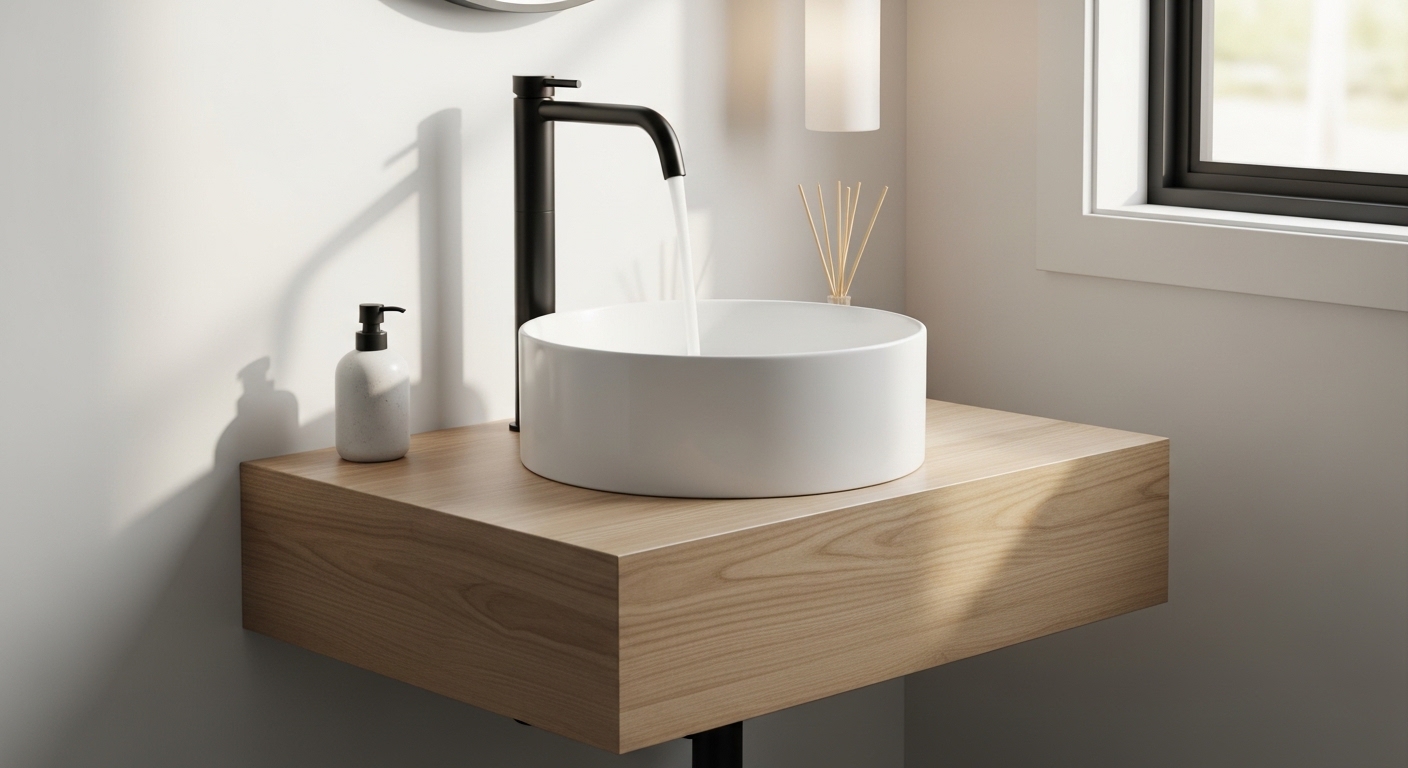
If you’ve installed a vessel sink and then realized your old faucet barely peeks over the rim, you already know the problem: a matte black faucet for vessel sink setups has to be tall enough to arc water down into a bowl that sits above the counter, not level with it. Get the height wrong and you’re either splashing water everywhere or washing your hands under a spout that’s an inch from the drain. This guide walks through the exact heights, spout reaches, finishes, and valve types that actually work — plus how to avoid the two mistakes almost everyone makes on their first vessel sink faucet.
Why do you need a special tall faucet for a vessel sink at all?
Because a vessel sink sits on top of the counter, its rim is usually 4–6 inches higher than a standard drop-in or undermount sink. A normal bathroom faucet is built to clear a rim that’s flush with the counter, so its 4–6 inch spout ends up too short — you can’t fit your hands under it. A vessel faucet is simply a taller-bodied faucet designed to clear that raised bowl.
Here’s the math that matters. Measure from your finished countertop to the top rim of the vessel bowl. Most bowls add 4–6 inches. You then want roughly 4–6 more inches of clearance between the rim and the spout outlet so hands and cups fit comfortably. That’s why vessel faucets typically run 11 to 16 inches tall overall, versus 5–7 inches for a standard faucet. If your bowl is unusually tall (some stone or hammered-copper vessels are 6+ inches), size up.
- Short bowl (4″): a 11–12″ faucet works fine.
- Standard bowl (5–6″): aim for a 12–14″ faucet.
- Tall bowl (6″+): go 15–16″, or you’ll be cramped.
The second number people forget is spout reach — how far the spout extends horizontally over the bowl. For most round vessels 15–17 inches wide, a 5–6 inch reach puts the water stream over the drain instead of hitting the front lip or the back wall. Too short a reach and water sheets down the inside back of the bowl and splashes; too long and it overshoots into the basin edge.
What spout height and reach do you actually need for your bowl?
For a standard 5–6 inch tall vessel bowl, buy a faucet that’s 12–14 inches tall with a 5–6 inch spout reach — that’s the sweet spot that fits 80% of vessel sinks sold today. Below is a quick reference so you can match the faucet to your specific bowl instead of guessing.
| Vessel bowl height | Recommended faucet height | Ideal spout reach | Best faucet type |
|---|---|---|---|
| 3–4 in (low profile) | 10–12 in | 4.5–5.5 in | Single-hole tall |
| 5–6 in (standard) | 12–14 in | 5–6 in | Single-hole tall |
| 6–7 in (tall / stone) | 14–16 in | 5.5–6.5 in | Wall-mount or extra-tall |
| Any height, narrow counter | Match bowl + 5 in | Wall-mount, 6–7 in | Wall-mount |
One tip most product pages won’t tell you: if your counter is shallow (front-to-back depth under 20 inches) or the bowl sits close to the backsplash, a wall-mount faucet in matte black can be a smarter choice than a deck-mount one, because you control the exact height and reach at the plumbing rough-in stage. Wall-mount also frees up counter space around the bowl for soap and a tray. If you want a deeper dive on getting the arc right, our guide to the best long spout reach bathroom faucet for a deep or vessel sink covers reach measurement in detail.
Is a matte black finish actually durable, or will it scratch and fade?
A quality matte black finish is very durable — but only if it’s a real PVD (physical vapor deposition) or baked powder-coat finish over a solid-brass body, not a cheap spray coating over zinc. Done right, matte black resists fingerprints and water spots better than chrome and won’t tarnish. Done cheaply, it chips at the spout edges and goes patchy within a year or two.
Here’s how to tell what you’re buying. Ask (or read the spec sheet) for two things: the base material and the finishing method.
- Solid brass body + PVD matte black: the gold standard. PVD bonds the finish at a molecular level, so it’s scratch- and corrosion-resistant. Expect it on faucets $120 and up.
- Solid brass + powder-coat / electroplate matte black: still good, slightly softer finish. Common in the $70–130 range.
- Zinc alloy + sprayed black: avoid for a faucet you’ll use daily. Zinc is heavier-feeling but corrodes at the threads, and sprayed black rubs off. If a “matte black” faucet is unusually cheap, this is usually why.
Matte black hides limescale and toothpaste splatter far better than polished chrome, which is a real advantage in hard-water areas. To keep it looking new, wipe it with a soft damp cloth and skip anything abrasive or acidic — vinegar, bleach, and scouring pads are the enemies of any coated finish. We put together a full routine in how to protect faucet finishes from scratches, and it applies doubly to matte black because scratches show more on dark surfaces. Also compare base materials in our breakdown of whether a zinc bathroom faucet is worth buying versus spending more on brass — for a vessel faucet you handle every day, that choice matters.
Single-hole or widespread — which mounting is right for a vessel sink?
For almost every vessel sink, a single-hole faucet is the right answer, because vessel bowls give you limited deck space and a single tall faucet looks cleaner and installs faster. Widespread (three-hole) faucets are usually too short and take up too much of the narrow counter behind a raised bowl.
The reasons single-hole wins for vessels:
- Height availability: the tall 12–16 inch bodies you need are almost all single-hole designs.
- Counter space: a vessel bowl already eats the middle of the counter; one hole leaves room for the bowl and a soap pump.
- Simpler install: one hole to drill, one supply set, one lever. Less to seal, less to leak.
If you love the look of separate hot/cold handles, a wall-mount widespread set can work — but you’ll be committing to in-wall plumbing. For a standard deck install on a new or existing single-hole vanity top, stick with a single-hole vessel faucet and a single-lever cartridge. It’s the most forgiving choice for DIY installation, too.
How much should you spend, and what do you get at each price?
Plan on $70–160 for a good matte black vessel faucet that will last; under $50 you’re gambling on zinc and sprayed coatings, and over $250 you’re mostly paying for a designer name. The valve cartridge inside matters more than the badge on the front.
| Price range | Typical body | Finish quality | What to expect |
|---|---|---|---|
| Under $50 | Zinc alloy | Sprayed black | Fine for a rarely-used guest bath; may fade in 1–2 yrs |
| $70–120 | Solid brass | Powder-coat / electroplate | Sweet spot for most homes; good ceramic cartridge |
| $120–200 | Solid brass | PVD matte black | Best durability, smooth lever, drip-free for years |
| $200+ | Solid brass | PVD, designer | Premium styling; diminishing returns on function |
Whatever you spend, insist on a ceramic disc cartridge rather than a rubber-washer valve. Ceramic cartridges are what let a faucet turn smoothly and stay drip-free for a decade; they’re the single biggest predictor of whether you’ll be fixing a leak in two years. If you ever do get a drip, it’s usually a $10 cartridge swap, not a new faucet — our walkthrough on how to fix a leaking tap valve yourself in under an hour covers exactly that repair.
How do you install a matte black vessel faucet yourself?
You can install a single-hole vessel faucet in about 45–60 minutes with basic tools — the tall body doesn’t change the process, just the plumbing connections underneath. Here’s the sequence:
- Shut off the water at the two supply valves under the vanity and open the old faucet to release pressure.
- Set the faucet through the single hole with its rubber gasket on top of the counter; hand-tighten the mounting nut from below.
- Connect the supply lines — most vessel faucets use flexible braided hoses. Snug them by hand, then a quarter turn with a wrench. Don’t overtighten.
- Install the pop-up or grid drain in the vessel bowl with plumber’s putty or the supplied gasket, and connect the tailpiece to the P-trap.
- Turn the water back on slowly, run the faucet, and check every joint for drips. Tighten only where needed.
The one vessel-specific gotcha: because the faucet is tall and the bowl is above the counter, double-check that the spout actually points over the drain before you fully tighten the mounting nut. It’s easy to lock it in slightly rotated and end up with water hitting the bowl wall. Loosen, aim, retighten. If you’re removing an old setup first, the same shut-off and disconnect steps in our two-handle faucet repair guide apply to the teardown.
What are the most common mistakes people make?
The two biggest mistakes are buying a faucet that’s too short for the bowl, and buying a “matte black” faucet that’s really sprayed zinc. Both are avoidable with one measurement and one spec check. Beyond those:
- Ignoring spout reach: a tall faucet with a short reach still splashes. Match reach to bowl width.
- Forgetting the matching drain: a chrome pop-up under a matte black faucet looks unfinished. Buy a matte black grid or pop-up drain to match.
- Over-tightening supply lines: braided hoses seal with a gentle snug; cranking them strips the fitting.
- Using harsh cleaners: abrasives and acids dull the finish. Soft cloth and mild soap only.
FAQ
How tall should a faucet be for a vessel sink?
Measure your bowl height from counter to rim and add about 4–6 inches of clearance. For a standard 5–6 inch bowl, a 12–14 inch faucet is ideal. Taller stone or copper bowls need 15–16 inches.
Does a matte black faucet show water spots and fingerprints?
Less than chrome, actually. Matte black hides limescale, toothpaste, and hard-water spotting well, which is one reason it’s popular in hard-water regions. A quick wipe with a damp cloth keeps it looking clean.
Do I need a special matte black drain for a vessel sink?
You need a drain that fits a vessel sink (usually a pop-up without overflow, since most vessel bowls have no overflow hole). Buy it in matte black to match the faucet — a mismatched chrome drain is the most common finishing mistake.
Will a matte black finish chip or peel over time?
A real PVD or powder-coat finish over solid brass won’t peel under normal use and typically carries a limited lifetime finish warranty. Sprayed black over zinc alloy is what chips — check the base material before buying.
Can I put any tall faucet on a vessel sink, or does it have to be labeled “vessel”?
It doesn’t have to say “vessel,” but it must be a single-hole faucet tall enough to clear your bowl with a spout reach that lands over the drain. Faucets sold as “vessel” or “tall bathroom” faucets are simply pre-sized for that job, which saves you the guesswork.
About the author: This guide was written by the Avovida fixtures team, drawing on hands-on testing of dozens of vessel sink faucets across height, reach, and finish durability. We measure real spout arcs over standard bowls and stress-test finishes against hard water and common cleaners.
About Avovida: Avovida (avovida.net) specializes in bathroom and kitchen fixtures, curating faucets that meet cUPC/NSF standards for lead-free wetted surfaces and drinking-water safety. We prioritize solid-brass bodies, ceramic disc cartridges, and PVD finishes backed by manufacturer limited lifetime finish and function warranties — because a faucet you touch every day should last decades, not seasons.