
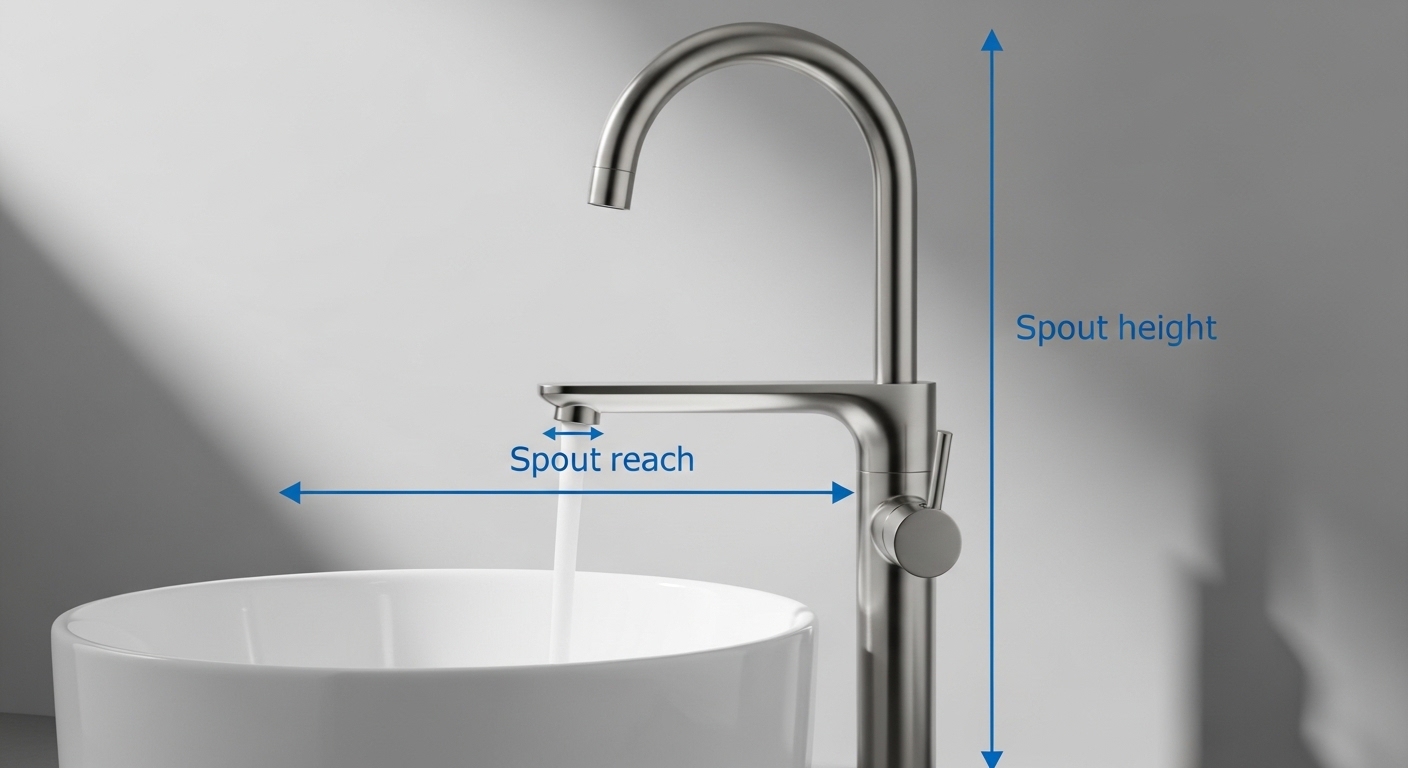
A long spout reach bathroom faucet solves one specific, maddening problem: you turn on the tap and the water either splashes off the back of the bowl or forces you to cram your hands against the sink wall to rinse them. “Reach” (also called spout projection or spout length) is the horizontal distance from the center of the faucet base to the tip of the spout where the water actually falls. Get it right and everything about washing your hands, filling a cup, or rinsing a razor feels effortless. Get it wrong — and you’ll be wiping down the countertop three times a day.
This guide answers the real questions people ask before buying: how much reach you actually need, how reach differs from height, which faucet styles give you the most projection, and how to avoid the splash-and-spray disaster that sends so many vessel-sink faucets back in the box. Let’s get into it.
How much spout reach do I actually need for my sink?
For most bathroom sinks, aim for a spout reach of 5 to 6 inches; for a vessel sink or an extra-wide undermount basin, you’ll usually want 6 to 7 inches or more. The rule that never fails: the water needs to land in or very near the center of the drain, not on the sloped back wall of the bowl.
Here’s the simple way to measure it yourself before you buy anything. Look at where the faucet will be installed — usually that’s the mounting hole about 1.5 to 2.5 inches behind the back edge of the sink. Now measure from that spot to the center of your drain. That horizontal distance is the minimum reach you need. If your drain is 5.5 inches from the faucet hole, a faucet with 5.5 inches of reach or slightly more will drop water right where you want it.
A few real-world scenarios:
- Standard drop-in or undermount basin (16–20 in wide): 4.5–6 inches of reach is plenty.
- Vessel sink (a bowl that sits on top of the counter): 6–7 inches, because the bowl is often wider and the faucet base sits farther back on the counter.
- Trough or wide rectangular sink: 6–8 inches, or a wall-mounted faucet designed for extra projection.
- Small powder-room or corner sink: 4–5 inches — too much reach here and the water overshoots into the front of the bowl.
The mistake buyers make is chasing the longest spout they can find. A 7-inch reach over a compact 15-inch basin will splash water at the very front lip and soak your counter every time. Reach should match the sink, not maximize a number.
What’s the difference between spout reach and spout height?
Reach is horizontal; height is vertical. Spout reach determines where the water lands front-to-back, while spout height (the distance from the sink deck to the spout outlet) determines how much clearance you have to fit your hands, a cup, or a wide bottle underneath. They’re independent numbers, and a good faucet listing gives you both.
This matters a lot for vessel sinks specifically. Because a vessel bowl sits on top of the counter — often 4 to 6 inches tall — a standard 5-inch-tall faucet would leave almost no room between the spout and the rim of the bowl. That’s why vessel faucets are built tall, commonly 10 to 13 inches high, with the reach tuned so the taller arc still lands in the center. If you buy a tall faucet but ignore reach, you get a beautiful arc of water that splashes down the back wall. If you buy for reach but ignore height, your knuckles hit the bowl.
Think of it as a target: height gets the water high enough to clear the bowl and your hands; reach gets it far enough forward to hit the drain. You need both dialed in.
Which faucet style gives the longest spout reach?
Wall-mounted faucets give you the most controllable reach, followed by tall single-hole vessel faucets with a curved or gooseneck spout. Widespread and centerset deck faucets tend to offer the least, because their spouts are designed for standard-depth basins. Here’s how the common styles stack up.
| Faucet style | Typical spout reach | Typical height | Best for |
|---|---|---|---|
| Wall-mounted | 6–9 in (adjustable at install) | Set by wall placement | Vessel & trough sinks, custom counters |
| Single-hole gooseneck (vessel) | 5–7 in | 10–13 in | Vessel bowls, deep basins |
| Widespread (3-hole) | 4.5–5.5 in | 5–9 in | Standard drop-in / undermount |
| Centerset (4-inch) | 4–5 in | 4–6 in | Small basins, powder rooms |
| Single-hole low-arc | 4.5–5.5 in | 5–7 in | Compact modern basins |
Wall-mounted faucets win on reach flexibility because you decide during rough-in exactly how far the spout projects over the bowl — but they require planning the plumbing inside the wall before the tile goes up, so they’re a renovation decision, not a swap. For most people replacing a faucet on an existing counter, a tall single-hole gooseneck is the practical sweet spot: strong reach, dramatic height, and it only needs one deck hole.
If you’re weighing materials while you shop, it’s worth knowing that spout length and finish durability are separate questions. A longer spout puts a bit more leverage on the faucet body, so a solid brass core holds up better over years than lighter alloys — we break down that trade-off in our guide on whether a zinc bathroom faucet is worth buying versus spending more on brass.
Will a long spout reach bathroom faucet splash more?
Not if you match the height, reach, and water pressure correctly — splashing comes from water falling too far or hitting a hard flat surface, not from spout length itself. A long spout that drops water into the deep center of a bowl actually splashes less than a short spout that hits the shallow back slope. The variables that create splash are the drop distance, the angle the stream hits the porcelain, and the flow rate.
Three practical fixes that keep a long-reach faucet splash-free:
- Use a laminar or aerated stream. A quality aerator softens the water into a fatter, slower column that lands gently. Most bathroom faucets ship with a 1.2 GPM aerator, which is calm enough for a tall pour.
- Keep the drop distance reasonable. If the spout outlet sits more than about 8–9 inches above the bottom of a shallow bowl, the stream gains speed and splashes. Deeper bowls tolerate more height.
- Aim for the drain, not the wall. Water hitting the vertical back wall of a bowl at an angle is what sprays onto your mirror and counter. Center it.
If your home has strong water pressure (above roughly 60 psi), splashing gets worse with any faucet, long spout or not. A 1.2 or even 1.0 GPM aerator tames it. Hard water is a separate concern — mineral buildup slowly clogs the aerator and turns a smooth stream into a spitting one, which then splashes. If you’re on hard water, a periodic aerator soak in white vinegar keeps the stream true.
How do I stop the faucet from scraping my knuckles on a vessel sink?
Knuckle-scraping happens when the spout is too short or too low for the bowl — you need enough combined height and reach that your hands fit comfortably under the stream without pressing against the bowl’s rim or wall. For a vessel sink, that usually means a faucet whose outlet clears the rim of the bowl by at least 3 to 4 inches, with the water landing an inch or two in front of the center so your fingers naturally cup under it.
Before you buy, do this quick check: add your bowl height to the clearance you want under the spout. A 5-inch-tall vessel bowl plus 4 inches of hand room means the spout outlet needs to be about 9 inches above the counter — so a 10-to-12-inch vessel faucet is right. Pair that with 6 inches of reach and your hands slide in from the front with room to spare.
Once your faucet is installed, protecting that finish matters, especially on a tall spout that gets bumped by rings, bottles, and cleaning cloths. Our walkthrough on how to protect faucet finishes from scratches covers the everyday habits that keep a brushed or polished spout looking new for years.
What finish and reach combination looks best on a modern bathroom?
For a modern look, a matte black or brushed nickel gooseneck with 6 inches of reach and a 12-inch height reads as intentional and high-end; for a warmer, softer room, a polished or brushed brass in the same silhouette works beautifully. The finish doesn’t change performance, but reach and silhouette together create the “designer” proportions people are really after when they search for a long-spout faucet.
A tall, long-reach spout is a visual centerpiece, so the finish carries more weight than it would on a squat centerset. Brushed finishes hide water spots and fingerprints better on that large surface, which is a genuine daily-maintenance win in a hard-water home. If you love the mirror-bright look, our guide on whether a polished nickel faucet is worth it for your bathroom gets into how the warmer, softer tone of nickel plays against tile and stone. And if you’re comparing established brands with proven long-reach vessel lines, our roundup of the best Delta bathroom faucets is a good next stop for models with documented spout specs and solid warranties.
How do I install a tall single-hole long-reach faucet myself?
Installing a single-hole vessel faucet is a genuine DIY job for most people — you drop the faucet through the deck hole, secure it from below with a mounting nut, connect the two supply lines, and test. Here’s the short version, assuming you already have a single 1⅜-inch deck hole.
- Shut off the hot and cold supply valves under the sink and open the faucet to release pressure.
- Feed the faucet’s supply hoses and threaded stem down through the deck hole.
- From underneath, slide on the rubber gasket and mounting bracket, then hand-tighten the mounting nut and snug it with a basin wrench. Keep the spout aimed at the drain center as you tighten.
- Connect the hot and cold flexible supply lines to the shutoff valves; tighten a quarter-turn past hand-tight.
- Turn the water back on slowly, run the faucet for a minute, and check every connection for drips.
Two tips specific to long-reach faucets: because the spout has more leverage, make sure the mounting nut is genuinely tight — a loose tall faucet will wobble and eventually loosen the seal. And if you’re upgrading from an old unit, take the chance to replace the supply lines rather than reusing brittle ones. If any connection weeps after install, our guide on how to fix a leaking tap valve yourself in under an hour walks through the usual culprits.
Long spout reach bathroom faucet: quick buyer’s checklist
Before you check out, confirm these five specs. A long spout reach bathroom faucet only performs when reach, height, and your actual sink dimensions line up.
- Reach: matches your faucet-hole-to-drain distance (usually 5–7 in).
- Height: clears your bowl rim plus 3–4 in of hand room.
- Mounting: matches your deck holes (single-hole is easiest).
- Flow rate: 1.0–1.2 GPM for a calm, low-splash stream.
- Material & warranty: solid brass core, ceramic disc cartridge, and a warranty you can point to.
FAQ
What is considered a “long” spout reach for a bathroom faucet?
Anything over about 5.5 inches of horizontal projection is generally considered long for a bathroom faucet. Standard bathroom faucets sit around 4.5 to 5 inches of reach; “long reach” models designed for vessel sinks and wide basins run 6 to 7 inches, and wall-mounted units can push to 8 or 9 inches.
Is a long spout faucet good for a small bathroom sink?
Usually not — a long spout over a small basin overshoots the drain and splashes at the front lip. For compact powder-room or corner sinks under about 16 inches wide, a 4-to-5-inch reach is better. Save the long-reach faucets for vessel bowls, deep undermounts, and wide trough sinks where the drain sits farther from the faucet base.
Do long spout reach faucets waste more water?
No. Spout length has no effect on water use — flow rate does. A long-reach bathroom faucet with a 1.2 GPM aerator uses exactly the same water as a short faucet with the same aerator. Look at the GPM rating, not the spout, if water efficiency matters to you; WaterSense-labeled models cap at 1.5 GPM or less.
Can I put a long spout kitchen-style faucet on a bathroom sink?
You can, but be careful with reach and height — a kitchen faucet often projects 8 to 9 inches and stands 15 or more inches tall, which overshoots most bathroom basins and splashes badly. If you love the tall gooseneck look, buy a faucet actually rated for bathroom vessel use so the reach and flow are tuned for a smaller bowl.
Will hard water ruin a long spout faucet faster?
Hard water doesn’t damage the spout itself, but mineral scale builds up in the aerator and cartridge over time, which weakens and splits the stream — and a split stream on a tall faucet splashes more. Soaking the aerator in white vinegar every couple of months restores a smooth flow. A ceramic disc cartridge resists mineral wear better than older rubber-washer valves.
How do I know the spout will line up with my drain before it arrives?
Measure the horizontal distance from your faucet mounting hole to the center of the drain, then match that number to the faucet’s published “spout reach” spec. If the reach is within about half an inch of your measurement, the water will land on or very near the drain. Any reputable listing publishes both spout reach and spout height — if it doesn’t, treat that as a reason to skip it.
The bottom line
A long spout reach bathroom faucet isn’t about buying the biggest spout on the shelf — it’s about matching reach and height to your specific sink so the water lands in the drain and your hands fit comfortably underneath. Measure your faucet-hole-to-drain distance, add 3 to 4 inches of hand clearance above your bowl, choose a 1.0–1.2 GPM aerator to keep things splash-free, and insist on a solid brass body with a ceramic cartridge. Do that, and the daily annoyance of splashing and knuckle-scraping simply disappears.
Author note: This guide was written by the avovida fixtures team, drawing on hands-on bench testing of vessel and single-hole faucets across a range of sink depths and water pressures. avovida specializes in faucets and bathroom fixtures, and we evaluate reach, splash behavior, and finish durability against real installation scenarios rather than spec sheets alone. As always, buy from listings that publish spout reach, spout height, GPM flow rate, and a written warranty — and look for faucets that meet standard low-lead (NSF/ANSI 372) and WaterSense flow guidelines so you know the specs are independently verified.