
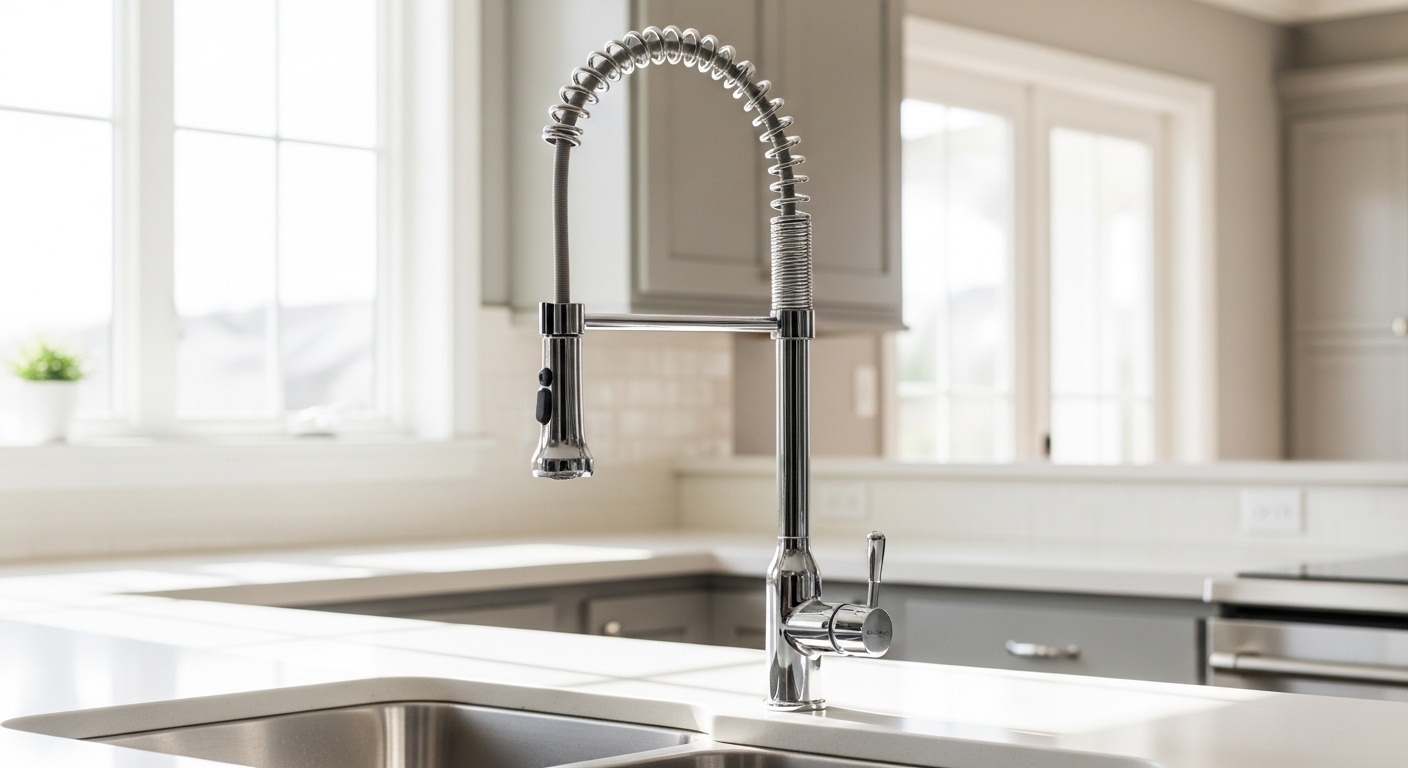
If you’ve searched for a commercial kitchen tap Toolstation stocks, you’re almost certainly picturing that tall, coiled spring-neck design with a pull-down spray hose — the kind you see behind the pass in a restaurant kitchen. The good news is that Toolstation (and its close rival Screwfix) genuinely sells that style at trade prices, and for a home cook filling stockpots and rinsing roasting trays, it can be a smart, hard-wearing choice. The caveat is that “commercial style” at a hardware store isn’t the same as a certified NSF commercial unit, and the details — flow rate, valve cartridge, spout reach — vary a lot between the budget and premium models on the shelf. Let’s break down exactly what you get, who it suits, and when you should spend a little more.
What exactly is a “commercial kitchen tap,” and is the Toolstation version the real thing?
A commercial kitchen tap is a tall, exposed spring-neck faucet with a pre-rinse spray head on a flexible hose — designed for high-volume rinsing and washing large pots. The versions Toolstation sells are “commercial-style” taps built for domestic and light-trade use: they copy the professional look and the powerful spray, but they run on standard UK 15mm supply pipes and domestic water pressure, not the high-flow, foot-pedal, NSF-rated setup a real restaurant uses.
That distinction matters more than it sounds. A true catering-grade pre-rinse unit is certified to standards like NSF/ANSI 61 and 372 (for material safety and lead-free contact), often delivers 6–9 litres per minute of spray, and is built to survive a commercial kitchen’s abuse and inspection regime. A domestic commercial-style tap from a general hardware retailer gives you the ergonomics and the visual drama at a fraction of the price — usually with a flow rate closer to 5–8 L/min and a 5-year finish warranty rather than a heavy-duty trade guarantee. For a home, that’s usually exactly what you want. For an actual commercial kitchen that will be inspected, always check the tap is specifically certified for that use.
Who should actually buy one?
Buy a commercial-style spring tap if you have a deep single-bowl sink, cook in volume, and regularly wrestle with big pans and baking trays. The tall spout clears a stockpot easily, and the pull-down spray blasts stuck-on food far better than a standard mixer. Skip it if you have a shallow sink under a window, a low wall cabinet above, or a low-pressure gravity-fed system — the height and the spray both suffer.
How much does a commercial kitchen tap cost at Toolstation vs elsewhere?
At Toolstation you’ll generally pay £70–£180 for a domestic commercial-style spring tap, which undercuts most brand-name kitchen showrooms. Screwfix sits in the same band, big-box brands like Grohe or Franke run £200–£450 for their pro-style ranges, and true catering suppliers start around £250 and climb well past £500 for certified NSF units. Here’s how the tiers really compare on the things that matter day to day.
| Option | Typical price | Flow / pressure needs | Warranty | Best for |
|---|---|---|---|---|
| Toolstation / Screwfix commercial-style tap | £70–£180 | ~5–8 L/min, needs 1.0+ bar | 2–5 yr (finish/parts) | Home cooks who want the look and spray on a budget |
| Mid-range brand pro-style (Grohe, Franke, Bristan) | £200–£450 | Optimised for 1.0–3.0 bar, ceramic disc | 5–10 yr | Buyers who want a known brand and better cartridge |
| True catering / NSF-certified pre-rinse | £250–£600+ | 6–9 L/min, high-flow, often 3+ bar | Trade / commercial terms | Actual commercial kitchens facing inspection |
| Standard pull-down domestic mixer | £60–£150 | ~4–6 L/min, works at low pressure | 5+ yr | Normal kitchens, low ceilings, gentle pressure |
The headline is that Toolstation wins clearly on price-for-look. Where it’s less clear-cut is longevity and cartridge quality: the mid-range brands tend to use better-sealed ceramic disc valves and offer longer warranties, which can matter over ten years of daily use. If you want the deep-dive on which everyday kitchen taps testers actually rate, our roundup of the best kitchen faucet reviews buyers trust is a good cross-check before you decide.
Will a commercial kitchen tap work with my UK water pressure?
Yes — if you have mains or combi-boiler pressure of roughly 1.0 bar or more, a commercial-style spring tap will perform well. If you’re on a low-pressure gravity-fed system (a cold-water tank in the loft feeding a hot cylinder), the tall spout and the spray hose can leave you with a weak, disappointing stream. Check the tap’s minimum-pressure spec on the product page before you buy.
This is the single most common reason people are unhappy with a hardware-store commercial tap: the powerful spray they saw in the shop needs decent pressure behind it. A few practical checks before you commit:
- Know your system. Combi boiler or a pressure gauge reading 1.0–3.0 bar? You’re fine. Loft tank and hot cylinder with no pump? Look for a tap rated for low pressure, or fit a pump.
- Check the minimum bar rating. Many commercial-style taps list a minimum of 0.5–1.0 bar. Under that, expect a dribble from the spray.
- Measure your headroom. These taps are tall (often 45–55cm). Measure from the sink deck to any window sill or wall cabinet above — you need clearance to swing the spout and lift the spray.
- Check spout reach over the bowl. A spring tap that lands water at the back of the bowl is annoying; you want the outlet reaching toward the centre.
If your pressure is genuinely low and you’d rather adapt a standard tap than fight a tall one, it’s worth understanding how flexible domestic connections work — our guide on connecting a pull-down kitchen faucet to a hose adapter covers the fittings and thread sizes you’ll run into.
Chrome, matte black or brushed steel — which finish holds up best in a busy kitchen?
For a hard-working kitchen, brushed/satin stainless steel is the most forgiving finish because it hides water spots and fingerprints, while chrome looks sharpest but shows every smudge. Matte black looks fantastic and is very on-trend, but it’s the fussiest to keep clean and the easiest to scratch if you scrub it with anything abrasive.
Here’s the honest breakdown after years of looking at how finishes wear on high-use taps:
- Brushed / satin steel: best all-rounder. Hides limescale and prints, wipes clean, ages gracefully. The safe choice for a family kitchen.
- Polished chrome: brightest, most classic, cheapest to produce — but a fingerprint magnet that needs frequent wiping to look its best.
- Matte black: striking and modern, pairs beautifully with a white or concrete-look worktop, but avoid abrasive cleaners entirely and expect to wipe off water marks in hard-water areas.
Speaking of hard water: if you live in a limescale-heavy region, finish matters less than your cleaning routine. Wipe the tap dry after heavy use and avoid acidic descalers directly on the coating. The spray head’s rubber nozzles (usually silicone “anti-lime” tips) are your friend here — you can rub scale straight off them with a thumb.
What should I check before buying — the spec details that actually matter
Before you add a commercial kitchen tap to your basket, check five specs: valve type, flow rate, spout height and reach, hose type, and the warranty. These five decide whether the tap is a joy or a regret far more than the brand name does.
- Valve/cartridge: look for a ceramic disc cartridge, not a rubber-washer valve. Ceramic discs give a smooth quarter-turn action and rarely drip. If a tap ever does start weeping, it’s usually a cartridge job — the same principle covered in our walkthrough on how to fix a leaking tap valve yourself.
- Flow rate: 5–8 L/min is plenty for a home. Higher isn’t always better if it drains your combi’s hot supply.
- Spout height + reach: measure your clearance and confirm the outlet reaches over the bowl centre.
- Hose + spray: a braided or nylon-sleeved hose lasts longer than bare PVC; check whether the spray has a “pause” or dual-mode (stream/spray) function.
- Warranty + certification: a 5-year finish/parts warranty is the minimum you should accept. For any commercial premises, confirm WRAS approval (UK) and, if inspected, NSF certification.
One more thing that trips people up: connection fittings. UK taps usually terminate in flexible tails that connect to 15mm supply via isolation valves. If you’re retrofitting and the pipework doesn’t line up, you may need adapters — the same category of parts we cover in our piece on which faucet adapter from Screwfix you actually need, which applies just as well to Toolstation’s range.
Toolstation vs Screwfix vs a plumber’s merchant — where should you actually buy?
Buy from Toolstation or Screwfix if you value price, fast click-and-collect, and easy returns; buy from a plumbers’ merchant or specialist showroom if you want expert fitting advice, a wider finish range, and a better cartridge. For a straightforward domestic commercial-style tap, the two big hardware retailers are hard to beat on convenience and cost — they’re the reason “commercial kitchen tap Toolstation” is such a common search in the first place.
Where the merchants and showrooms earn their premium is edge cases: unusual pressure setups, non-standard sink cut-outs, matching a specific finish across taps and accessories, or needing a genuinely certified commercial unit. This same “big-box vs specialist” trade-off shows up across fixtures — we walked through it for pot fillers in our look at whether buying a pot filler faucet at Ferguson is worth it, and the logic carries over directly to commercial taps.
How do you install a commercial kitchen tap yourself?
Most single-hole commercial-style spring taps can be self-installed in about an hour if you have isolation valves and a basin/tap wrench. Turn off the water, disconnect the old tap, drop the new tap through the sink hole, secure it from below, connect the flexible tails to your isolation valves, then flush and check for leaks.
- Isolate the supply. Turn off the hot and cold isolation valves under the sink (or the mains stopcock if there are none), then open the old tap to drain pressure.
- Remove the old tap. Disconnect the flexible tails, undo the backnut from below with a basin wrench, and lift the old tap out.
- Fit the new tap. Feed the new tap’s tails and spray hose through the mounting hole, seat the rubber gasket, and tighten the backnut/mounting bracket from underneath until snug — don’t overtighten.
- Connect and route the spray. Attach the flexible tails to the isolation valves, fit the counterweight on the spray hose (it helps the head retract), and make sure the hose runs free without kinking.
- Test. Slowly reopen the isolation valves, run hot and cold, and check every joint for weeping. Tighten a fraction more only if you see a drip.
If you’re not confident cutting off water or working in a cramped cabinet, this is a cheap job for a plumber — often under an hour of labour.
FAQ
Is a commercial kitchen tap from Toolstation suitable for an actual commercial kitchen?
Not automatically. Toolstation’s commercial-style taps are designed for domestic and light-trade use. For a genuine commercial kitchen facing environmental-health inspection, you need a tap that is specifically certified (WRAS-approved in the UK, and NSF-rated where required) for commercial food-contact use. Check the product’s certifications, not just its “commercial” styling.
Do I need high water pressure to run a commercial-style spring tap?
You need roughly 1.0 bar or more for the spray to feel powerful. Combi boilers and mains-pressure systems are fine. If you’re on a gravity-fed system with a loft tank, either choose a tap rated for low pressure or fit a pump — otherwise the tall spout and spray will underperform.
What’s the difference between a commercial kitchen tap and a normal pull-down mixer?
A commercial tap has a tall exposed spring-neck and a heavy-duty pre-rinse spray on an external hose, built for rinsing large pots. A standard pull-down mixer has an integrated spray head that retracts into the spout, is shorter, and works better under low ceilings and lower pressure. The commercial style prioritises reach and spray power; the pull-down prioritises compactness.
How long does a hardware-store commercial tap last?
With a ceramic disc cartridge and normal domestic use, expect 8–12 years, with the spray hose and nozzle being the first parts to wear. The cartridge is usually replaceable, so a drip rarely means a new tap. Matte black and painted finishes wear faster than steel or chrome if cleaned abrasively.
Can I fit a commercial kitchen tap myself, or do I need a plumber?
If you have isolation valves under the sink and a basin wrench, most single-hole models are a straightforward one-hour DIY job. Turn off the water, swap the tap, connect the flexible tails, and check for leaks. If there are no isolation valves, or the pipework doesn’t line up, get a plumber — it’s usually a quick, inexpensive fitting.
Is Toolstation cheaper than buying the same style from a brand showroom?
Almost always, yes — expect to pay £70–£180 at Toolstation versus £200–£450 for a comparable-looking pro-style tap from a mid-range brand. The trade-off is finish range and cartridge quality: showroom brands often offer longer warranties and better valves, which can be worth the premium for a decades-long install.
Expert note & how we assess taps
Author: This guide was written by the Avovida fixtures team, who spend their days testing and comparing kitchen and bathroom taps across finishes, valve types, and pressure conditions. We assess taps the way a buyer actually uses them — spout clearance over a real stockpot, spray force at typical UK combi pressure, and how each finish holds up to hard water and daily wiping — rather than reading spec sheets alone.
About Avovida: Avovida is a specialist faucet and bathroom-fixtures brand focused on helping people choose the right tap for their exact sink, pressure, and budget. We reference recognised standards throughout — WRAS approval and NSF/ANSI certification for material safety, and ceramic-disc cartridge quality as our benchmark for valve longevity — and we always recommend checking a tap’s warranty (5 years minimum on finish and parts) before you buy. If you’re comparing UK-available options more broadly, our rundown of the best basin tap brands UK buyers can trust is a useful companion to this guide.