
If you’ve been searching “pot filler faucet ferguson,” you’re almost certainly deciding between the confidence of a big plumbing-supply retailer and the price of shopping around. Here’s the honest answer from people who install and test these things: Ferguson is a solid, trustworthy source with in-person showrooms and real plumbing staff, and that’s genuinely worth something on a hardwired wall fixture you’ll live with for 15+ years. But you pay for that reassurance. Below, we’ll break down exactly what a pot filler is, what Ferguson actually offers, how to know if you’re overpaying, and how to pick the right one for your kitchen — hard-water quirks, mounting height, and all.
What exactly is a pot filler faucet, and do I actually need one?
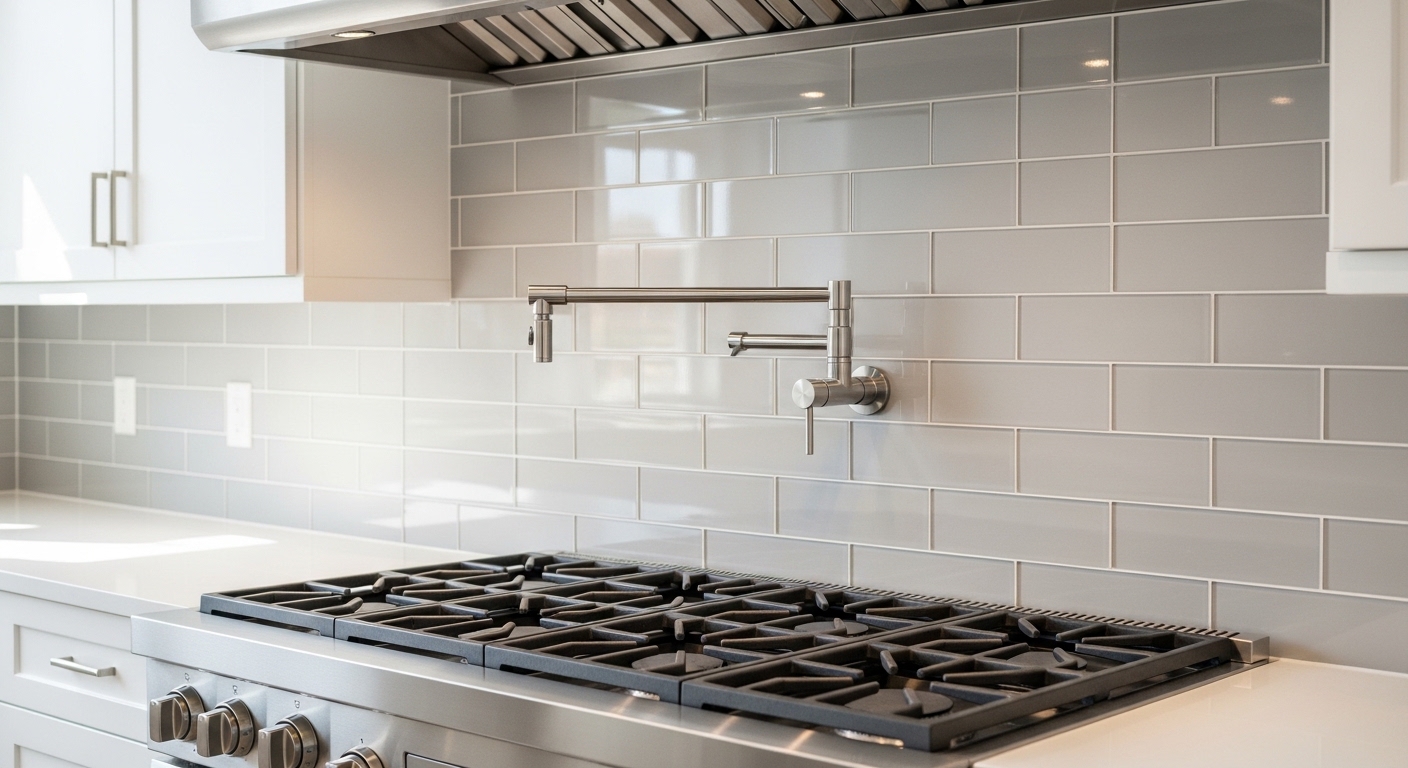
A pot filler is a cold-water-only faucet mounted on the wall (or occasionally the deck) right above your stove, on a double-jointed swing arm that folds flat against the backsplash when not in use. Its whole job is to let you fill a big stockpot with water where you’re going to cook it — so you’re not hauling a sloshing 12-quart pot from the sink across the kitchen.
Do you need one? No — it’s a convenience and a resale-appeal feature, not a plumbing necessity. But if you cook big batches (pasta, stock, canning, boiling seafood), have a heavy cast-iron Dutch oven, or have a range that sits far from your main sink, it earns its keep fast. The people who regret installing one usually didn’t run a proper water line to the stove wall and had to open up drywall after the fact.
- Great fit: serious home cooks, canners, families cooking in volume, kitchens with a range island or a stove far from the sink.
- Skip it: rentals, tight budgets, or a remodel where you can’t easily run a supply line to the stove wall.
- Key limitation: almost all are cold-water only, and they have no drain — you fill the pot, you don’t wash in it.
Is a pot filler faucet from Ferguson worth the price?
It’s worth it if you value showroom service, in-stock brand-name inventory, and a no-drama warranty channel — and it’s not worth it if you already know the exact model number and just want the lowest price. That’s the short version.
Ferguson is one of the largest plumbing distributors in North America, and their showrooms carry the real, full-line versions of premium brands — not the stripped “big-box exclusive” SKUs. When you buy a pot filler faucet from Ferguson, you’re getting a genuine unit with the manufacturer’s full warranty, and their staff can actually talk rough-in valves, supply lines, and mounting height with you. For a wall-mounted fixture that gets soldered or connected inside your wall, that competence has real value.
The trade-off is price. Ferguson generally sells at manufacturer’s list price (MSRP), and they rarely discount premium plumbing brands because those brands enforce minimum pricing. So a Waterstone or high-end Delta pot filler that lists at $400–$900 will cost roughly that at Ferguson. If you’re comfortable identifying the model yourself, you can frequently find the identical faucet for less. The catch: buy only from authorized sellers, or you can void the warranty — and on a fixture inside your wall, a voided warranty is exactly what you don’t want.
How much should a pot filler faucet cost in 2026?
Expect $120 to $250 for a solid mid-range pot filler, $250 to $500 for premium brands like Delta or Kohler, and $500 to $1,000+ for luxury American-made units like Waterstone. Anything under about $90 is usually thin-wall brass or zinc with weak joints — fine for light use, risky as a lifetime fixture.
What you’re really paying for as the price climbs is valve quality (ceramic disc vs. cheap rubber washers), joint durability (the swing-arm hinges are the first thing to fail on cheap units), and finish quality (a real PVD finish resists scratches and hard-water spotting far better than plated coatings). If you care about protecting that finish long-term, our guide on how to protect faucet finishes from scratches applies directly to pot fillers, which sit in a splatter-heavy zone above the burners.
| Price tier | Typical brands | What you get | Best for |
|---|---|---|---|
| $90–$150 (budget) | Import/house brands | Single-joint arm, basic ceramic valve, plated finish | Occasional use, secondary kitchens |
| $150–$300 (mid) | Delta, Moen, Kingston Brass | Double-joint arm, dual shutoffs, solid brass body | Most home cooks — the sweet spot |
| $300–$550 (premium) | Kohler, higher Delta lines | Better finishes, smoother joints, strong warranty | Design-forward kitchens, heavy use |
| $550–$1,000+ (luxury) | Waterstone, Newport Brass | US-made, heavy solid brass, lifetime feel | High-end remodels, forever homes |
Should I buy from a Ferguson showroom or online to save money?
Buy from the Ferguson showroom if you want hands-on help, want to feel the finish and joint action in person, or are running a full remodel with a plumber. Buy online — from Ferguson.com or another authorized dealer — if you already know the exact model and want it shipped for less hassle or a better price.
A few realities worth knowing before you decide:
- Showrooms shine for undecided buyers. Actually swinging the arm and seeing “champagne bronze” vs. “matte black” under real light prevents expensive regret. Finish choices photograph very differently than they look in your kitchen.
- Online wins on price and selection. You can compare a dozen models, read reviews, and cross-check the MSRP against other authorized sellers in minutes.
- Warranty is the tiebreaker. Whether in-store or online, confirm the seller is authorized by the manufacturer. Ferguson always is. Random marketplace third parties often are not, and that’s how warranties quietly die.
If you’re weighing finishes generally, the same logic in our breakdown of the best Delta bathroom faucet applies to Delta’s kitchen and pot-filler lines — Delta’s finish warranty (Lifetime Faucet and Finish) is one of the strongest reasons to buy their pot fillers specifically.
What features actually matter when choosing a pot filler?
The four that matter most: a double-jointed arm, dual shut-off valves, a solid brass body, and a ceramic disc cartridge. Get those four and you have a pot filler that will outlast most of your appliances.
Here’s why each one earns its place:
- Double-jointed arm: two hinges let the spout reach across a wide range or a big burner, then fold completely flat. Single-joint arms are cheaper but reach poorly and stick out.
- Dual shut-off valves: one handle at the wall and one at the spout. The second valve near the tip means you control flow right where the water comes out — and gives redundancy against drips over your burners.
- Solid brass body: stands up to heat, steam, and grease from cooking. Avoid zinc-alloy bodies for a fixture that lives in the hottest, greasiest spot in the kitchen.
- Ceramic disc valve: the difference between a lifetime of drip-free use and replacing washers. This is the same valve tech that makes quality bathroom taps last; if you’re curious how a failing valve behaves, our walkthrough on how to fix a leaking tap valve shows exactly what wears out and why ceramic beats rubber.
One hard-water note: pot fillers are cold-water only, so scale builds slower than on a hot line, but the aerator at the tip still clogs over time. Look for a model with a removable aerator you can soak in vinegar. If your area has genuinely hard water, that single feature saves you a lot of weak-stream frustration.
What height and rough-in do I need before installing one?
Mount the pot filler so the spout clears your tallest stockpot sitting on the burner — typically the faucet centerline lands about 18 to 22 inches above the cooktop surface. Rough in a single half-inch cold-water supply line to the stud behind that spot before the drywall goes up.
The most common mistake is roughing in too low, so a tall pot won’t fit under the spout. Measure your biggest pot, add a couple inches of clearance, and set the outlet height from there. Because the water line lives inside the wall, this is the one part of the job most people should hand to a plumber unless they’re confident soldering or making a solid connection — a leak behind a tiled backsplash is a miserable, expensive fix.
A quick pre-install checklist:
- Confirm a cold-water line can reach the stove wall (this is the deal-breaker on retrofits).
- Set spout height to clear your tallest pot with room to spare.
- Add an accessible shut-off valve on the supply line for future maintenance.
- Use plumber’s tape and quality connections — steam and heat cycle the joints hard.
- Test at full pressure and check for weeping before you close up the wall.
Which pot filler brands does Ferguson carry, and which are best?
Ferguson typically stocks Delta, Moen, Kohler, Waterstone, Newport Brass, and Rohl among others. For most buyers, Delta and Moen offer the best balance of price, warranty, and reliability; Waterstone and Newport Brass are the splurge picks for a forever kitchen.
Quick guidance by buyer type: pick Delta for the strongest finish-and-function lifetime warranty and easy parts availability; pick Moen for smooth operation and wide finish options; pick Kohler for design-forward looks; and pick Waterstone or Newport Brass if you want American-made heft and don’t blink at the price. Whichever you choose, buying a pot filler faucet from Ferguson (or any authorized dealer) means you get the genuine article with the full warranty intact — which, on a wall fixture, is the whole point.
FAQ
Does Ferguson sell genuine, warranty-backed pot filler faucets?
Yes. Ferguson is an authorized dealer for the brands it carries, so every pot filler comes with the full manufacturer warranty and is the genuine full-line model — not a stripped big-box version. That warranty protection is one of the strongest reasons to buy from an authorized source like Ferguson rather than an unknown marketplace seller.
Are pot fillers hot and cold, or cold water only?
The vast majority are cold-water only. That’s by design — you’re filling a pot to boil on the stove, so you don’t need hot water, and running a single cold line is simpler and cheaper. A handful of specialty dual-supply models exist, but they’re rare and add real cost and plumbing complexity.
What height should a pot filler be mounted above the stove?
Aim for the spout to clear your tallest stockpot on the burner, which usually puts the faucet centerline around 18 to 22 inches above the cooktop. Always measure your biggest pot first and add a couple inches of clearance, because mounting too low is the number-one regret with pot fillers.
Can I install a pot filler myself, or do I need a plumber?
If a cold-water line already reaches the stove wall and you’re comfortable making a leak-free connection, a handy DIYer can do it. But because the supply line runs inside the wall behind the range, most people should hire a plumber for the rough-in — a hidden leak behind a tiled backsplash is expensive to find and fix.
Do pot fillers leak or drip over the stove?
A quality pot filler with a ceramic disc cartridge and dual shut-off valves should not drip in normal use. Drips almost always come from a worn valve or debris on the seal — the same failure mode as any faucet. That’s exactly why the dual-valve design matters: the second valve near the spout gives you redundant control right over the burners.
Is a pot filler worth it for resale value?
For mid-to-upper-tier homes and serious-cook buyers, yes — a clean, well-installed pot filler reads as a premium kitchen feature and rarely hurts. For budget homes or rentals, the money is better spent elsewhere. It’s a “nice signal,” not a guaranteed dollar-for-dollar return.
Author note: This guide was written by the Avovida fixtures team, drawing on hands-on installation and testing of kitchen and wall-mounted faucets across a range of finishes and price tiers. We evaluate valve type, joint durability, finish resistance, and real-world flow before recommending anything.
About Avovida: Avovida is a specialist in faucets, showers, and bathroom fixtures, focused on helping buyers choose fittings that actually last. We recommend buying only from authorized dealers so your manufacturer warranty stays valid, and we favor fixtures that meet recognized standards for lead-free wetted surfaces (such as NSF/ANSI 372) and carry genuine manufacturer warranties — because a faucet mounted inside your wall is not the place to gamble on an unbacked import.