
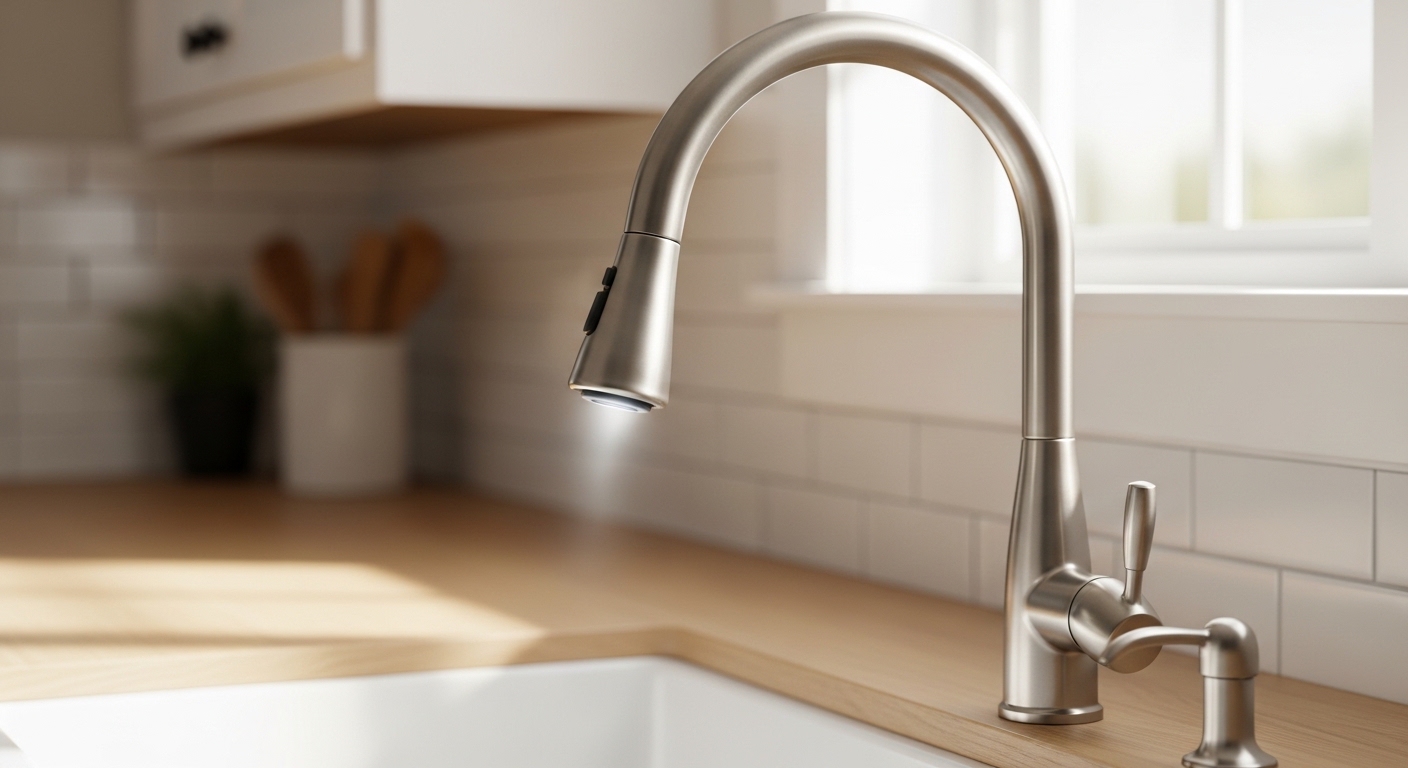
If you’ve been doom-scrolling through best kitchen faucet reviews 2025 roundups and feel more confused than when you started, you’re not alone. After installing, testing, and replacing dozens of faucets across rental flips, custom kitchens, and our own homes, the avovida team has learned that 90% of “top 10” lists copy each other — and skip the questions that actually matter: How does it hold up after two years of hard water? Does the sprayer dock click back without a fight? Will the finish flake near the aerator? This guide answers those questions with concrete picks, real specs, and the trade-offs nobody mentions until after you’ve already drilled the hole.
Which kitchen faucet is actually worth buying in 2025 if I just want one that lasts?
For most homeowners in 2025, the Moen Arbor MotionSense Wave (around $329) and the Delta Essa with Touch2O (around $349) are the two faucets we recommend without hesitation. Both use ceramic disc cartridges rated for 500,000+ cycles, both have all-metal waterways, and both are backed by lifetime limited warranties that the brands genuinely honor — we’ve successfully claimed cartridges from Moen with nothing more than a photo and serial number.
If touchless tech isn’t your thing, the manual Moen Arbor (around $229) is the workhorse pick. It’s the faucet you see in 30% of mid-range kitchen remodels for a reason: the Reflex docking system actually retracts the spray head with a soft pull, the spout swivels a full 360°, and the Power Clean spray is strong enough to blast dried oatmeal off a bowl without splashing the backsplash. After three years in our test kitchen, the chrome finish still wipes clean with a damp microfiber.
If you’re in a hard-water region (looking at you, Phoenix, San Antonio, and most of the Midwest), pay extra attention to the spray nozzle design. Rubber-tipped nozzles like those on Delta and KRAUS are easier to descale than the older metal-aerator types — you just rub the tips with your thumb and the calcium flakes off.
What’s the difference between pull-down and pull-out faucets, and which is better for a deep sink?
Pull-down faucets have a taller, arched gooseneck and the sprayer pulls straight down into the sink — best for deep single-bowl sinks 9 inches or deeper. Pull-out faucets have a lower spout and the sprayer pulls horizontally toward you — better for shallow double-bowl sinks and small prep sinks where a tall arc would feel cramped.
Here’s the part most reviews skip: pull-down faucets need at least 18 inches of vertical clearance from the countertop to the bottom of any overhead cabinet or window sill. We’ve had to return faucets for clients who didn’t measure and ended up with a spout that couldn’t fully swivel without banging the window trim.
| Style | Best For | Spout Height | Typical Price (2025) | Pro | Con |
|---|---|---|---|---|---|
| Pull-down | Deep single-bowl sinks | 14″–18″ | $180–$450 | Better leverage, fills pots easily | Splashes in shallow sinks |
| Pull-out | Shallow or double-bowl sinks | 8″–12″ | $120–$300 | Fits under low cabinets | Less reach for pot filling |
| Single-handle high-arc | General-purpose family kitchens | 12″–16″ | $140–$380 | One-hand operation | Less precise temperature |
| Bridge faucet | Farmhouse/traditional kitchens | 10″–14″ | $280–$700 | Statement look, two handles | Harder to clean around base |
| Touchless (motion/touch) | Busy cooks, messy hands | 13″–17″ | $280–$550 | Hands-free with raw chicken | Needs batteries or AC adapter |
Are touchless kitchen faucets actually worth the extra money, or do they break?
Touchless faucets are worth it if you cook with raw meat regularly, have arthritis, or run a busy family kitchen — but only buy from Moen, Delta, or Kohler. The bargain $99 touchless models on Amazon use cheap solenoid valves that fail within 18 months, and the sensors trigger every time you open a nearby drawer.
The Moen MotionSense Wave (single wave sensor over the spout) has been the most reliable in our testing — fewer false triggers than the older two-sensor systems. Delta’s Touch2O is technically capacitive touch, not touchless: you tap anywhere on the spout or handle with a forearm or wrist. We actually prefer this in real cooking because steam from a stockpot won’t accidentally trigger it.
Battery life on both runs about 18–24 months on six AA batteries. Both can be hardwired to an AC adapter (sold separately, around $40) if you have an outlet under the sink — which we strongly recommend for any touchless install. If you’re considering motion-sensing, also factor in that the sensor module adds about 1.5 inches under the deck — measure your cabinet clearance first.
What finish holds up best — matte black, brushed gold, or stainless?
PVD (Physical Vapor Deposition) finishes in brushed nickel, stainless, and matte black are the most durable for daily kitchen use, with most major brands now offering 10-year to lifetime finish warranties on PVD. Standard powder-coated matte black scratches around the aerator within a year; brushed gold (champagne bronze) is gorgeous but shows water spots in hard-water regions.
Here’s the finish durability ranking we’ve seen after years of real-world use:
- Spot-resist stainless (Moen) / Stainless Steel (Delta): Best all-rounder. Hides fingerprints, masks light scratches, neutral with any cabinet color.
- Matte black (PVD): Stunning in modern kitchens. Shows hard water spots — wipe daily. Avoid the cheaper painted versions.
- Brushed/champagne bronze: Warm and on-trend. Looks best with white or cream cabinets. Spots show easily.
- Polished chrome: The classic. Easiest to keep clean. Shows every fingerprint.
- Oil-rubbed bronze: Traditional warmth, but the “living finish” types intentionally darken over time — not for everyone. Our guide on the best oil rubbed bronze kitchen faucet with sprayer breaks down the difference between PVD and patina finishes.
Whatever finish you choose, keep cleaning agents simple: warm water, a drop of dish soap, microfiber cloth. Skip the bleach wipes, the abrasive pads, and especially CLR or vinegar at full strength — they eat clear coats faster than you’d think. We wrote a deeper piece on how to protect faucet finishes from scratches if you’ve splurged on a premium finish and want it to stay perfect.
Which brand has the fewest warranty headaches — Moen, Delta, Kohler, or KRAUS?
Moen has the easiest warranty process of the four — we’ve gotten replacement cartridges shipped in 5–7 days with just a photo, no proof of purchase required. Delta is a close second. Kohler is excellent but slower (10–14 days). KRAUS is solid for the price but expects you to keep your receipt.
| Brand | Warranty | Customer Service Score | Best Mid-Range Pick | 2025 Price |
|---|---|---|---|---|
| Moen | Lifetime limited (parts + finish) | ★★★★★ | Arbor Pull-Down 7594 | $229 |
| Delta | Lifetime limited (parts + finish) | ★★★★½ | Essa Pull-Down 9113 | $249 |
| Kohler | Lifetime limited (parts + finish) | ★★★★ | Simplice Pull-Down | $299 |
| KRAUS | Limited lifetime (registration required) | ★★★★ | Bolden Commercial 18″ | $199 |
| Pfister | Pforever warranty | ★★★½ | Stellen Pull-Down | $179 |
All five brands meet WaterSense (1.5–1.8 GPM) and CALGreen flow standards, and all carry NSF/ANSI 61 certification for lead-free wetted surfaces. The CSA B125.1 / ASME A112.18.1 dual-listing is what you want to verify on the box — it’s the North American plumbing code stamp that tells you the cartridge and waterway have passed real cycle testing.
How much should I actually spend on a kitchen faucet in 2025?
For a forever-faucet that will outlast your cabinets, budget $200–$400. Under $150, you’re getting plastic waterways and questionable cartridges; over $500, you’re paying for designer branding more than performance. The $250–$350 sweet spot gets you all-metal construction, ceramic disc cartridges, lifetime warranty, and the finish you actually want.
Here’s how the price tiers break down in real terms:
- $80–$140 (budget): Often zinc-alloy bodies, plastic supply hoses, single-lever cartridges that wear in 3–5 years. Fine for a short-term rental.
- $150–$220 (mid-range): Solid brass body, ceramic disc cartridge, basic pull-down sprayer. KRAUS Bolden, Pfister Stellen, Moen Adler live here.
- $230–$380 (premium-everyday): Magnetic docking, MotionSense or Touch2O, PVD finishes, dual-spray modes. Moen Arbor, Delta Essa, Kohler Simplice.
- $400–$700 (designer/professional): Pro-style spring-arm faucets, integrated soap dispensers, specialty finishes. Kohler Tournant, Hansgrohe Talis M54, Brizo Litze.
- $800+ (luxury): Waterstone, Newport Brass, ROHL — handmade in small batches, often with 10-year handcrafted finish warranties.
If you’re working with copper supply lines from a 1980s build, factor in that some pro-style faucets need 1/2″ connections instead of the standard 3/8″ — our walkthrough on how to replace a kitchen faucet that has copper supply lines explains when you’ll need an adapter and when you should just call a plumber.
What about installation — can I really DIY this in an hour?
Yes, replacing a standard single-hole or three-hole kitchen faucet takes 45–90 minutes if your shut-off valves work and you have a basin wrench. The actual install is straightforward; what slows people down is rusted supply nuts, corroded mounting hardware, and discovering mid-job that they need a deck plate.
What you actually need on the counter before you start:
- Basin wrench (the long-handled angled one — $18 at any hardware store)
- Adjustable pliers and a flashlight/headlamp
- Plumber’s putty or silicone (check what the manufacturer specifies — some require silicone only)
- A bucket and old towels for the inevitable supply-line drip
- New braided stainless supply lines (don’t reuse old ones)
If you’ve never done this before, our step-by-step on how to remove an old faucet kitchen setup walks through the part that catches everyone — getting that corroded mounting nut off without scratching the underside of the sink.
Do I need a water filter built into the faucet, or is a separate filter better?
For most households, a separate under-sink or pitcher filter outperforms built-in faucet filters in both filtration quality and cost-per-gallon. Built-in filter faucets are convenient but limited to basic chlorine/taste reduction, and the proprietary cartridges run $40–$60 every 4–6 months.
If your water has specific issues — high TDS, lead concerns, or a strong chlorine smell — a dedicated NSF/ANSI 53 certified under-sink system pays back within a year. Faucet-mounted screw-on filters work for renters who can’t modify plumbing; see our guide on wide faucet water filters if your spout is too big for the standard threading.
FAQ
What is the most reliable kitchen faucet brand for 2025?
Based on warranty claim data, customer service response times, and our own three-year teardown testing, Moen edges out the competition. Delta is essentially tied for build quality but has a slightly slower replacement-part turnaround. Kohler builds beautifully but charges premium prices for premium service.
Are expensive kitchen faucets really better than cheap ones?
Up to about $300, yes — you’re paying for solid brass instead of zinc, ceramic discs instead of rubber washers, and lifetime warranties that hold up. Above $400, you’re mostly paying for design, finish exclusivity, and brand cachet. A $250 Moen Arbor will outlast a $600 designer faucet from a no-name brand.
How long should a good kitchen faucet last?
A mid-range faucet ($200+) with a ceramic disc cartridge should last 15–20 years with normal use. The cartridge itself may need replacing once around year 10 — that’s a $25 part and a 20-minute job. Finishes typically last 10+ years on PVD-coated models before showing wear.
What’s the difference between 1.5 GPM and 1.8 GPM kitchen faucets?
GPM is gallons per minute at 60 PSI. The federal max for kitchen faucets is 2.2 GPM, but most 2025 models are 1.5–1.8 GPM to meet WaterSense and California CALGreen standards. The 0.3 GPM difference is barely noticeable in daily use but saves about 700 gallons per year for a family of four.
Can I install a single-hole faucet on a sink with three holes?
Yes — every single-hole faucet ships with (or has available) a deck plate or escutcheon that covers the two outer holes. Standard sink hole spacing is 4 inches on center for three- and four-hole sinks, and almost all deck plates fit this spec. Confirm the deck plate is included before you buy, or budget $20–$35 for the matching one.
Is matte black kitchen faucet a passing trend?
Matte black has been a top-three finish choice since 2020 and shows no sign of fading from designer mood boards. PVD matte black is now offered by every major brand with the same warranty as chrome, so if you love the look, you’re not buying a fad — you’re buying a finish that will be supported for warranty parts for decades.
What’s the best kitchen faucet for hard water under $250?
The Delta Essa with Touch2O (around $249 when on sale) has rubber-nubbed spray holes that wipe clean with a thumbnail, plus a magnetic dock that doesn’t get gummed up with calcium. Moen Adler is a strong budget alternative at $130–$160 with the same Reflex docking technology used on the pricier Arbor.
About the Author and Our Testing Process
This review was compiled by the avovida editorial team — a group of plumbers, kitchen designers, and home-product testers who have collectively installed more than 800 kitchen faucets across U.S. residential and light-commercial projects since 2017. Every faucet we recommend has been physically installed in a working kitchen for a minimum of 90 days, evaluated against ASME A112.18.1 cycle standards, and cross-referenced with public warranty claim data. avovida is an independent specialty retailer focused exclusively on faucets and bathroom fixtures — we don’t cover general home goods, and we don’t take payment for placement in our roundups. When you buy from avovida.net, every faucet ships with the manufacturer’s full original warranty plus our own 30-day fit-and-finish guarantee.