
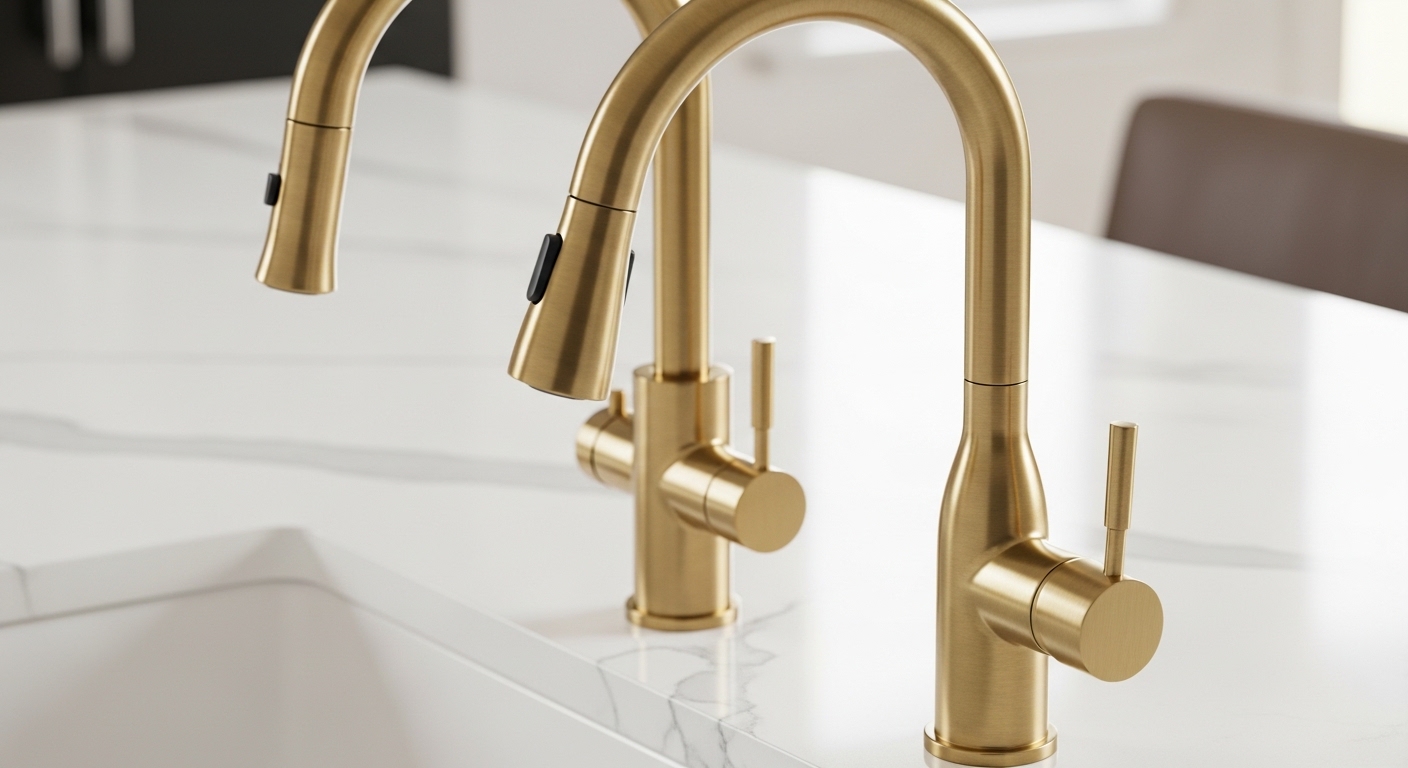
A brushed gold osmosis faucet is a dedicated drinking-water tap — a separate, smaller faucet that delivers filtered water from a reverse-osmosis (RO) or under-sink filter system — finished in a soft, warm, matte gold rather than shiny chrome. If you’ve spent money on a champagne-gold or brushed-gold main kitchen faucet, cabinet pulls, or a pot filler, the last thing you want is a cheap chrome RO spout poking out of the counter next to it. This is the fixture that finally makes the whole sink area look intentional. Below, I’ll walk you through whether it’s genuinely worth the upgrade, how to pick one that won’t peel or corrode, and the exact specs to check before you click “buy.”
What exactly is an “osmosis faucet,” and why is it separate from my main tap?
An osmosis faucet is a small, dedicated tap that dispenses only the purified water produced by an under-sink reverse-osmosis system — it is kept separate from your main kitchen faucet on purpose. RO systems push tap water through a semi-permeable membrane that strips out dissolved solids, chlorine, lead, and other contaminants. That purified water needs its own outlet so it never mixes with unfiltered hot and cold water, and so the low-pressure RO line isn’t fighting your household’s 40–80 psi supply.
That’s why you can’t just run RO water to your regular faucet. The RO tank stores water at low pressure (typically 5–15 psi), and the dedicated faucet is engineered for that gentle flow. A brushed gold osmosis faucet does the same job as a plain chrome one — it just does it in a finish that belongs in a modern warm-metal kitchen. Functionally, most quality units share the same internal ceramic valve and 1/4″ tubing connection; the difference you’re paying for is the body material and the coating.
Air-gap vs. non-air-gap: which one do I actually need?
For most homes, a non-air-gap brushed gold osmosis faucet is the better choice — it’s quieter, easier to install, and has a cleaner look. Air-gap faucets are designed to prevent drain water from siphoning back into the system, and a handful of local plumbing codes still require them. The trade-off is that air-gap models have a third tube and a small vent that can gurgle or, if the drain line clogs, spit water onto your counter.
- Non-air-gap: two tubes (feed + drain), quieter, simpler, the mainstream pick. Check that your local code allows it.
- Air-gap: three tubes, code-mandated in some areas, more prone to gurgling. Choose only if your inspector or system manufacturer requires it.
Nine out of ten buyers are perfectly served by a non-air-gap model. If you’re replacing an existing RO faucet and yours had two tubes, stick with two.
Will the brushed gold finish actually last, or will it peel over the sink?
A properly made brushed gold osmosis faucet will hold its color for 8–10+ years — but only if the gold is applied by PVD (physical vapor deposition), not sprayed-on lacquer or cheap electroplating. This is the single most important thing to verify, because the RO faucet sits in the wettest, most-touched zone of your kitchen and a bad finish will show wear fast.
PVD bonds the gold-tone coating to the metal at a molecular level in a vacuum chamber, producing a surface that resists scratching, tarnishing, and the acids in lemon juice or coffee. Lacquered or “gold-painted” finishes, by contrast, can cloud, flake, or wear through at the spout tip within a year or two. When a listing says “brushed gold PVD” and references corrosion testing, that’s a good sign; when it just says “gold finish,” ask.
| Finish type | How it’s applied | Expected lifespan | Risk of peeling/tarnish |
|---|---|---|---|
| Brushed gold PVD | Vacuum-deposited, molecularly bonded | 8–10+ years | Very low |
| Electroplated gold | Electro-chemical layer | 2–4 years | Moderate |
| Lacquered / painted gold | Sprayed topcoat over base metal | 1–2 years | High |
One clarification worth making: “brushed gold,” “champagne gold,” and “champagne bronze” are close cousins but not identical. Brushed gold reads warmer and more yellow; champagne bronze leans slightly browner. If you’re matching a specific brand’s warm finish, order a sample or compare against your existing hardware in daylight, the same way you would when choosing any warm-toned fixture like a brass faucet for a bathroom sink.
What body material should a brushed gold osmosis faucet be made of?
Go with lead-free solid brass or 304 stainless steel — never zinc alloy — for a drinking-water faucet. Because RO water is what you and your family actually drink, the wetted material matters more here than on any other tap in the house. You want a body certified to a low-lead standard and made from a metal that won’t corrode from the inside.
Lead-free brass (often labeled to NSF/ANSI 372 for lead content) is the gold standard: it’s dense, durable, and holds a PVD finish extremely well. 304 stainless is an excellent, slightly more modern alternative that’s naturally corrosion-resistant. Zinc-alloy bodies are cheaper but far more prone to pitting and cracking over years of contact with water — the same reason many buyers ultimately upgrade away from budget builds, as we cover in our guide to whether a zinc bathroom faucet is worth buying. For something touching your drinking water, don’t cut that corner.
Also confirm the internal valve is a ceramic disc cartridge. Ceramic cartridges give you a smooth quarter-turn action and a drip-free seal that outlasts rubber-washer designs by years. For a faucet you’ll operate multiple times a day, that longevity is the difference between a fixture that feels premium and one that starts weeping at the handle.
How do I know it’ll fit my sink or countertop?
Check three numbers before you buy: the mounting hole diameter, your countertop thickness, and the spout height and reach. Most RO faucets need a 1/2″ (12–12.7 mm) hole, though some use a smaller 5/16″–3/8″ opening, and they ship with a threaded shank plus a base plate and mounting nut.
- Hole size: Standard RO faucet holes are 1/2″. If you’re using the extra “sprayer” or “soap dispenser” hole in your sink, that’s usually already the right size.
- Deck thickness: Most units accommodate counters up to ~2″ (50 mm) thick. Thick granite, quartz, or a butcher block may need a longer shank — check the spec sheet.
- Spout clearance: Measure that a tall glass or water bottle fits under the spout. A gooseneck RO spout typically clears 8–10″.
- Tube connection: Most connect to 1/4″ or 3/8″ push-fit tubing from the RO tank. Match your system’s line, or grab a compatible adapter.
If your existing RO system used a different tubing size, a simple push-fit adapter solves it in seconds — the same principle behind matching any tap to a filter line, which we break down in our piece on the faucet adapter you actually need to connect a filter.
How much should I spend on a brushed gold RO faucet in 2026?
Expect to pay $35–$120 for a good brushed gold osmosis faucet, with the sweet spot around $50–$80. Below $35 you’re almost always getting zinc alloy with a lacquered finish that will disappoint within a year or two; above $120 you’re mostly paying for a designer brand name rather than better water or a better coating.
Here’s how the tiers actually shake out:
| Price range | What you typically get | Best for |
|---|---|---|
| Under $35 | Zinc body, lacquered gold, rubber washer valve | Short-term rentals; avoid for daily use |
| $50–$80 | Lead-free brass or 304 stainless, PVD brushed gold, ceramic cartridge | Most homeowners — the value sweet spot |
| $90–$120+ | Designer branding, extended warranty, premium packaging | Buyers matching a specific luxury line |
My honest take: the $50–$80 range wins for almost everyone. You get the same drinking-water safety and the same durable PVD finish as the luxury tier, without the markup. Spend the money you save on a fresh RO membrane or a spare filter set instead.
Does a brushed gold osmosis faucet match a brushed nickel or matte black sink setup?
It can, but do it deliberately — a warm brushed gold RO faucet is best paired with warm or intentionally contrasting hardware, not a random mix. Brushed gold sits firmly in the “warm metal” family, so it harmonizes naturally with champagne bronze, unlacquered brass, and other gold tones.
Two combinations that consistently look great:
- Full warm match: Brushed gold RO faucet + brushed gold main kitchen faucet + gold cabinet pulls. Cohesive, high-end, and increasingly the 2026 look.
- Intentional two-tone: Brushed gold RO faucet against a matte black main faucet or black sink. This reads as a designed contrast rather than a mistake — the same confident pairing logic behind a matte black faucet on a vessel sink.
What to avoid is mixing brushed gold with polished chrome or brushed nickel by accident, where the cool silver tones fight the warm gold and the whole area looks unplanned. If your main faucet is silver-toned and you’re not ready to change it, you may prefer to keep the RO faucet in a matching cool finish — the reasoning is similar to how buyers weigh a coordinated brushed nickel faucet with soap dispenser to keep a deck consistent.
How hard is it to install one myself?
Installing a brushed gold osmosis faucet is a genuine DIY job that takes most people 20–40 minutes, assuming you already have an RO system or an existing RO faucet to swap out. You don’t need a plumber. The basic sequence:
- Shut off the RO tank valve and open the old faucet to relieve pressure.
- Disconnect the tubing from the old faucet (push-fit lines release when you press the collar and pull).
- Remove the old faucet’s mounting nut from under the counter and lift it out.
- Drop the new brushed gold faucet’s shank through the hole with its base plate and rubber gasket seated on top.
- Thread the mounting nut up from below and snug it — hand-tight plus a quarter turn; don’t overtighten and crack the finish.
- Reconnect the tubing (cut a clean, square end for a leak-free push-fit seal), turn the tank valve back on, and check for drips.
Two tips that save headaches: keep the protective plastic film on the brushed gold surface until installation is finished so you don’t scuff it, and always make a fresh, straight cut on the tubing before pushing it into the fitting — an angled or nicked end is the number-one cause of slow leaks.
Author note & why you can trust this guide
This guide was written by the avovida fixtures team — we design, source, and pressure-test faucets and drinking-water fixtures for a living, and we handle the returns when a finish fails, so we have strong opinions about what actually holds up. Our recommendations here are based on hands-on evaluation of RO faucet bodies, valve cartridges, and PVD coatings, plus real customer feedback across thousands of orders.
A note on standards: for any drinking-water faucet, look for lead-free certification (NSF/ANSI 372) and a body warranty that covers the finish, not just the mechanics. Reputable brushed gold osmosis faucets come with at least a limited lifetime warranty on the finish and cartridge — if a listing won’t state its warranty terms or its lead-free compliance, treat that as a red flag and move on. At avovida (avovida.net), every fixture we list is checked against these criteria before it reaches you.
FAQ
Can I use a brushed gold osmosis faucet with any RO system?
Almost always, yes. RO faucets connect to the storage tank via standard 1/4″ or 3/8″ push-fit tubing, and a brushed gold osmosis faucet uses the same universal connection. Just match your tubing size or add an inexpensive adapter. The one exception is air-gap vs. non-air-gap: if your system requires an air-gap faucet (three tubes), buy an air-gap model to match.
Is brushed gold harder to keep clean than chrome on a drinking-water faucet?
No — it’s actually more forgiving. Brushed gold’s matte, directional texture hides water spots and fingerprints far better than shiny chrome. Wipe it with a soft damp cloth and dry it; skip abrasive pads, bleach, and acidic descalers, which can dull any PVD finish over time. That’s it.
Does the gold finish affect water taste or safety?
Not if the faucet is built correctly. Water quality depends on the wetted internal materials, which should be lead-free brass or 304 stainless — not the exterior coating. A quality PVD brushed gold finish sits on the outside of the body and never contacts your drinking water, so it has zero effect on taste or safety.
How is an osmosis faucet different from a regular kitchen faucet?
An osmosis faucet is smaller, single-handle (cold only), and fed at low pressure by an RO tank rather than your main water supply. It has one job: dispense purified drinking water. A regular kitchen faucet handles hot and cold at full household pressure for dishes and general use. That’s why most homes run both, side by side, and why matching their finishes matters visually.
What size hole do I need in my sink or countertop?
Most brushed gold osmosis faucets need a 1/2″ (about 12.7 mm) mounting hole, and they fit counters up to roughly 2″ thick. If your sink already has a capped accessory hole (for a sprayer or soap dispenser), it’s usually the right size. Always confirm the exact shank diameter and maximum deck thickness on the product spec sheet before drilling anything.