
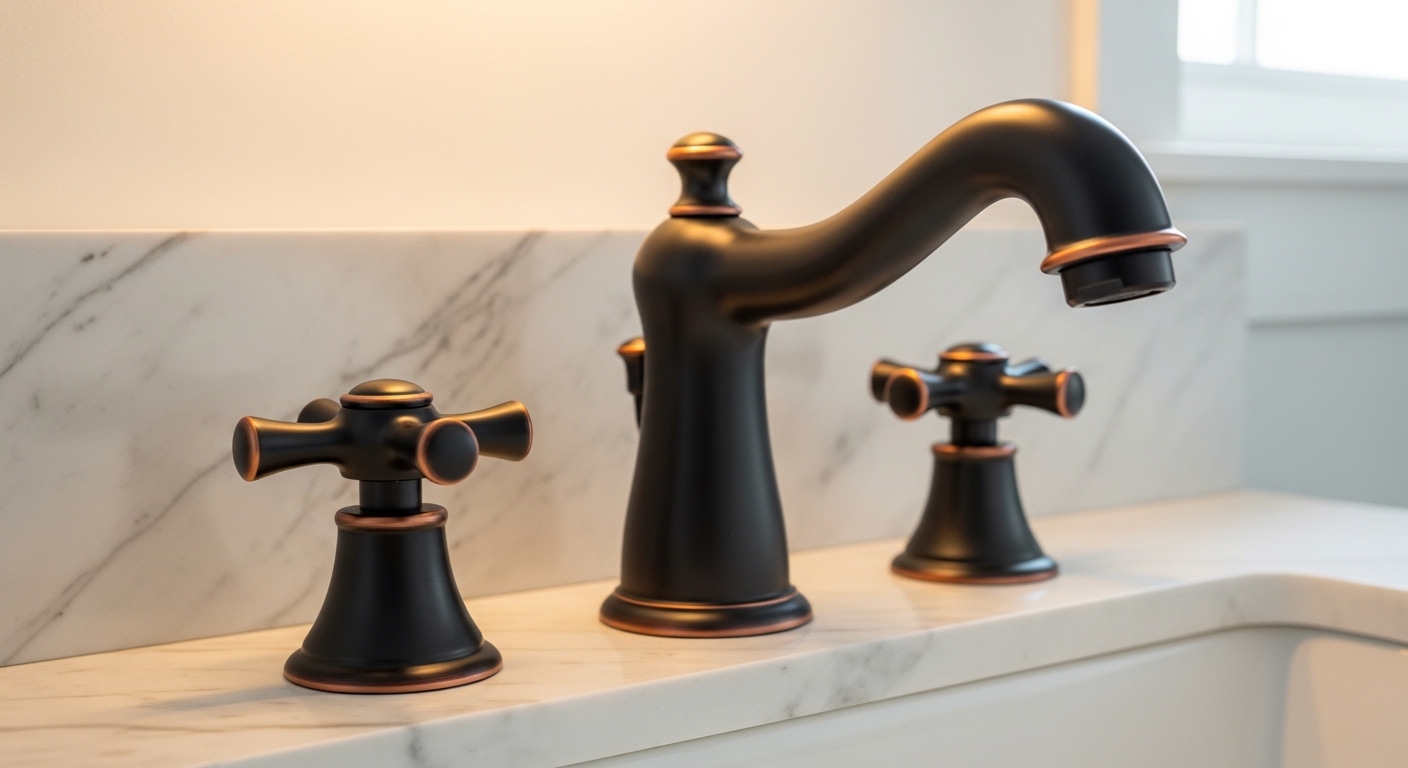
An oil rubbed bronze bath faucet is a bathroom sink faucet finished in a deep, dark brown-black tone with subtle copper highlights that show through on the high-touch edges. It’s one of the most forgiving finishes you can put in a bathroom: the matte, dark surface hides limescale, toothpaste splatter, and fingerprints almost completely, which is exactly why it’s stayed popular for over a decade even as trends swung toward matte black and brushed gold. But “oil rubbed bronze” is a look, not a material — and the difference between a good one and a bad one comes down to what’s underneath the color. Below, I’ll walk through who this finish is actually right for, how to avoid the ones that fade, and how it compares to the finishes people cross-shop it against.
What exactly is oil rubbed bronze, and is it real bronze?
No — despite the name, an oil rubbed bronze (often shortened to ORB) bath faucet is almost never made of solid bronze metal. “Oil rubbed bronze” refers to the finish color and texture, not the base metal. Historically, real oil-rubbed bronze meant a bronze fixture chemically darkened with an oil-and-patina process, where the raised areas were literally rubbed back to expose lighter metal. Today, the vast majority of faucets sold as ORB are made of brass or zinc and given a dark bronze coating.
That distinction matters more than the marketing suggests. Here’s what’s really going on under the finish:
- The base metal — solid brass is the gold standard for durability and corrosion resistance. Zinc alloy is cheaper and heavier-feeling but more prone to cracking at threaded connections over time.
- The color layer — this is either an electroplated/baked coating or a genuine living finish. Cheap ORB is essentially dark paint or a thin lacquer that can chip and wear.
- The topcoat — better faucets seal the bronze color with a clear PVD (physical vapor deposition) layer or a durable baked coating that resists abrasion from daily handle use.
A “living finish” ORB will naturally lighten and shift tone over years of use as the topcoat wears and skin oils interact with it — some buyers love this aged, characterful look; others hate the unevenness. A sealed finish stays uniform. Knowing which one you’re buying prevents an unpleasant surprise a year in. If you want to understand base-metal quality in depth, our guide on whether a brass faucet for a bathroom sink is worth it breaks down brass versus zinc in detail.
Does oil rubbed bronze fade or wear off around the handles?
It can — and this is the single biggest complaint about cheap ORB faucets. The high-contact zones (the handle tops, the spout tip you bump with a toothbrush cup, the base ring you wipe daily) are where a thin or unsealed finish wears through first, revealing brassy or silvery metal underneath. On a quality faucet with a PVD or properly baked finish, this essentially doesn’t happen within any reasonable ownership window.
To avoid the fade problem, check for these three things before you buy:
- Finish type stated explicitly — look for “PVD,” “physical vapor deposition,” or a stated finish warranty. If the listing is silent on how the color is applied, assume it’s a sprayed/lacquered finish.
- A lifetime finish warranty — reputable brands back the finish, not just the mechanics. A lifetime finish-and-function warranty is a strong signal the manufacturer trusts its coating.
- Solid brass construction — brass takes plating better than zinc and won’t corrode from behind and lift the finish.
Cleaning also plays a role. Abrasive pads, scouring powders, and acidic or ammonia-based cleaners are the fastest way to destroy any bronze finish, sealed or not. Warm water, mild dish soap, and a soft cloth are all an ORB faucet needs. We cover this in more detail in our guide on how to protect faucet finishes from scratches, which applies directly to keeping bronze looking new.
How does oil rubbed bronze compare to matte black, brushed nickel, and brushed gold?
Oil rubbed bronze is the warmest and most traditional of the popular dark finishes — it reads vintage, rustic, or transitional, while matte black reads modern and brushed gold reads contemporary-luxe. If your bathroom has warm tones (travertine, wood vanities, oil-rubbed cabinet hardware, Edison-bulb lighting), ORB harmonizes better than cool-toned black or nickel. Here’s how the four most cross-shopped finishes stack up:
| Finish | Look / Style | Hides spots & prints? | Best paired with | Typical price range* |
|---|---|---|---|---|
| Oil Rubbed Bronze | Warm, vintage, rustic-transitional | Excellent | Warm tones, wood, travertine, bronze hardware | $60–$220 |
| Matte Black | Cool, modern, high-contrast | Good (shows dried water film) | White, gray, modern/industrial baths | $70–$250 |
| Brushed Nickel | Neutral, safe, timeless | Very good | Almost anything; cool or neutral palettes | $50–$200 |
| Brushed / Champagne Gold | Warm, luxe, contemporary | Very good | White, navy, marble, warm modern baths | $90–$280 |
*Approximate US retail for a single-hole or widespread bathroom sink faucet in 2026; premium designer lines run higher.
The practical takeaway: if hiding water spots and everyday grime is your top priority, ORB and brushed nickel are the two easiest finishes to live with. Matte black looks fantastic but shows a chalky film when hard water dries on it. If you’re weighing ORB against a cooler modern look, our comparison of the best matte black faucet for a vessel sink is a useful companion read, and if you lean toward a brighter metal, see whether a polished nickel faucet bath setup fits your space.
Which oil rubbed bronze bath faucet configuration should you buy — single-hole, centerset, or widespread?
Match the faucet to the number of pre-drilled holes in your sink or vanity top — that’s the deciding factor, not looks. Installing the wrong configuration means either drilling new holes or leaving ugly gaps. Here’s the quick decision:
- Single-hole — one hole, one handle (or a joystick lever). Cleanest modern look, easiest DIY install, ideal for compact powder rooms and vessel-sink vanities. Many come with an optional deck plate to cover a 3-hole sink.
- Centerset (4-inch) — three holes spaced 4 inches apart on a single base plate. The most common builder-grade layout in US bathrooms; two handles, one unit.
- Widespread (8-inch) — three separate pieces (spout plus two independent handles) spanning 8–16 inches. The most upscale, traditional look — and ORB widespread faucets in particular nail that classic vintage vibe.
- Wall-mount — mounts to the wall above the basin, freeing the deck entirely. Dramatic with vessel sinks, but requires in-wall rough-in plumbing.
If you’re drawn to the wall-mounted look specifically in this finish, we have a dedicated guide on whether a wall mount faucet in oil rubbed bronze is the right call, including the rough-in requirements you need to plan for. And if your basin is deep or you’re using a tall vessel bowl, check reach and height in our guide to the best long spout reach bathroom faucet so the water lands in the drain, not on the front rim.
What should you actually spend, and what do you get at each price?
For a bathroom sink, expect to spend $60–$120 for a solid, well-finished ORB faucet from a reputable brand — that’s the sweet spot where you get brass construction, ceramic-disc valves, and a real finish warranty without paying for a designer name. Here’s roughly what each tier buys you:
- Under $60 — usually zinc-bodied with a sprayed or lacquered bronze finish. Fine for a rarely-used guest bath, but the finish and valve are the first things to fail. Verify the base metal before buying.
- $60–$120 — the value sweet spot: solid brass, ceramic-disc cartridge (drip-free for years), often a lifetime finish warranty. This is what most people should buy.
- $120–$220 — premium widespread and designer-styled models, heavier build, smoother lever action, PVD-sealed finish, and better-integrated pop-up drains.
- $220+ — luxury and artisan/living-finish pieces, often with genuine hand-applied patinas that age uniquely.
One spec worth prioritizing at any price: a ceramic-disc valve/cartridge. It’s the single biggest predictor of whether your faucet stays drip-free. Rubber-washer or compression valves are cheaper but wear out and drip within a few years. If you’re comparing specific mainstream brands in this finish, our roundup of the best Delta bathroom faucet options is a good place to see how a major manufacturer executes ORB across price points.
Can you install an oil rubbed bronze bath faucet yourself?
Yes — a standard deck-mounted ORB bathroom faucet is one of the most beginner-friendly plumbing jobs, and most people can do it in 30–60 minutes with a basin wrench and an adjustable wrench. Wall-mount versions are the exception; those need in-wall rough-in and are best left to a pro unless the valve is already roughed in. For a typical single-hole or centerset swap:
- Shut off the hot and cold supply valves under the sink and open the faucet to relieve pressure.
- Disconnect the supply lines and the pop-up drain linkage, then unthread the mounting nuts from below with a basin wrench.
- Lift out the old faucet and clean the deck of old putty or gasket residue.
- Set the new faucet (use the supplied gasket or a bead of plumber’s putty), tighten the mounting hardware from below, and reconnect the supply lines — hand-tight plus a quarter turn.
- Turn the water back on slowly and check every connection for leaks before you walk away.
Two tips specific to bronze: don’t over-tighten the decorative parts (you can mar the finish or crack a zinc body), and wipe the faucet dry after install so no plumber’s putty or hard-water residue sits on the new finish. If your existing faucet is old and stubborn, the removal steps in our complete DIY faucet removal guide transfer directly to bathroom faucets too.
What are the real downsides of oil rubbed bronze in 2026?
The two honest drawbacks are finish inconsistency and matching difficulty. Because “oil rubbed bronze” isn’t a standardized color, the exact tone varies noticeably between brands — one company’s ORB skews near-black, another’s leans warm brown with heavy copper highlights. If you’re matching a faucet to an existing shower valve, towel bar, or cabinet knob, buy the same brand or the same collection to guarantee the tones agree. Mixing brands is where people end up with a faucet that clashes with everything else in the room.
The second downside is that it’s a warmer, more traditional look that some feel has peaked in trendiness compared to matte black. That’s a style judgment, not a quality issue — ORB remains a classic that reads timeless rather than dated when paired with the right materials. If you want maximum resale-neutral safety, brushed nickel is the more universally agreeable choice; if you want warmth and character with excellent spot-hiding, ORB is hard to beat.
Author note & how we tested
This guide was written by the Avovida fixtures team, drawing on hands-on evaluation of dozens of bathroom faucets across finishes and price tiers. We assess base-metal construction (solid brass vs. zinc alloy), valve type (ceramic-disc vs. compression), finish durability, and warranty terms — and we cross-reference against recognized US plumbing standards, including ASME A112.18.1/CSA B125.1 for faucet performance and NSF/ANSI 61 and 372 for lead-free drinking-water safety. When we single out a “value sweet spot,” it reflects the configuration that consistently balances durable construction with a finish warranty a manufacturer is willing to back for life. Avovida focuses exclusively on faucets and bathroom fixtures — we don’t drift into general home décor — so our recommendations stay grounded in the plumbing details that actually determine how long a faucet lasts and looks good. Always confirm a specific model carries a lifetime finish-and-function warranty before you buy, since that’s your best protection against the fading issue described above.
FAQ
Is oil rubbed bronze out of style in 2026?
No. It’s less of a runaway trend than matte black or brushed gold right now, but oil rubbed bronze remains a classic, timeless finish — especially in traditional, farmhouse, rustic, and transitional bathrooms. It reads as intentional and warm rather than dated, particularly when paired with wood, travertine, or warm lighting.
Does oil rubbed bronze show water spots and fingerprints?
Barely — this is its biggest practical advantage. The dark, matte-to-satin surface hides limescale, toothpaste splatter, and fingerprints far better than chrome or polished finishes. A quick wipe with a soft dry cloth keeps it looking clean, and it never shows the chalky dried-water film that matte black can.
How do I clean an oil rubbed bronze faucet without ruining the finish?
Use only warm water, mild dish soap, and a soft cloth, then dry it. Never use abrasive scrubbers, scouring powders, or acidic/ammonia-based cleaners — those strip or dull the bronze finish, sealed or not. Avoiding harsh chemicals is the single most important thing you can do to keep it looking new.
Will an oil rubbed bronze faucet match my existing bronze shower or towel bars?
Only reliably if they’re the same brand or collection. Because ORB isn’t a standardized color, tones vary between manufacturers — some lean near-black, others warm brown with copper highlights. To guarantee a match, buy your faucet, shower trim, and accessories from the same product line.
Is a solid brass oil rubbed bronze faucet worth paying more than a zinc one?
For a faucet you use daily, yes. Solid brass resists corrosion, holds its finish better, and won’t crack at threaded connections the way zinc alloy can over time. Zinc is acceptable for a low-use guest bath, but for a primary bathroom, the brass upgrade (usually the $60–$120 tier) pays off in longevity.