
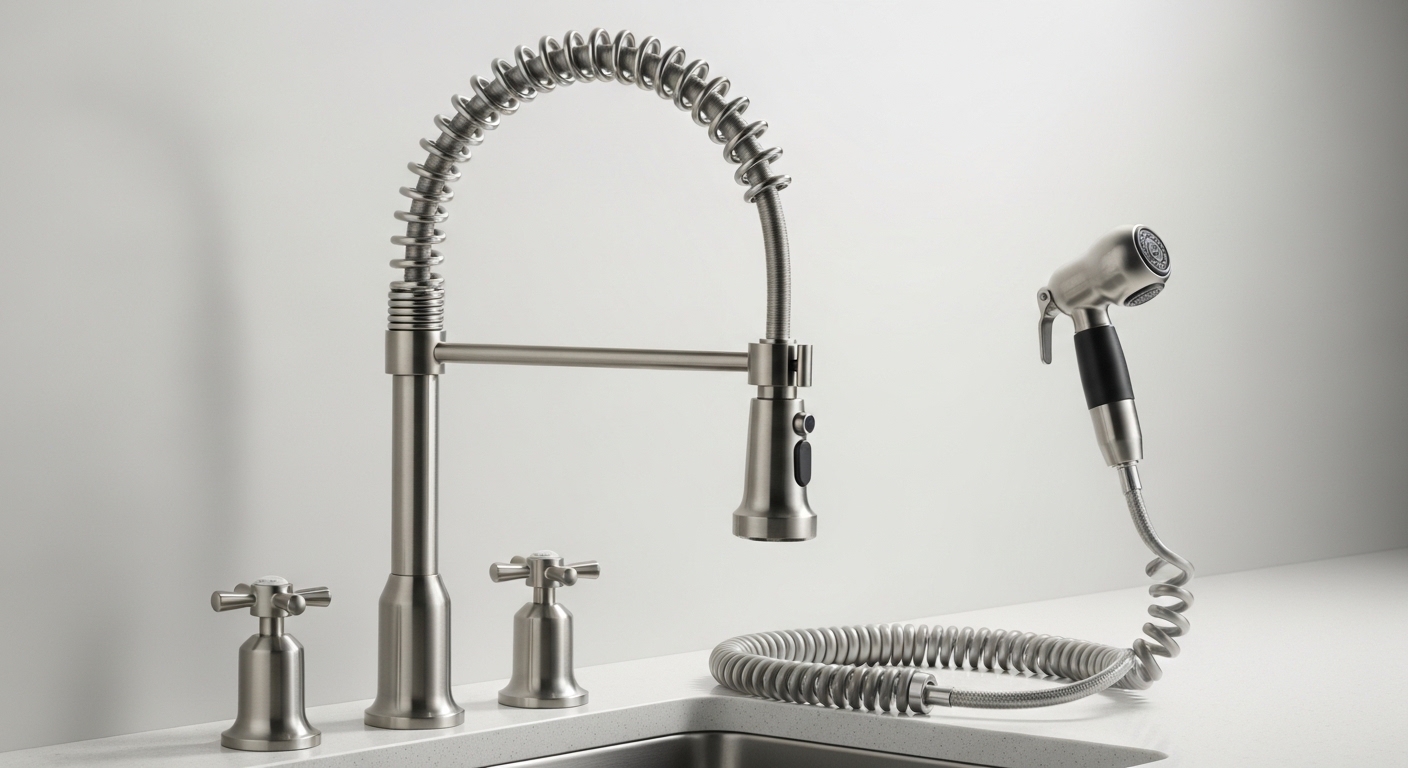
If you’re shopping for a commercial kitchen faucet with 8 centers, you’re really asking two questions at once: “Will it physically fit my sink or countertop?” and “Is it built tough enough to survive real cooking-line abuse?” The good news is that “8 centers” (kitchen-trade shorthand for 8-inch center-to-center inlet spacing) is one of the most common configurations in both commercial kitchens and heavy-use residential setups, so you have a lot of solid options. This guide walks through what the measurement actually means, how to confirm your sink matches, what specs separate a workhorse from a warranty headache, and which style fits your workflow.
What Does “8 Centers” Actually Mean on a Kitchen Faucet?
“8 centers” means the two water-supply holes on your faucet (or in your sink deck) are spaced exactly 8 inches apart, measured from the center of one hole to the center of the other. It has nothing to do with the faucet’s height, spout reach, or spray power — it’s purely the mounting spread.
This matters because faucets are drilled to a standard. The three common spreads you’ll see are:
- 4-inch centerset — usually a small bathroom or bar faucet where everything sits on one base plate.
- 8-inch (8 centers) widespread / two-handle — the workhorse spread for kitchens and commercial decks; hot and cold valves are separate castings 8″ apart.
- Single-hole — one hole, one lever, no “centers” measurement at all.
In commercial and food-service equipment, 8″ centers is the near-universal default. Deck-mount pre-rinse units, wall-mount pot-fillers, and two-handle prep faucets are overwhelmingly built to this spacing because commercial sinks and dish tables are pre-punched at 8″. So when a listing says “8 centers” or “8” adjustable centers,” it’s telling you the faucet will bolt onto a standard commercial or widespread-drilled deck.
How Do I Know if My Sink Actually Fits an 8-Center Faucet?
Grab a tape measure and measure center-to-center between your two outer supply holes — if it reads 8 inches, you’re set for a true 8-center faucet. Here’s how to check correctly so you don’t order the wrong body:
- Clear the deck and find your mounting holes. A two-handle setup has two outer holes (supply valves) and often a middle hole for the spout or a soap dispenser.
- Measure from the center of the left hole to the center of the right hole. Ignore the edges — center-to-center is the only number that counts.
- 8″ (203 mm) = 8 centers. If you get 4″, that’s a centerset and an 8-center faucet won’t fit without re-drilling. If there’s only one hole, you need a single-hole faucet instead.
- Check hole diameter too. Most decks are punched at 1-3/8″ (35 mm); commercial faucet shanks are sized to match, but always confirm.
One trap worth flagging: many commercial deck-mount faucets are labeled “adjustable 8″ centers,” which means the inlet arms swivel or the bridge flexes a bit to absorb small variances (say 7-7/8″ to 8-1/8″). That flexibility is a feature — it forgives the tiny inconsistencies you get in older or field-drilled sinks. If your holes are meaningfully off from 8″, though, don’t force it; a mis-aligned mount is exactly how you end up with leaks at the base, which is its own headache to chase down later. Our guide on why a kitchen faucet leaks at the base covers what happens when mounting hardware and seals aren’t seated square.
Why Choose a Commercial-Style Faucet Instead of a Regular Residential One?
Choose a commercial-style faucet when you cook hard, wash big pots, and want a spout that can blast food off a sheet pan — its high-arc gooseneck, spring-tensioned pre-rinse sprayer, and heavier valve internals are built for volume that would wear out a light residential faucet. The trade-off is size, splash, and price.
Here’s the honest breakdown of what “commercial” buys you:
- Flow and pressure handling. Commercial-rated bodies tolerate the higher line pressure and constant-use cycling of a busy kitchen. Residential faucets in the US are capped at 1.8 GPM by regulation; commercial pre-rinse units run higher (often 1.15–2.2 GPM at the sprayer depending on model and jurisdiction) for genuine rinsing muscle.
- Reach and clearance. That tall gooseneck and pull-down spring give you room to fit a stockpot or a full sheet pan under the spout — the single biggest reason home cooks buy commercial-style.
- Serviceability. Commercial valves use ¼-turn ceramic discs and standardized cartridges you can rebuild instead of replace. Parts availability tends to be better and longer-lived.
- Build materials. Solid lead-free brass bodies and stainless springs versus lighter zinc alloy and plastic in budget residential lines.
The downsides are real, so weigh them: commercial faucets are tall (they can look oversized on a compact kitchen), the high spout plus firm sprayer means more splash on a shallow sink, and they cost more. If you like the pro look but want a gentler footprint, a residential-scale gooseneck can be the sweet spot — our comparison of whether a chrome gooseneck faucet is right for your kitchen lays out that middle ground. And if you’re deciding between mainstream residential brands for a non-commercial build, the Moen vs Kohler breakdown from Reddit is a useful reality check.
What Specs Actually Matter When Buying an 8-Center Commercial Faucet?
The specs that matter most are the valve type, the body material, the finish certification, and the spout style — get those four right and everything else is preference. Here’s what to look for and why:
| Spec | What to look for | Why it matters |
|---|---|---|
| Valve / cartridge | ¼-turn ceramic disc | Long life, drip-free, easy to rebuild instead of replace |
| Body material | Lead-free solid brass | Corrosion resistance and rigidity under constant use |
| Inlet connection | ½” NPS or ½”-14 NPT male | Standard commercial thread; matches most supply lines |
| Finish | Brushed/polished stainless or chrome, NSF/ANSI 61 certified | Hygienic, easy to sanitize, code-compliant for food areas |
| Spout height / reach | Confirm clearance under cabinets and over the sink | A tall gooseneck can hit an upper shelf or window sill |
| Flow rate (GPM) | Match to code and use case | Residential capped at 1.8 GPM; commercial pre-rinse runs higher |
A few field notes on these. On valves, ceramic-disc cartridges are the single best predictor of a long, drip-free life — avoid old-style rubber compression washers on anything you’ll use daily. On certification, look for NSF/ANSI 61 (drinking-water safety) and NSF/ANSI 372 (lead-free compliance) if the faucet touches potable water in a food-service context — this isn’t marketing fluff, it’s often a health-code requirement. On finish, stainless and chrome dominate commercial kitchens because they wipe clean and sanitize easily; if you’re weighing the two, our piece on stainless steel vs chrome faucets explains where each actually wins.
Deck-Mount vs Wall-Mount 8-Center Faucet: Which One Do I Need?
Pick a deck-mount 8-center faucet if your supply holes come up through the sink or countertop; pick a wall-mount if your plumbing comes out of the wall behind the sink. The 8″ spacing applies to both — it’s just a question of where your water lines terminate.
| Feature | Deck-mount (8 centers) | Wall-mount (8 centers) |
|---|---|---|
| Where it bolts | Through holes in sink/countertop | To the wall via two elbows 8″ apart |
| Best for | Standard sinks, retrofits, most homes | Prep sinks, pot fillers, splash-heavy areas |
| Cleaning | Wipe deck around base | Nothing on the deck — easiest to clean under |
| Install difficulty | Moderate — access under sink | Harder — plumbing must exit wall at correct spread |
For most home kitchens and retrofits, deck-mount is the practical answer because you’re working with the holes you already have. Wall-mount shines in a dedicated prep or wash area where you want a totally clear deck to wipe down — common in true commercial builds. Either way, the 8-center measurement is the same idea; you’re just matching it to your inlet locations.
How Much Should I Budget for a Good One?
Expect to spend roughly $120–$250 for a solid mid-range 8-center commercial-style faucet, $250–$500 for a genuine food-service-grade pre-rinse unit, and under $120 for budget imports that may cut corners on valve and finish quality. Price tracks three things: valve quality, body material, and certification.
- Under $120: Often zinc-alloy or thin brass bodies, sometimes stainless-look finishes over lesser metal. Fine for light use; scrutinize the cartridge and warranty.
- $120–$250: The sweet spot for heavy home use — lead-free brass, ceramic-disc valves, real stainless finish, reasonable warranty.
- $250–$500+: True commercial pre-rinse units with heavy springs, high-flow sprayers, and full NSF certification for actual food-service deployment.
Before you buy purely on price, it’s worth reading how buyers rate a well-known commercial line — our take on whether a commercial kitchen tap from Toolstation is worth buying shows how the same “commercial” label can mean very different build quality depending on where you shop.
Can I Install an 8-Center Commercial Faucet Myself?
Yes — if your sink already has two holes at 8″ centers and you can reach the underside, a deck-mount 8-center faucet is a 45-to-90-minute DIY job with basin wrench, plumber’s tape, and supply lines. The work is mostly about clean connections, not plumbing wizardry.
The basic sequence: shut off the hot and cold supplies, remove the old faucet, set the new body onto the deck with its gasket, secure the mounting nuts from below, wrap the male inlet threads with PTFE tape, connect your supply lines (confirm the ½” thread matches), then turn the water back on slowly and check every joint for weeping. Run hot and cold for a minute and watch the base — no drips means you’re done. If you do see moisture creeping up around the base afterward, that’s almost always a gasket or mounting-nut issue rather than a faulty faucet, and it’s fixable.
The most common DIY mistakes are over-tightening (which cracks fittings), skipping the tape on threaded inlets, and not fully seating the deck gasket. Take your time on those three and you’ll avoid the usual callbacks.
Author Note & Why You Can Trust This Guide
This guide was written by the avovida fixtures team — we sell and test faucets, sinks, shower heads, and bathroom fixtures full-time, and we’ve installed and pulled apart commercial-style faucets across both home and food-service settings. Our recommendations lean on real specs (valve type, thread standard, flow rate) and recognized standards rather than marketing copy. Whenever we mention certification, we’re referring to genuine benchmarks: NSF/ANSI 61 for drinking-water safety, NSF/ANSI 372 for lead-free compliance, and manufacturer warranties that typically run from a limited 1-year on budget units to lifetime on the valve and finish for premium brands. Always register your faucet and keep the receipt — warranty claims almost always require proof of purchase and, for finish claims, evidence you used non-abrasive cleaners.
FAQ
Is “8 centers” the same as “8-inch widespread”?
Essentially yes. “8 centers” is trade shorthand for 8-inch center-to-center inlet spacing, which is the same spread used by 8-inch widespread two-handle faucets. Commercial listings tend to say “8 centers,” while residential listings say “widespread,” but the mounting dimension is identical.
Will an 8-center faucet fit a 4-inch centerset sink?
No. A 4-inch centerset has its holes only 4″ apart, so an 8-center faucet won’t reach both. You’d need to re-drill the deck to 8″ spacing, install a different faucet type, or use a single-hole model with a base plate that covers the existing holes.
What thread size are the supply inlets on commercial 8-center faucets?
Most commercial deck-mount faucets use ½” NPS or ½”-14 NPT male inlets, which is the standard that matches common braided supply lines and shut-off valves. Always confirm the exact thread in the spec sheet before buying adapters.
Do I need an NSF-certified faucet for a home kitchen?
Not legally required in a home, but it’s a smart bonus — NSF/ANSI 61 and 372 certify the faucet is safe for drinking water and lead-free. If you’re outfitting an actual food-service space, certification is usually mandatory under local health code, so check your jurisdiction.
Why does my commercial faucet splash so much, and can I fix it?
Tall goosenecks and high-flow sprayers drop water from a height, so splash is common on shallow sinks. Fixes include adding an aerator to soften the stream, aiming the spray toward the drain, or choosing a deeper sink. A quality aerator makes a real difference — see our guide on choosing a stainless steel kitchen faucet aerator.
How long should a commercial 8-center faucet last?
A quality unit with a ceramic-disc valve and solid brass body can last 15–20 years with basic care, and the valve is rebuildable if it starts to drip. Budget zinc-body units with rubber-washer valves may need service in a few years, which is why the valve type is the spec worth paying up for.