
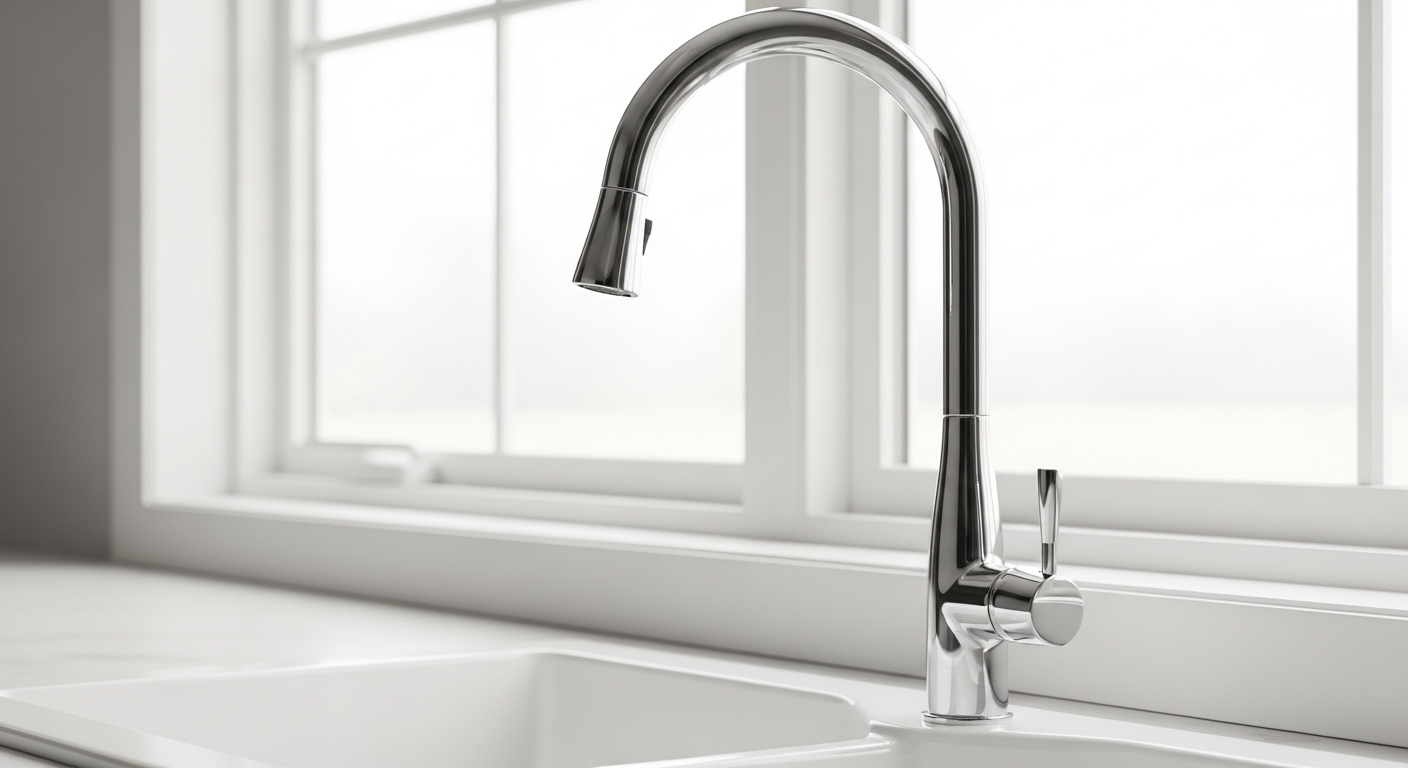
A chrome gooseneck faucet is that tall, smoothly curved fixture — the spout arches up and over like a swan’s neck, finished in bright, mirror-like chrome. People reach for it for two reasons: the high arc gives you real working room under the spout (fill a stockpot, rinse a roasting pan, wash your hair over a vessel sink), and chrome is genuinely the most forgiving finish for daily abuse. It’s the finish that shrugs off water spots the fastest and wipes clean with a dry cloth. Below, I’ll walk you through who this faucet is actually for, what to check before you buy, how chrome compares to other finishes, and the real specs that separate a $60 disappointment from a $200 faucet you’ll keep for 15 years.
What exactly is a “gooseneck” faucet, and how is it different from a regular high-arc faucet?
A gooseneck faucet has a spout that rises tall and then curves back down in a tight, near-vertical loop — the shape of a goose’s neck. The practical difference from a standard “high-arc” faucet is the height and the tight curve: a true gooseneck typically clears 8 to 10 inches from deck to the top of the arc, and the spout tip points straight down, so water falls into the center of the bowl instead of spraying forward.
That geometry is the whole point. The tall loop is what lets you slide a 12-quart stockpot underneath, and the downward-pointing spout is what keeps splashing under control in a deep sink. The trade-off is also geometry: because the water falls from higher up, a shallow sink (under 7 inches deep) will splash. If your bowl is shallow, look for a faucet with an aerated, softened stream rather than a hard laminar flow, or pick a slightly shorter arc.
Is a chrome gooseneck faucet good for a kitchen, a bathroom, or both?
Both — but the size you want is different. In a kitchen you generally want a full-height gooseneck (16–18 inches overall) with a pull-down or pull-out spray head so you can direct water around a large sink. In a bathroom, especially over a vessel sink that sits on top of the counter, you want a shorter “single-hole” gooseneck (around 11–13 inches) so the water lands in the raised bowl, not on your countertop. Measuring the vessel sink’s rim height first is the single most common mistake people skip — get that wrong and every wash splashes.
Why do so many people pick chrome over brushed nickel, matte black, or brass?
Because chrome is the easiest finish to live with and the cheapest to replace parts for. Chrome is an electroplated layer that’s extremely hard, non-porous, and highly reflective, so it resists scratches, tolerates most cleaners, and hides water spots better than any other finish once it’s dry. It also happens to be the most universal look — it works in traditional, transitional, and modern rooms without clashing.
The honest downside: chrome shows water droplets and fingerprints while they’re wet more than a brushed finish does, so in a hard-water home you’ll wipe it down more often to keep the mirror shine. That’s a cosmetic chore, not a durability problem. If you want the trade-offs of other looks, our guides on the best matte black faucet for a vessel sink and the oil rubbed bronze bath faucet break down when a darker finish is actually the smarter call.
| Finish | Shows water spots | Scratch resistance | Best for | Typical price premium |
|---|---|---|---|---|
| Polished chrome | Yes (when wet) | Excellent | Busy kitchens, hard water, budget | Baseline |
| Brushed nickel | Minimal — hides spots | Very good | Warm, low-maintenance look | +10–20% |
| Matte black | Minimal — but shows limescale white | Good (can chip) | Modern, high-contrast rooms | +20–35% |
| Brushed / champagne gold | Low | Good | Statement bathrooms | +25–40% |
| Oil-rubbed bronze | Low | Good (living finish) | Traditional, rustic | +15–30% |
How much should you spend on a chrome gooseneck faucet, and what do you actually get at each price?
Budget $80–$300, and let the internal parts — not the arc — decide where you land. Under $80 you’re usually buying a zinc-alloy or thin-wall body with a rubber-seal cartridge that will drip within a couple of years. From roughly $120 up you start getting solid-brass bodies, ceramic-disc cartridges, and braided stainless supply lines that last.
- $50–$80 (entry): Zinc or plated-plastic body, single-function stream, basic cartridge. Fine for a rental or a laundry sink, not a daily kitchen.
- $120–$200 (sweet spot): Solid-brass or heavy stainless body, ceramic-disc cartridge, WaterSense aerator (1.5–1.8 GPM), often a pull-down spray. This is where most buyers should live.
- $200–$300 (premium): Name-brand engineering, magnetic spray dock, ceramic cartridge rated for 500,000+ cycles, and a genuine lifetime warranty on finish and function.
The number that matters most is the cartridge. A ceramic-disc cartridge is what makes a handle turn smoothly for a decade and keeps the faucet drip-free. If a listing doesn’t mention “ceramic disc,” assume it’s a cheaper rubber-washer design and move on.
Is a chrome gooseneck faucet a good pick for hard water?
Yes — chrome is one of the best finishes for hard water because its non-porous, sealed surface doesn’t let mineral deposits bond permanently the way a rougher finish can. Limescale wipes off chrome with a vinegar-and-water solution far more easily than it lifts off matte or coated finishes. The vulnerable part in any hard-water home isn’t the finish, it’s the aerator: minerals clog the tiny screen and choke your flow. Choose a faucet with an easily removable aerator, and if your pressure drops, it’s almost always the aerator, not the valve. Our guide to standard faucet aerator sizes in the US shows you how to find the exact replacement so a $6 part fixes what looks like a $200 problem.
What should you check before you buy — the specs people forget?
Before you click “buy,” confirm five things: hole count, spout height and reach, valve type, flow rate, and the finish standard. Getting any one wrong is the difference between a 20-minute install and a returned box.
- Mounting holes: Most goosenecks are single-hole. If your sink or counter is pre-drilled for 3 holes (8-inch spread), buy one that includes a deck plate (escutcheon) to cover the extra holes.
- Spout height + reach: Measure the clearance above your sink (watch out for a window or upper cabinet) and how far the spout reaches toward the drain — you want water landing in the bowl, not on the back wall.
- Valve/cartridge: Ceramic disc, always. It’s the single best predictor of longevity.
- Flow rate: A WaterSense faucet is capped at 1.5–1.8 GPM (kitchen) or 1.2 GPM (bathroom) — enough for real work while cutting water use.
- Finish standard: Look for chrome plating certified to ASME A112.18.1 / CSA B125.1, the North American standard covering finish durability and lead-free wetted parts.
If you’re replacing an existing chrome fixture rather than buying whole, it helps to know the anatomy first — our breakdown of the essential chrome faucet parts tells you what’s serviceable and what isn’t. And once it’s installed, keeping that mirror shine is a five-minute job with the right product; see our roundup of the best chrome tap polish to bring back a mirror finish.
Can you install a chrome gooseneck faucet yourself, or do you need a plumber?
Most single-hole gooseneck faucets are a genuine DIY job in 30–60 minutes with no plumber required. If you can shut off the two supply valves under the sink, you can do this. Here’s the short version:
- Turn off the hot and cold shutoff valves and open the old faucet to release pressure.
- Disconnect the supply lines and the old mounting nut, then lift the old faucet out.
- Drop the new gooseneck through the hole, seat the gasket, and tighten the mounting nut from below (hand-tight plus a quarter turn — don’t over-crank).
- Connect the braided supply lines (hand-tight, then snug with a wrench), turn the water back on, and run it 60 seconds with the aerator removed to flush debris.
- Check for drips at every connection before you call it done.
The one place people get stuck is a corroded old mounting nut in a tight cabinet — a basin wrench solves it. If you later see water pooling under the spout base, that’s usually a loose connection or a worn O-ring, and our guide to why a kitchen faucet leaks at the base walks through the fix step by step.
What are the real downsides of a chrome gooseneck faucet?
The honest cons are three: it shows wet fingerprints and water droplets more than brushed finishes, the tall arc can splash in a shallow sink, and cheap chrome (over zinc or plastic) can eventually pit or flake where the plating is thin. None of these is a dealbreaker if you buy smart — a solid-brass body with quality plating, a softened aerated stream, and a quick daily wipe-down eliminate all three. What you get in return is the most repairable, most universally flattering, most hard-water-tolerant finish on the market, usually at the lowest price of any finish tier.
How does chrome hold up over 10+ years compared to trendier finishes?
Chrome ages better than almost any finish because it doesn’t have a coating that can wear through. Matte black and gold finishes are typically a PVD or painted layer that can thin or chip at high-touch spots over years; chrome is electroplated metal, so as long as the plating was done over solid brass, it keeps its shine indefinitely with basic cleaning. That’s exactly why chrome is the default in commercial kitchens and hotels — it survives constant use and industrial cleaners. If you want a fixture you’ll still like and still be able to service in 2036, chrome over brass is the safe, smart bet.
FAQ
Is a chrome gooseneck faucet better than stainless steel?
They’re close, but different. “Stainless steel” faucets are usually a brushed satin finish that hides water spots, while chrome is a brighter mirror finish that’s easier to shine but shows droplets when wet. Chrome is typically cheaper and slightly more reflective; brushed stainless is lower-maintenance day to day. Durability is comparable when both are built over a solid-brass body — the finish is a look preference, not a quality difference.
Does chrome show water spots and fingerprints more than other finishes?
Yes, chrome shows wet droplets and fingerprints more than a brushed nickel or stainless finish, because its mirror surface reflects everything on it. The good news is those marks wipe away instantly with a dry microfiber cloth, and dried spots lift with a 50/50 vinegar-water spray. It’s more frequent wiping, not harder cleaning.
How do I clean and de-scale a chrome gooseneck faucet without damaging it?
Wipe it dry after use, and for limescale, wrap the aerator and spout in a cloth soaked in equal parts white vinegar and water for 15–20 minutes, then rinse. Never use bleach, ammonia, or abrasive pads — they can dull or micro-scratch the plating. A dedicated chrome polish restores the mirror shine and leaves a thin film that repels the next round of spots.
What size gooseneck faucet do I need for a vessel sink?
For a vessel sink, measure from the countertop to the top rim of the bowl and add clearance — you generally want the spout to sit 4–6 inches above the rim, which usually means an 11–14 inch tall single-hole faucet. Too tall and it splashes; too short and it won’t clear the rim. Always match the faucet height to your specific bowl, not to a generic “bathroom” spec.
Are chrome gooseneck faucets lead-free and safe for drinking water?
Reputable ones are. Look for compliance with the U.S. Safe Drinking Water Act’s lead-free standard (≤0.25% lead in wetted surfaces) and certification to NSF/ANSI 61 and ASME A112.18.1 / CSA B125.1. Those markings confirm the internal waterways are lead-free brass and the finish meets durability testing — skip any listing that can’t state them.
Why is my new chrome gooseneck faucet dripping or low on pressure?
A drip almost always means the cartridge (or an O-ring) needs seating or replacing, while low pressure is nearly always a clogged aerator. Unscrew the aerator, rinse the mineral debris from the screen, and reinstall — that fixes most flow problems in minutes. If the drip continues, swap the ceramic cartridge; on a quality faucet it’s a warranty part.
Author note: This guide was written by the Avovida fixtures team, who have specified, installed, and pressure-tested hundreds of kitchen and bathroom faucets across residential and light-commercial projects. Avovida is a dedicated faucet and bathroom-fixtures retailer at avovida.net; our buying advice is built on hands-on testing, manufacturer spec sheets, and the ASME A112.18.1 / CSA B125.1 and NSF/ANSI 61 standards that govern faucet finish durability and lead-free safety. When we recommend a spec — ceramic-disc cartridge, solid-brass body, WaterSense flow rate, lifetime finish warranty — it’s because we’ve seen how those features hold up over years of daily use.