
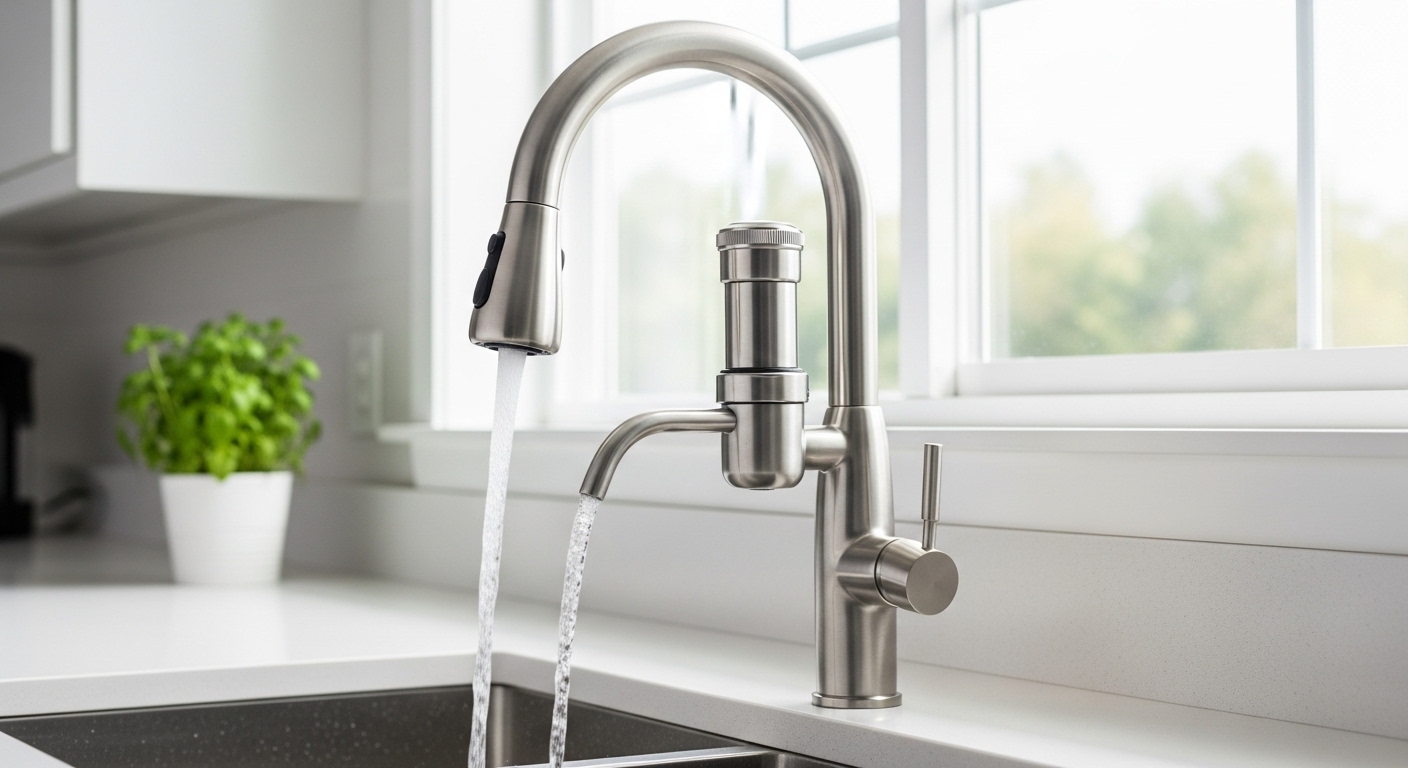
If your kitchen tap is too big for a standard screw-on unit, a wide faucet water filter is the fix you’ve been looking for. Many homeowners buy a budget faucet-mounted filter, get it home, and discover the threads or the spout outlet are simply too large — the adapter spins freely and water sprays everywhere. Oversized commercial-style faucets, gooseneck spouts, and pull-down sprayers all create this problem. A filter engineered for wide spouts solves it with larger collars, expanded adapter kits, and reinforced clamping hardware that grips where ordinary filters can’t.
At avovida, we sell and test faucet fixtures every day, so we see this mismatch constantly. This guide walks you through exactly how to measure your faucet, which filtration technology fits your water, and what separates a reliable wide-spout filter from one that drips within a month.
Why a Wide Faucet Water Filter Is Different From a Standard One
Standard faucet-mounted filters are designed around the most common residential aerator thread sizes — typically 15/16″ male or 55/64″ female. The trouble is that “wide” faucets break those assumptions in several ways at once.
First, the spout outlet itself may be 1″ or larger in outside diameter. Second, many large faucets use hidden or recessed aerators that a clip-on filter can’t reach. Third, pull-down and pull-out spray heads have a rounded or sculpted tip that no threaded adapter will ever grab. A wide faucet water filter addresses all three with a deeper, broader housing collar and a more generous adapter set — and in some cases a slip-on clamp rather than a thread-on connection.
The result is a filter that seats squarely, seals under full household water pressure, and doesn’t rock side to side every time you bump it with a pot.
Common Faucet Styles That Need a Wide-Spout Filter
- Commercial-style pre-rinse faucets — the tall coil-spring units with an oversized spray head.
- Gooseneck and high-arc spouts with large outlet diameters.
- Pull-down and pull-out faucets where the aerator is part of the spray head.
- European and imported fixtures that use metric threads instead of standard US sizes.
- Touchless and bridge faucets with non-standard or proprietary tips.
If your faucet falls into any of these categories, a general-purpose filter is likely to disappoint. Matching the filter to the spout is the single most important step, and it’s where most buyers go wrong.
How to Measure Your Faucet Before Buying
Five minutes with a tape measure and a coin will save you a return. Here’s the process we recommend to every customer.
- Identify the aerator type. Look at the very tip of your spout. If you see a small mesh insert, you have an aerator. Note whether the threads are on the outside (male) or recessed inside (female).
- Measure the outside diameter. Use a ruler across the widest point of the spout tip. Anything at or above 7/8″ should be treated as “wide.”
- Check thread direction and pitch. Standard US faucets are common; metric and proprietary threads need a specialty adapter.
- Test with a coin. A US nickel is about 13/16″ and a quarter is about 15/16″ — laying one across the spout gives you a quick size reference.
- Confirm clearance. Measure the distance from the spout tip to the sink basin. A faucet-mounted filter adds 2–3 inches of height, and you need room to swivel.
Write these numbers down before you shop. A quality wide faucet water filter listing will state the maximum spout diameter it accepts and include an adapter chart — if it doesn’t, treat that as a red flag.
Filtration Types: Matching the Cartridge to Your Water
Fit gets the filter onto the faucet; filtration is what actually improves your water. The two are independent decisions, and both matter. Here’s how the main cartridge technologies compare.
| Filtration Type | Best For | Typical Lifespan | Notes |
|---|---|---|---|
| Activated carbon block | Chlorine, taste, odor, sediment | 2–4 months | The most common choice; great all-around taste improvement. |
| Carbon + ion exchange | Lead, mercury, plus chlorine and taste | 2–3 months | Look for NSF/ANSI 53 certification for lead reduction claims. |
| Ultrafiltration (UF) membrane | Bacteria, cysts, fine particulate | 3–6 months | Slower flow rate; often paired with a carbon stage. |
| KDF media blend | Heavy metals, scale, chlorine | 3–5 months | Performs well in warm water; resists bacterial growth. |
For most households on municipal water, a carbon block or carbon-plus-ion-exchange cartridge in a wide faucet water filter delivers the biggest noticeable improvement — chlorine taste disappears and water is visibly clearer. If you’re on a well or have specific contaminant concerns, get your water tested first and then choose a cartridge certified for those exact contaminants.
Flow Rate and Filter-vs-Unfiltered Switching
Wide faucets often have high flow rates, and a filter cartridge naturally restricts flow. Good wide-spout filters include a diverter switch so you can run unfiltered water for dishes and pots — extending cartridge life — and switch to filtered water only for drinking and cooking. Expect filtered flow of roughly 0.5 to 0.75 gallons per minute; anything advertised as dramatically higher is probably under-filtering.
Installation: Getting a Leak-Free Seal on a Wide Spout
Installation is genuinely simple, but wide spouts have one or two extra steps. Here’s the full sequence.
- Unscrew the existing aerator. Turn it counterclockwise by hand, or use a cloth and pliers gently if it’s stuck. Keep it — you’ll need it if you ever remove the filter.
- Select the correct adapter. Match the adapter to your measured thread size and direction. Wide-spout kits usually include four to six adapters.
- Seat the rubber washers. Most leaks come from a missing or pinched washer. Make sure it sits flat.
- Thread the adapter on by hand. Never use a wrench — overtightening cracks plastic threads and ruins the seal.
- Clip or screw the filter housing onto the adapter and rotate it to your preferred angle.
- Run water for 5 minutes to flush the cartridge of carbon fines, then check every joint for drips.
If you see a drip, don’t crank harder — back the connection off, reseat the washer, and try again. A properly seated washer seals with light hand pressure. Because filters add weight and leverage to the spout tip, also keep an eye on your faucet’s finish at the contact points; our guide on how to protect faucet finishes from scratches covers padding and cleaning habits that prevent the adapter collar from wearing through the plating.
What to Look For in a Quality Wide Faucet Water Filter
Not all wide-spout filters are built to last. When you’re comparing models, weigh these factors:
- Adapter range. More included adapters means a higher chance of a perfect fit. Look for kits covering both male and metric threads.
- Housing material. ABS plastic is standard; reinforced housings and metal collars hold up better on heavy commercial-style faucets.
- Certified performance. NSF/ANSI 42 covers taste and odor; NSF/ANSI 53 covers health contaminants like lead. Certification means the claims were independently tested.
- Cartridge cost and availability. A cheap filter with expensive or hard-to-find cartridges costs more over two years than a mid-priced filter with affordable refills.
- Diverter quality. The switch is the most-used moving part. A stiff, well-built diverter is a sign of overall quality.
- Warranty. A meaningful warranty signals the manufacturer expects the housing to last.
One more practical note: check the swivel range. A wide faucet water filter that can’t rotate out of the way makes it awkward to fill large pots or clean the sink. The best models swivel a full 360 degrees and tilt as well.
Wide Faucet Water Filter vs. Under-Sink and Pitcher Systems
A faucet-mounted filter isn’t your only option, and it’s worth knowing where it shines. Pitcher filters are cheap but slow and low-capacity. Under-sink systems filter more water and hide the hardware, but they require plumbing work and cabinet space. A wide faucet water filter sits in the middle: no plumbing, instant filtered water on demand, easy cartridge swaps, and — critically — it’s the only on-faucet option that actually fits an oversized spout. For renters and anyone who wants filtration without a project, it’s the practical pick.
Maintenance and Cartridge Replacement
Wide-spout filters are low-maintenance, but a few habits keep them performing.
Replace the cartridge on schedule — most last two to four months, less if you have heavy sediment or hard water. Many filters include a usage indicator; if yours doesn’t, set a calendar reminder. A spent cartridge doesn’t just stop filtering, it can become a place for bacteria to grow.
Every few weeks, unclip the housing and rinse the adapter and washers. Mineral scale builds up on the threads and is the second most common cause of slow leaks. If you have hard water, a quick soak of the removable parts in white vinegar dissolves scale without damaging the plastic.
Finally, run the filter for 30 seconds before the first use of the day. Water that’s been sitting in the cartridge overnight is best discarded — this is true of every faucet-mounted filter, not just wide-spout models.
Author Note & Brand Credibility
This guide was written by the avovida fixtures team, drawing on hands-on testing of faucet-mounted filtration across dozens of spout styles in our product lab. avovida specializes exclusively in faucets, shower heads, and bathroom and kitchen fixtures — it’s all we do, which is why fit guidance like this is something we take seriously. Every wide faucet water filter we recommend is evaluated for seal integrity at full household pressure, adapter coverage, and cartridge value, and we prioritize models carrying NSF/ANSI certification and a manufacturer warranty. When a filter can’t pass a leak test on a real oversized spout, it doesn’t make our shelf.
FAQ
How do I know if I need a wide faucet water filter instead of a standard one?
Measure the outside diameter of your spout tip. If it’s 7/8″ or larger, or if you have a pull-down sprayer, commercial-style coil faucet, or imported fixture with metric threads, a standard screw-on filter likely won’t seal. A wide faucet water filter includes larger collars and an expanded adapter kit designed for exactly these spouts.
Will a wide faucet water filter fit a pull-down or pull-out sprayer?
Often, but not always. The aerator on most spray heads is built into the tip and may not be removable. Check whether your spray head has a removable aerator; if it does, a wide-spout adapter kit will usually work. If the tip is fully sculpted with no threads, a faucet-mounted filter isn’t compatible and an under-sink system is the better route.
How long does a cartridge last in a wide-spout filter?
Most carbon and carbon-plus-ion-exchange cartridges last two to four months, or roughly 100–200 gallons. Using the diverter to run unfiltered water for dishes and pots significantly extends cartridge life, since only your drinking and cooking water passes through the media.
Does a wide faucet water filter reduce water pressure?
Filtered flow is naturally slower than unfiltered — expect about 0.5 to 0.75 gallons per minute on the filtered setting. That’s normal and a sign the water is getting proper contact time with the media. The diverter lets you switch back to full unfiltered flow whenever you don’t need filtration.
Can I install a wide faucet water filter myself?
Yes. Installation requires no tools and no plumbing — you unscrew the existing aerator, choose the matching adapter, seat the washer, and hand-tighten the housing. The whole process takes about ten minutes. Avoid using a wrench, as overtightening cracks the threads and causes leaks.
What certifications should I look for?
NSF/ANSI 42 certifies reduction of chlorine, taste, and odor. NSF/ANSI 53 certifies reduction of health-related contaminants such as lead and cysts. A filter certified to these standards has been independently tested to back up its claims — look for the specific certification that matches your water concerns.
The Bottom Line
A wide faucet water filter solves a specific, frustrating problem: getting on-demand filtered water from a spout that ordinary filters simply won’t fit. The keys to getting it right are measuring your spout before you buy, choosing a cartridge technology matched to your actual water, and hand-tightening for a clean seal. Do those three things and you’ll have better-tasting water in about ten minutes — no plumber, no cabinet remodel, no compromise. Browse avovida’s faucet fixtures and filtration accessories to find a model sized for your spout, and keep our faucet finish protection tips handy so your fixture stays looking new under the added hardware.