
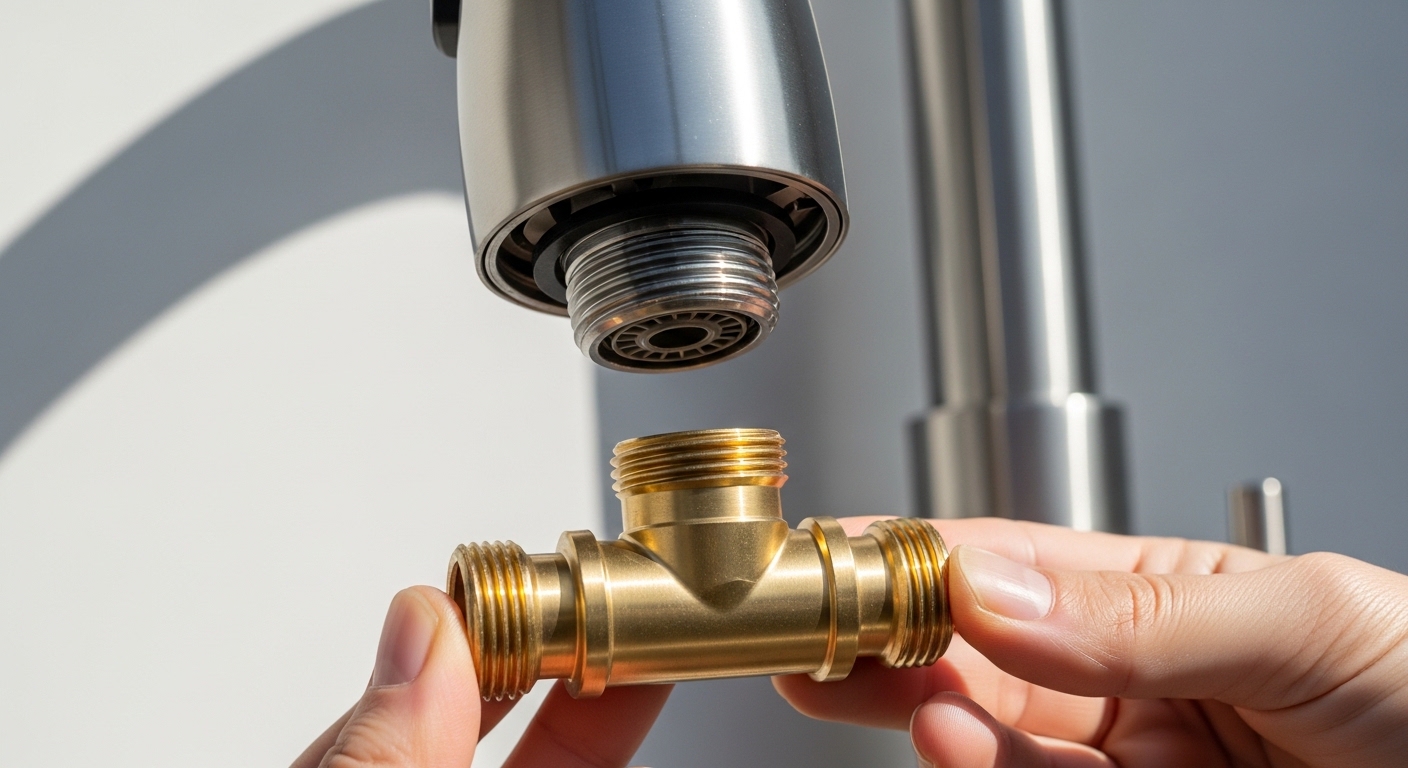
A pull down kitchen faucet to hose adapter is a small brass or plastic fitting that converts your kitchen faucet’s outlet into a standard ¾-inch garden-hose thread (GHT), so you can run a hose indoors — to fill an aquarium, hook up a portable dishwasher, water plants, or wash the dog. The catch most people hit: pull-down faucets are built differently from old-school faucets, and the part you’d normally thread an adapter onto is usually hidden inside the spray wand. Below I’ll show you exactly which adapter fits which faucet, how to install it without leaks, and when it’s genuinely not worth the hassle.
I’ve installed and tested dozens of kitchen faucets at avovida, and the hose-adapter question comes up constantly from people who don’t want to drag a hose to an outdoor spigot in winter. The good news is it’s almost always solvable. The trick is matching the adapter to your faucet’s specific outlet.
Why won’t a normal hose adapter just screw onto my pull-down faucet?
Because a pull-down faucet doesn’t have the same external threads a basic faucet does. On a standard kitchen or bathroom faucet, the spout tip has visible aerator threads — you unscrew the aerator and the adapter threads right on. On a pull-down model, the “tip” is a removable spray wand connected by a hose, and that wand is what holds the aerator. So when you look for threads on the spout, there’s nothing there.
You actually have two threaded points on most pull-down faucets, and knowing which one to use is the whole game:
- The spray wand outlet — the front face of the pull-down sprayer. Some wands have a removable aerator with standard 15/16″-27 (male) or 55/64″-27 (female) threads. If yours does, you can thread an adapter directly onto the wand.
- The hose-to-wand quick connect — where the supply hose snaps into the back of the wand. This is a proprietary fitting (often a plastic “click” coupler), NOT a standard thread, so adapters generally won’t fit here.
The practical answer: in most cases you remove the spray wand’s aerator and thread the adapter onto the wand itself, or you use a universal clamp/slip adapter that grips the outside of the spout. The proprietary quick-connect is a dead end for hose adapters.
How do I find out what thread size my faucet has?
Unscrew the aerator from the tip of your pull-down spray wand (turn counterclockwise as you face it; a rubber jar-gripper helps if it’s tight). Then measure or test-fit. Male threads on the outside that measure about 15/16 inch are the most common “regular male” size; female threads inside the tip measuring about 55/64 inch are “regular female.” There are also “junior” sizes on smaller faucets. Most universal faucet adapter kits include both male and female sides plus the two common sizes, which is why I steer people toward a kit rather than a single fitting.
| Outlet type on your faucet | Adapter you need | Typical price | Best for |
|---|---|---|---|
| Wand has removable aerator with standard threads | Faucet aerator-to-GHT adapter (multi-thread kit) | $8–$15 | Most pull-down faucets |
| Wand has non-standard or no usable threads | Universal clamp-on / slip-fit rubber adapter | $6–$12 | Odd-shaped or sealed spray heads |
| You want to keep the sprayer and add a hose | Diverter aerator adapter with shut-off | $12–$25 | Frequent switching between tap and hose |
| Filling a portable dishwasher/washer | Quick-connect faucet adapter (appliance-specific) | $10–$20 | Recurring appliance hookups |
What kind of adapter do I need to connect a pull-down faucet to a garden hose?
For a one-time or occasional hose hookup, buy a multi-thread faucet-to-garden-hose adapter kit — it’ll match almost any pull-down wand’s aerator threads and convert them to standard ¾” GHT. For odd or threadless spray heads, get a universal slip-on adapter that clamps over the spout with a rubber gasket and hose clamp. That’s the decision in one sentence.
Here’s how the three main adapter styles actually behave in a real kitchen:
- Threaded aerator adapter (the default choice). You remove the wand’s aerator and thread the adapter on in its place. Solid, leak-free, full water pressure. The only downside is you lose the spray function while it’s installed, so it’s best when you’ll attach the hose, do your task, and reconnect the aerator afterward.
- Universal clamp-on / slip adapter. A rubber cone slips over the spout tip and a small clamp tightens it down. No threads required, so it works on sealed pull-down wands. The trade-off: at higher pressure these can pop off or weep, so keep the flow moderate.
- Diverter adapter with shut-off valve. This screws on like the threaded type but has a lever that switches flow between the faucet and the hose, plus an on/off. Great if you’re filling something repeatedly and don’t want to keep walking back to the handle. It adds a bit of bulk under the spout.
One important note for GHT outdoor hoses: the threads on a garden hose are coarse ¾” GHT, which is NOT the same as the fine aerator thread on your faucet. The adapter exists precisely to bridge those two thread standards — don’t try to force a hose directly onto faucet threads, you’ll cross-thread and leak.
Will connecting a hose hurt my pull-down faucet or its warranty?
Occasional, low-to-moderate-pressure use won’t hurt a quality faucet, but two things genuinely matter: don’t exceed normal household pressure (40–60 psi), and don’t leave a pressurized hose connected for long unattended. The risk isn’t the adapter — it’s back-pressure or a kinked hose stressing the faucet’s internal cartridge and the spray hose’s quick-connect.
Most major faucet brands (Moen, Delta, Kohler, and avovida included) offer limited lifetime warranties on the faucet body and finish, but those warranties cover defects, not damage from non-standard attachments or excessive pressure. If you’re attaching a hose to feed an appliance permanently, that’s a different job — use a proper braided supply line and a tee fitting at the shut-off valve under the sink instead of hanging a hose off the spout. For a clean swap of the supply side, our guide on how to replace a kitchen faucet that has copper supply lines walks through doing it without leaks.
How do I install a faucet-to-hose adapter step by step?
Installing a pull-down faucet to hose adapter takes about 5 minutes and no tools beyond your hands and maybe a rag. Pull the spray wand down, remove its aerator, thread on the adapter, attach the hose, and test at low pressure first. Here’s the full sequence:
- Pull the wand out and hold it. Grip the pull-down spray head so the weighted hose doesn’t retract while you work.
- Remove the aerator. Turn the aerator at the tip counterclockwise. Use a rubber gripper or cloth — never pliers directly on the finish, or you’ll scratch it.
- Check the threads. Look for male threads outside or female threads inside. Match your adapter’s matching side and confirm the rubber washer is seated inside.
- Hand-thread the adapter. Spin it on clockwise until snug. Hand-tight plus a gentle nudge is enough — over-tightening cracks plastic adapters and crushes washers.
- Wrap with PTFE tape if it weeps. If you see a drip at the joint, add 2–3 wraps of plumber’s (PTFE) tape on the threads and reattach.
- Connect the hose and test. Thread your garden hose onto the GHT side, then turn the faucet on slowly to about half pressure. Watch the joint for leaks before going to full flow.
- Support the wand. A pull-down wand isn’t built to hold a heavy water-filled hose dangling. Rest the wand in the sink or clip the hose so the weight isn’t pulling on the faucet’s spray hose.
If you ever need to take the whole faucet off — say it’s old and you’re upgrading before adding a permanent hose feed — the process is the reverse of installation; our walkthrough on how to remove an old faucet kitchen setup covers the under-sink disconnects so you don’t snap a supply line.
What if my pull-down faucet has no threads at all on the wand?
If the spray wand has no removable aerator or non-standard threads, skip the threaded adapter entirely and use a universal slip-on (clamp) adapter — a rubber sleeve that fits over the outside of the spout and tightens with a small hose clamp or screw collar. It’s the go-to fix for sealed, sculpted, or magnetic-dock spray heads where there’s simply nothing to screw onto.
These slip-on adapters are intentionally forgiving on shape but unforgiving on pressure. Run the water at a gentle flow, keep an eye on it, and don’t walk away — at full blast the rubber can balloon off the spout and spray everywhere. They’re perfect for filling watering cans, buckets, or a cooler, and they cost almost nothing. They’re a poor choice for anything you want to leave running, like an unattended appliance fill.
Worth knowing: the finish on a pull-down wand is part of what you’re paying for, and clamp adapters can scuff softer coatings over time. If you’ve got a premium finish you want to keep pristine, line the clamp area with a thin cloth, and read our tips on how to protect faucet finishes from scratches before you start clamping things to your spout.
Which is better for a sprayer faucet — a hose adapter or a dedicated sprayer?
If you mostly need spray power for rinsing and cleaning, your pull-down wand already does that better than a hose — keep the faucet as-is. Add a hose adapter only when you need to route water somewhere the spray wand can’t reach: an aquarium across the room, a portable appliance, or plants on the floor. The two solve different problems.
A high-quality pull-down or pull-out sprayer gives you a focused spray, a soft aerated stream, and reach across the sink — that’s the everyday job and it’s exactly why these faucets dominate kitchens. A hose adapter is a niche tool for the times you need a continuous, hands-free stream sent down a length of hose. If you’re shopping for a faucet that nails the sprayer experience first and can take an adapter when needed, our roundup of the best kitchen faucet reviews buyers actually trust and the deep-dive on the best oil rubbed bronze kitchen faucet with sprayer both flag which models have standard, adapter-friendly aerator threads versus proprietary ones.
| Task | Pull-down sprayer alone | Faucet + hose adapter |
|---|---|---|
| Rinsing dishes, cleaning the sink | Best — spray patterns and reach | Overkill |
| Filling tall pots/buckets on the counter | Good | Good |
| Filling an aquarium or floor planter | Can’t reach | Best — run the hose to it |
| Portable dishwasher / washing machine | Not possible | Use a quick-connect appliance adapter |
| Washing a pet in a deep sink | Workable | Best — hose gives free movement |
How much should I spend, and what should I avoid?
Spend $8–$20 on a brass multi-thread adapter kit from a known plumbing brand, and avoid the bargain all-plastic single-size fittings that don’t list their thread sizes. Brass threads last, seal better, and won’t crack when you snug them. The cheapest plastic adapters strip on the first install and are the number-one cause of the “why is my adapter leaking” complaints.
Quick buying checklist:
- Material: brass or stainless beats plastic for the threaded body; a good rubber washer matters as much as the metal.
- Thread coverage: a kit that lists both male (15/16″) and female (55/64″) sizes covers nearly every pull-down faucet.
- GHT output: confirm the hose side is standard ¾” garden-hose thread so any hose fits.
- Shut-off option: if you’ll use it often, pay a few dollars more for a built-in valve so you’re not running back to the handle.
- Certification: look for adapters that note lead-free brass compliance (relevant if you’re filling anything you’ll drink from or cook with).
One safety point on drinking water: if the hose touches anything dirty — a planter, a pet bath, a chemical bucket — don’t then use that same hose or adapter for water you’ll consume, and ideally use a backflow preventer for any semi-permanent setup. This is a real cross-connection concern that plumbing codes take seriously.
FAQ
Can every pull-down kitchen faucet accept a hose adapter?
Almost all can, one way or another. If the spray wand has a removable aerator with standard threads, a threaded adapter works directly. If it doesn’t, a universal slip-on clamp adapter grips the outside of the spout instead. The only true exception is a sealed wand with an unusual shape that a clamp can’t grip — rare, but it happens on a few designer models.
What size thread is on a standard kitchen faucet?
The two most common aerator thread sizes are 15/16″-27 male (external) and 55/64″-27 female (internal). Smaller “junior” faucets use 13/16″ male or 3/4″ female. A multi-size adapter kit includes the two common sizes, which is why I recommend a kit over a single fitting — you won’t have to guess or return anything.
Why is my faucet-to-hose adapter leaking?
Nine times out of ten it’s a missing or pinched rubber washer, cross-threaded plastic threads, or over-tightening that cracked the adapter. Back it off, check the washer is seated flat, hand-thread it straight, and add 2–3 wraps of PTFE tape if it still weeps. If the adapter body itself is cracked, replace it with a brass one.
Can I leave a hose connected to my kitchen faucet permanently?
It’s not recommended. A pull-down spray hose and its quick-connect aren’t designed to bear a constantly pressurized garden hose, and a sustained connection raises cross-contamination risk. For a permanent feed to an appliance, tee off the shut-off valve under the sink with a proper braided line instead of hanging a hose from the spout.
Will using a hose adapter void my faucet warranty?
Using one occasionally and correctly generally won’t, since warranties cover manufacturing defects in the body and finish. But damage from excessive pressure, non-standard attachments, or leaving a hose pressurized is on you, not the manufacturer. Keep pressure moderate and disconnect when you’re done, and you stay on the safe side.
Is a slip-on clamp adapter safe at full water pressure?
No — run slip-on adapters at low-to-moderate flow and stay nearby. The rubber sleeve relies on friction and a small clamp, so high pressure can push it off the spout. Threaded adapters are the ones that handle full household pressure reliably; reserve clamp-ons for filling buckets, cans, and coolers where you’re standing right there.
About the author: This guide was written by the avovida fixtures team, who install, pressure-test, and live with kitchen faucets and adapters every week. We test thread fitment across the common 15/16″ and 55/64″ aerator standards and check each recommended adapter for leak-free performance at typical 40–60 psi household water pressure.
About avovida: avovida designs and sells kitchen and bathroom fixtures built to standard, adapter-friendly specs, backed by a limited lifetime warranty on faucet body and finish. We publish plain-English buying and DIY guides at avovida.net so you can fix and upgrade your fixtures with confidence — no upsell, just the answer.