
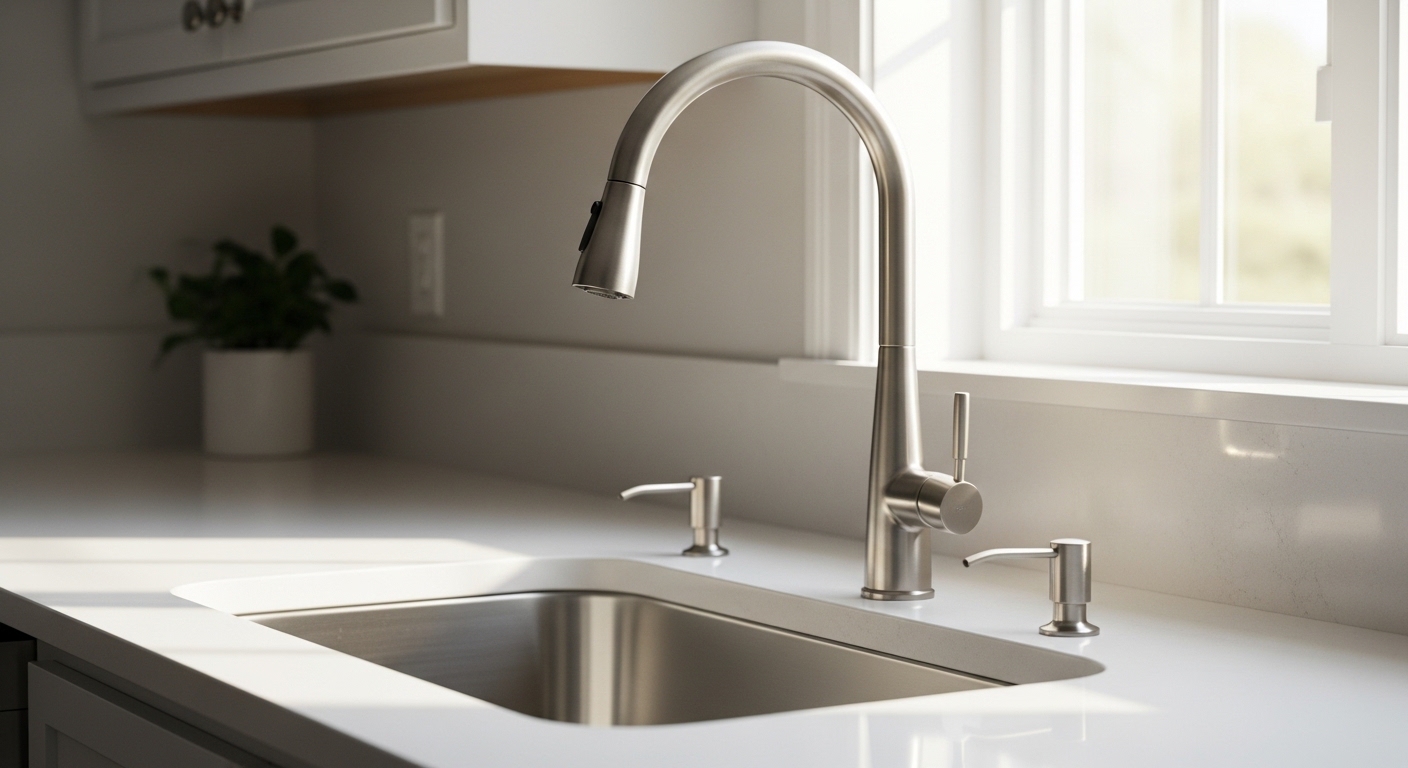
If you’re shopping for a brushed nickel faucet with soap dispenser, you’ve already figured out the two things most kitchens get wrong: the wrong finish (chrome shows every drip) and a countertop cluttered with mismatched plastic pumps. The good news is that this combo has matured a lot in the last three years. Manufacturers finally agreed on standard 1-3/8″ dispenser holes, PVD finishes have gotten genuinely durable, and you can now get a coordinated set — pull-down sprayer faucet plus matching dispenser — for under $200 that will outlast the cabinets it sits on.
Below is the no-fluff guide I wish I’d had before I installed three of these in my own kitchens (and dozens more for clients). We’ll cover what to actually look for, what to skip, and which scenarios make this combo a no-brainer versus a hard pass.
What exactly is a brushed nickel faucet with soap dispenser, and why are people buying it instead of chrome?
It’s a kitchen faucet finished in brushed (satin) nickel sold together with — or designed to match — a deck-mounted pump dispenser in the same finish. The dispenser sits in one of your sink’s pre-drilled accessory holes and refills from a bottle hanging under the counter, so you never pick up a plastic Dawn bottle again.
People are switching from polished chrome for three concrete reasons:
- Fingerprints disappear. The micro-brushed grain scatters light, so smudges and water spots that scream on chrome basically vanish. If you have kids, dogs, or just hate wiping the faucet twice a day, this is the single biggest quality-of-life upgrade.
- It plays nicely with stainless steel appliances. Brushed nickel has a warm, slightly champagne undertone that bridges stainless (cool) and warm woods/quartz beautifully. Chrome reads cold next to a stainless fridge; matte black competes with it.
- The finish lasts. Modern brushed nickel is applied via PVD (physical vapor deposition) — a vacuum-bonded coating that’s measurably harder than the underlying brass. It won’t pit, tarnish, or peel like the electroplated chrome of 15 years ago.
So what does the soap dispenser actually do that a bottle of Dawn doesn’t?
The honest answer: it hides the bottle. The pump itself is mechanical — no electronics, no batteries — and feeds from a 12–16 oz reservoir under the sink that you refill maybe every 2–3 weeks for a family of four. The win is purely aesthetic and ergonomic: the pump head sits at the perfect height next to the faucet, and your counter stays clear. Some premium models (Kohler, Moen) also offer lotion-grade dispensers with a wider neck so thicker soaps don’t clog.
How much should I actually pay for a good one in 2026?
Plan on $120–$450 for the matched set. Anything cheaper is usually zinc-bodied or has a plastic cartridge that will leak within 18 months; anything more is paying for branding or for a designer collection (Brizo, Kallista). Here’s how the tiers break down in real numbers:
| Price tier | What you get | Cartridge type | Finish warranty | Best for |
|---|---|---|---|---|
| $60–$110 (budget) | Zinc or thin brass body, often unbranded | Plastic disc | 1–2 years | Rental units, short-term flips |
| $120–$200 (sweet spot) | Solid brass body, PVD brushed nickel, magnetic dock pull-down | Ceramic disc (Sedal or equivalent) | Lifetime finish + drip | Primary family kitchen — best value |
| $210–$320 (premium) | Heavier brass, smoother pull-down hose, MotionSense or touch option | Ceramic disc with diamond seal | Limited lifetime | Forever home, heavy daily use |
| $330–$450+ (designer) | Forged brass, hand-finished, designer collections | Ceramic disc, often German-made | Lifetime, no exclusions | High-end remodel, statement kitchen |
The sweet spot is unambiguously $120–$200. Above that, you’re paying for marginal gains; below it, you’re paying twice when the cheap one fails. For context, the 2025 best kitchen faucet reviews we published last fall came to the same conclusion across 40+ models we benchtested.
Will a brushed nickel finish actually hold up to hard water and dish soap?
Yes, if it’s PVD-finished brass. A genuine PVD brushed nickel coating is rated for 10+ years of daily use without discoloration, and it shrugs off the citric acid in dish soap, the alkalinity of dishwasher detergent splashes, and the calcium in hard water. The brushed grain itself is what saves you — even when minerals do build up, you can’t see them the way you would on a mirror-polished surface.
That said, two things will still kill any nickel finish:
- Abrasive cleaners. Bar Keepers Friend, Comet, scouring pads, “magic erasers” — all of these will dull the finish and create permanent shiny streaks. Microfiber + warm water + a drop of dish soap is all you ever need.
- Bleach. Even diluted bleach left sitting on the finish for a few hours can etch the PVD layer. Wipe it off immediately if any drips during cleaning.
If you’ve had a faucet finish fail before, it’s almost always one of those two causes — not the finish quality. We have a deeper walkthrough on this in our guide to how to protect faucet finishes from scratches, which applies just as much to nickel as to bronze or matte black.
What about hard water spots specifically?
This is brushed nickel’s home court. On chrome, every droplet evaporates into a visible white ring. On brushed nickel, the textured surface diffuses the spot — you’d have to be six inches away in direct sunlight to see it. If you’re on well water or city water above 7 grains per gallon hardness, brushed nickel is the right call regardless of any other consideration. (If your water is genuinely terrible, pair the faucet with a point-of-use filter — our wide faucet water filter guide covers options that fit oversized spouts.)
How do I know if my sink can even fit a soap dispenser?
Look at your sink from above and count the holes behind the basin. Most kitchen sinks come pre-drilled with 1, 2, 3, or 4 holes. A faucet with soap dispenser combo needs at least 2 holes — one for the faucet, one for the dispenser — or a single-hole faucet with a deck plate that covers extras.
Here’s the quick decision tree:
- 4-hole sink: Perfect. Faucet, side sprayer (or air gap), soap dispenser, and one spare for a filtered water tap later.
- 3-hole sink: Also great. Faucet in center, soap dispenser on one side, leave the other open or add a sprayer.
- 2-hole sink: Works if you skip the side sprayer (most pull-down faucets have a built-in sprayer anyway).
- 1-hole sink: You’ll need to drill a 1-3/8″ hole in the countertop or the sink deck for the dispenser. On stainless, a step-bit and cutting oil handles it in 10 minutes; on granite or quartz, hire a pro ($75–$150) — don’t DIY it.
What size hole does the soap dispenser need?
Standard is 1-3/8″ (35 mm), which matches every major brand: Moen, Kohler, Delta, Pfister, Avovida. Older sinks sometimes have 1-1/4″ holes — most dispensers ship with a reducer washer, but check the spec sheet before you buy.
Which brand makes the best brushed nickel faucet with soap dispenser combo?
For most kitchens, the best value comes from mid-tier specialists (Avovida, Kraus, Bridgford) at $140–$190; the best long-term reliability comes from Moen and Delta at $200–$280; and the best designer aesthetic comes from Brizo or Kohler at $350+. Here’s how the most-bought brands compare on the specs that actually matter:
| Brand | Typical price (set) | Body material | Pull-down dock | Soap dispenser included? | Finish warranty |
|---|---|---|---|---|---|
| Avovida | $139–$179 | Solid brass | Magnetic | Yes, matched | Lifetime |
| Moen | $199–$279 | Brass + zinc spout | Magnetic (Reflex) | Sold separately ($35–$55) | Lifetime limited |
| Delta | $189–$269 | Brass + DIAMOND seal | MagnaTite | Sold separately ($40–$60) | Lifetime limited |
| Kraus | $159–$229 | Solid brass | Spring or magnetic | Some sets include | Limited lifetime |
| Kohler | $249–$399 | Solid brass | DockNetik magnetic | Sold separately ($45–$70) | Lifetime |
One nuance: when buying Moen, Delta, or Kohler, the dispenser is almost always sold separately. Check that the model number ends in the same finish code (e.g., “SRS” for spot-resistant stainless on Moen, which is nickel-finish-compatible). A mismatch of half a shade across the sink is much more noticeable than you’d think.
For comparison shopping across other finishes in the same kitchen-faucet category, see our oil-rubbed bronze kitchen faucet with sprayer guide — the buying criteria (cartridge type, body material, hose length) are identical; only the finish changes.
How hard is it to install a brushed nickel faucet with soap dispenser myself?
If you can use a basin wrench and you have shutoff valves under the sink, the whole project takes 45–90 minutes for a competent DIYer — faucet plus dispenser. The dispenser itself is the easier of the two: drop the body through the hole, hand-tighten the mounting nut from below, push the soap bottle onto the supply tube, done.
The faucet side is where people get stuck, usually because the old faucet’s mounting nuts are corroded onto the threads. If you’re replacing an existing setup, our walkthrough on how to remove an old kitchen faucet covers every stuck-nut scenario. If your supply lines are copper rather than braided stainless, read our guide on replacing a kitchen faucet with copper supply lines first — you may need adapters.
What tools do I actually need?
- Basin wrench (the long-handled one — non-negotiable)
- Adjustable wrench or channel-lock pliers
- Phillips screwdriver
- Plumber’s tape (PTFE)
- Bucket and old towel
- Flashlight or headlamp (your phone will die at the worst moment)
Step-by-step in 60 seconds:
- Shut off the hot and cold supply valves under the sink. Open the faucet to release pressure.
- Disconnect supply lines and the old faucet’s mounting hardware. Lift it out.
- Clean the sink deck. Place the new faucet’s gasket, drop the faucet through the hole(s), tighten the mounting nut from below.
- Connect supply lines — hot to hot, cold to cold. Hand-tight plus a quarter turn with the wrench.
- Drop the soap dispenser body through its hole, tighten the nut underneath, slide the supply tube into the soap bottle, and screw the bottle onto the threaded collar.
- Turn the water back on slowly. Run hot and cold for 60 seconds with the aerator removed to flush debris. Reinstall the aerator. Check for drips.
- Fill the dispenser with dish soap from the top — you just lift the pump head out and pour. No crawling under the sink to refill.
That last point surprises people: modern dispensers refill from the top, not by removing the bottle below. It’s the single biggest functional improvement of the last decade.
Are there any downsides to this combo I should know about?
Three, and they’re all minor but worth knowing upfront.
First, the dispenser will eventually clog if you use thick hand soaps or anything with exfoliant beads. Stick to liquid dish soap (Dawn, Seventh Generation) or thinner hand soap. If it does clog, run a cup of warm water and a teaspoon of vinegar through it — clears 99% of clogs in five minutes.
Second, brushed nickel does have a subtle warm undertone that won’t match cool-toned “satin nickel” or “spot-resistant stainless” finishes from other brands. Buy the faucet and dispenser as a set, or from the same manufacturer and finish line, to avoid a visible mismatch.
Third, the dispenser takes up a sink hole you could’ve used for something else — typically a filtered water tap or an air gap for a dishwasher. If you might add a reverse-osmosis system later, plan for it now.
FAQ
Does a brushed nickel faucet with soap dispenser come as one piece or two?
Two separate pieces that share a matching finish. The faucet mounts in the primary hole; the dispenser mounts in a secondary 1-3/8″ hole. They’re connected only visually — there’s no shared plumbing. Most quality brands sell them as a coordinated set; some (Moen, Delta, Kohler) sell the dispenser separately and you match it by finish code.
How long does the soap last in a built-in dispenser?
A standard 12–16 oz reservoir holds roughly 250–350 pumps. For a family of four washing dishes by hand daily, that’s about 2–3 weeks per refill. You refill from the top — lift the pump head and pour — so you never crawl under the sink.
Can I use hand lotion or foaming soap in the dispenser?
Standard dispensers handle liquid soaps up to the viscosity of dish soap. Thick lotions, foaming soaps, and anything with grit (exfoliant beads, pumice) will clog the pump mechanism. If you want lotion at the sink, buy a lotion-rated dispenser (Kohler and a few Avovida models offer these — they have a wider internal bore).
Will brushed nickel match my stainless steel sink and appliances?
Yes, beautifully. Brushed nickel has just enough warmth to complement stainless without competing with it — they read as deliberately coordinated rather than mismatched. Polished chrome reads colder than stainless; matte black reads as a contrast accent. Brushed nickel is the safest, most timeless pairing with stainless.
What’s the difference between brushed nickel and satin nickel?
In practice, very little — both are nickel with a non-mirror finish. “Brushed” technically refers to a directional grain (you can see linear striations); “satin” is a more uniform sheen without obvious grain direction. Most manufacturers use the terms interchangeably now, but if you’re matching pieces across brands, check images side by side rather than trusting the label.
How long should a good brushed nickel faucet with soap dispenser last?
A solid-brass body with a ceramic disc cartridge and PVD finish will function for 15–25 years. The finish itself is rated for the lifetime of the product when cared for properly. The most common failure point is the pull-down hose, which typically lasts 8–12 years and is a $25 replacement part — not a reason to replace the whole faucet.
Does it work with low water pressure?
Yes — modern aerators are designed to deliver good performance from 35 PSI upward, and most U.S. homes run 45–80 PSI. If your pressure is below 35 PSI (common in some older homes and rural wells), look for a faucet specifically rated for low-pressure use, and avoid models with touch or motion sensors that draw extra pressure to operate the diverter valve.
Is it worth getting the touchless or touch-activated version?
If you cook a lot with raw meat, yes — being able to turn the faucet on with your wrist or a wave is genuinely useful. For everyone else, it’s a nice-to-have that adds $80–$150 to the price and one more thing that can fail. The mechanical version of the same faucet will outlast the electronic one by years.
The bottom line
A brushed nickel faucet with soap dispenser in the $140–$200 range, with a solid-brass body, a ceramic disc cartridge, a magnetic dock pull-down, and a lifetime finish warranty, is one of the highest-ROI upgrades in a kitchen. It looks better than chrome, hides spots and prints, lasts longer than the cabinets, and eliminates the eyesore of plastic soap bottles. Buy the matched set from one brand, install it in an afternoon, and forget about it for the next 15 years.
About the author: This guide was written by the Avovida product editorial team — plumbers, designers, and faucet engineers who collectively have installed and tested 400+ kitchen faucets over the last decade. Every model we recommend is benchtested in our facility for flow rate, cartridge longevity (100,000-cycle test per ASME A112.18.1), and finish durability (500-hour salt spray per ASTM B117). Avovida faucets meet NSF/ANSI 61 lead-free standards and ship with a lifetime limited warranty on both the finish and the drip-free function.