
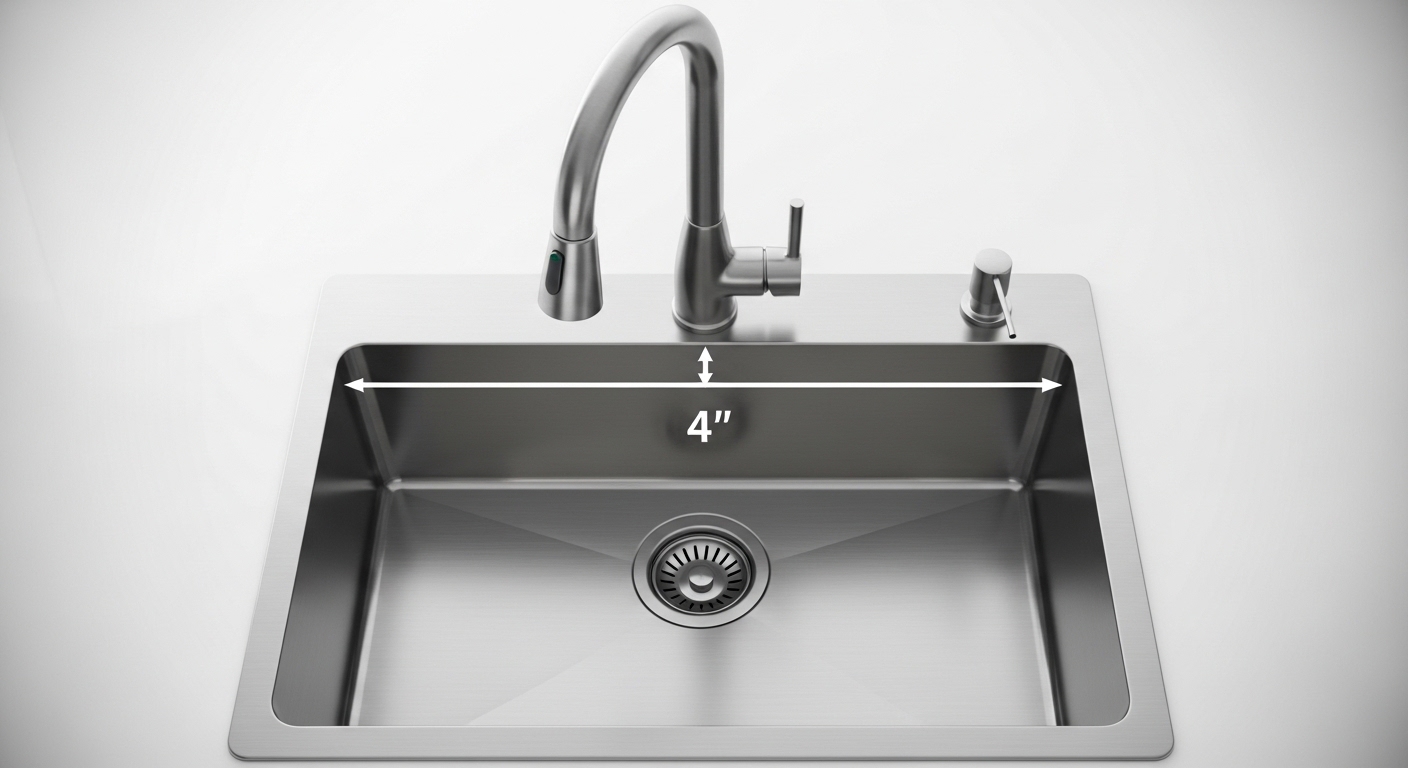
If you’re deciding how far should a soap dispenser be from the faucet before you drill a hole or order a deck-mounted pump, the short answer is 3 to 6 inches of horizontal spacing, measured center-to-center from the faucet base to the dispenser. That range works for the vast majority of kitchen and bathroom sinks, and it’s the spacing designed into most three- and four-hole sink layouts. Below, we’ll walk through exactly why that number works, how to adjust it for your specific sink, and what changes when you’re dealing with a farmhouse sink, a vessel basin, or a touchless setup.
At avovida, we spend our days matching faucets, pumps, and accessories to real sinks, so this isn’t guesswork — it’s the same spacing logic our team uses when we help customers lay out a fixture set that actually works day to day.
What’s the ideal distance between a soap dispenser and faucet on a standard sink?
On a standard drop-in or undermount sink with pre-drilled holes, the ideal distance is whatever your factory hole spacing already gives you — usually 4 inches on center for a widespread-style deck, or the outer holes of a 4-hole configuration. If you’re drilling into stainless steel or a solid-surface deck yourself, aim for 3 to 6 inches between the faucet and the dispenser.
Here’s the reasoning. Too close (under 2 inches) and the dispenser’s pump head or nozzle physically fights the faucet handle when you turn the water on. Too far (over 8 inches) and you have to stretch or take a step, which defeats the whole point of a deck-mounted pump — one-handed soap while the water runs. The 3-to-6-inch sweet spot keeps everything inside a comfortable hand’s reach.
A few placement rules that matter more than the exact inch count:
- Same side as your dominant hand. Right-handed users pump with the right hand while the left rinses — so mount the dispenser to the right of the faucet.
- Nozzle clears the sink, not the deck. The dispenser spout should dispense soap over the basin, not onto the counter. Check the nozzle reach before you commit.
- Handle swing has room. Single-handle faucets swing side to side. Make sure the handle’s full arc never collides with the pump.
- Away from the sprayer. If you have a pull-down or side sprayer, put the dispenser on the opposite side so it doesn’t get in the way of the hose.
Why does the 3–6 inch spacing actually matter?
It matters because a soap dispenser is a one-handed tool, and one-handed reach has a real geometry to it. Your thumb and fingers can comfortably operate a pump within roughly a 6-inch radius of where your hand already is — under the faucet stream. Push the dispenser past that and you break the flow: you stop rinsing, reach over, pump, and come back. That tiny friction is exactly what a good layout eliminates.
There’s also a clearance issue people don’t think about until it’s too late. Faucet bodies have a footprint — an escutcheon (the base plate) that can be 2 to 3 inches wide, plus handles that stick out or swing. A deck-mounted soap pump has its own body and a lever or push-top that travels when you press it. If you set them 2 inches apart, those moving parts overlap. We’ve seen customers drill a hole only to find the pump handle taps the faucet handle every single time. Six inches of breathing room prevents that entirely.
Finally, spacing affects splash and drip. A dispenser mounted right at the spout tends to catch overspray and stay wet and slimy. Nudging it a few inches to the side keeps the pump head cleaner and the soap flowing.
How does distance change for a bathroom sink vs a kitchen sink?
Bathroom sinks generally want the dispenser closer — around 3 to 4 inches — because the basin is smaller and your hands stay in a tighter zone. Kitchen sinks can go a little wider — 4 to 6 inches — because the deck is bigger, the faucet is taller, and you often have a sprayer or air gap competing for space.
The difference comes down to how each sink is used. At a bathroom lavatory you wash your hands in one spot, so the dispenser should be almost within the same footprint as the faucet. In the kitchen you’re rinsing produce, filling pots, and cleaning up, so the layout has more moving pieces and the dispenser gets pushed toward the edge of the reachable zone.
Vessel sinks are their own case. Because the bowl sits on top of the counter, a deck-mounted dispenser goes into the countertop beside the faucet — keep it 4 to 6 inches away and make sure the nozzle still reaches over the rim of the bowl. If you’re already navigating vessel-sink height and reach issues, our guide to the best long spout reach bathroom faucet covers how spout geometry and accessory placement work together on a raised basin.
Standard spacing at a glance: which sink layout are you working with?
Most of the confusion around dispenser placement disappears once you know your sink’s hole configuration. Here’s how the common setups line up with the right distance.
| Sink type / layout | Typical faucet-to-dispenser distance | Best dispenser mounting | Watch out for |
|---|---|---|---|
| Kitchen 4-hole (8″ spread) | 4–6 in | Outer deck hole, dominant-hand side | Leave a hole free for sprayer/air gap |
| Kitchen single-hole + deck plate | 4–5 in | Drill new hole or use accessory hole on plate | Confirm deck plate covers extra hole if unused |
| Bathroom 3-hole (4″ centerset) | 3–4 in | One of the outer handle holes if going single-handle | Handle clearance on a centerset |
| Bathroom single-hole / vessel | 4–6 in | Countertop drill beside faucet | Nozzle must clear the bowl rim |
| Farmhouse / apron sink | 4–6 in | Countertop behind the sink | Deep basin — check pump tube length |
One important note on drilling: cutting a new hole in a stainless deck, granite, or quartz countertop is permanent and material-specific. Stainless takes a step bit; stone needs a diamond hole saw and water cooling. If you’re not confident, this is the one step worth a pro — a cracked quartz countertop costs far more than a plumber’s hour.
What kind of soap dispenser should you buy for the spacing you have?
Buy the dispenser that fits both your hole size and your reach. Deck-mounted pump dispensers need a hole roughly 1 to 1.5 inches in diameter and a tube long enough to reach a refill bottle under the sink; countertop pumps need no hole at all and can sit anywhere within reach; touchless/automatic dispensers give you the most freedom because there’s no handle to clash with the faucet.
Here’s how the three main types compare for placement flexibility and everyday use.
| Dispenser type | Placement flexibility | Ideal distance from faucet | Best for |
|---|---|---|---|
| Deck-mounted pump | Fixed once drilled | 3–6 in | Clean built-in look, large under-sink refill bottle |
| Countertop pump bottle | Move anytime | 3–8 in (flexible) | Renters, no-drill setups |
| Touchless automatic | Move anytime, no handle clash | 3–8 in (flexible) | Hygiene, kids, messy-hands moments |
| Wall-mounted dispenser | Fixed once mounted | Above/beside, 6–10 in | Small decks, commercial-style setups |
Finish matters as much as function. A soap dispenser sitting inches from your faucet is in the same eyeline, so it should match the faucet finish — brushed nickel with brushed nickel, matte black with matte black, champagne bronze with champagne bronze. A mismatched pump next to a beautiful faucet reads as an afterthought. If you’re building a coordinated look, our breakdown of a freestanding tub filler that matches Delta champagne bronze shows how to think about finish-matching across a whole fixture set, and the same logic applies to a deck dispenser.
For a built-in pump, also check the pump mechanism itself — a metal pump head lasts far longer than a plastic one, which tends to crack or clog with thick soaps. If you like the idea of a deck accessory but are still wiring up the sink itself, it’s worth understanding your chrome faucet parts first, because the dispenser shank, washer, and mounting nut install almost exactly the way a faucet’s do.
How do you install a deck-mounted soap dispenser at the right distance?
Installing a deck-mounted dispenser takes about 20 minutes if you already have a hole, or an hour if you’re drilling. The dispenser drops through the deck hole, gets secured from below with a mounting nut, and connects to a refill bottle that sits in the cabinet.
- Mark your spot. Measure 3–6 inches from the faucet center, on your dominant-hand side, and confirm the pump handle clears the faucet handle’s full swing.
- Check clearance below. Look under the sink to make sure no bracket, sprayer hose, or garbage-disposal body sits directly under your chosen spot.
- Drill only if needed. Use a step bit for stainless or a diamond hole saw for stone, going slow and keeping the surface cool. Deburr the edge.
- Insert the dispenser. Drop the shank through the hole, add the washer and mounting nut from below, and hand-tighten plus a quarter turn with pliers.
- Attach the bottle. Thread or clip the refill bottle onto the tube. Fill it, then prime the pump with several presses until soap flows.
If you’re comfortable working under a sink, this is genuinely a DIY job — the mechanics are the same fittings-and-washer routine you’d use on a small faucet repair, so if you’ve ever tackled something like a leaking tap valve, you already have the skills for this.
Common placement mistakes (and how to avoid them)
The single most common mistake is mounting the dispenser too close to the faucet so the handles collide — always dry-fit and test the handle swing before you drill. The other frequent errors are all easy to dodge once you know them:
- Wrong side. Mounting on the non-dominant side forces an awkward cross-body reach every time. Match it to the hand you rinse with.
- Nozzle over the counter. If the pump spout doesn’t reach past the sink edge, every use leaves a soap puddle on the deck.
- Ignoring the sprayer. Putting the dispenser where a pull-down hose retracts means the two constantly interfere.
- Short refill tube. On a deep farmhouse or apron sink, a stock tube may not reach a bottle sitting on the cabinet floor. Check the tube length against your basin depth.
- Finish mismatch. A chrome pump beside a matte-black faucet stands out for the wrong reason.
Author note, brand credibility & standards
Written by the avovida fixtures team. avovida is a dedicated faucet and bathroom-fixtures retailer, and our product specialists lay out faucet-and-accessory combinations for real customer sinks every week. The spacing recommendations here reflect the hole configurations used across the major North American sink and faucet lines — the same 4-inch centerset and 8-inch widespread standards that govern where handles, sprayers, and dispensers land.
On the hardware side, look for dispensers and faucets that meet recognized plumbing and material standards. Fixtures that carry ASME A112.18.1 / CSA B125.1 compliance (the standard covering plumbing supply fittings) and lead-content certification under NSF/ANSI 372 are built to the specs that count for anything touching your sink. And always register the warranty — quality deck dispensers and faucets often carry limited lifetime warranties on finish and mechanical function, but coverage typically only applies if you keep proof of purchase and follow the installation instructions.
FAQ
Can a soap dispenser be right next to the faucet?
It can be adjacent, but leave at least 2 to 3 inches of clearance. Directly touching or within an inch of the faucet usually means the pump handle collides with the faucet handle, and the dispenser catches constant overspray, which keeps the pump head wet and grimy. Three inches is the practical minimum.
Which side of the faucet should the soap dispenser go on?
Put it on your dominant-hand side. If you’re right-handed, mount the dispenser to the right of the faucet so you can pump with your right hand while your left hand rinses under the stream. Left-handed users should mirror that and mount it on the left.
What size hole do I need to drill for a deck-mounted soap dispenser?
Most deck dispensers need a hole about 1 to 1.5 inches in diameter — check the spec sheet for your exact model. Use a step drill bit for stainless steel decks and a diamond hole saw with water cooling for granite or quartz countertops. Always deburr the edge before inserting the dispenser.
How far should a soap dispenser be from the faucet on a farmhouse sink?
Keep the same 4 to 6 inches of horizontal spacing, but mount the dispenser in the countertop behind the sink rather than on the apron. Because farmhouse basins are deep, double-check that the dispenser’s refill tube is long enough to reach a bottle sitting on the cabinet floor.
Do I need a soap dispenser hole in my sink, or can I use a countertop pump?
You don’t need a drilled hole. A countertop or touchless pump bottle sits anywhere within reach and requires no drilling, which makes it ideal for renters or for anyone who doesn’t want to cut into a stone counter. A deck-mounted pump only makes sense if you want the clean built-in look and a large hidden refill bottle.
Should the soap dispenser match my faucet finish?
Yes — because the dispenser sits inches from the faucet in the same eyeline, matching the finish (brushed nickel, matte black, chrome, champagne bronze, etc.) makes the whole sink look intentional. A mismatched pump is one of the most noticeable and easily avoided design slips at a sink.