
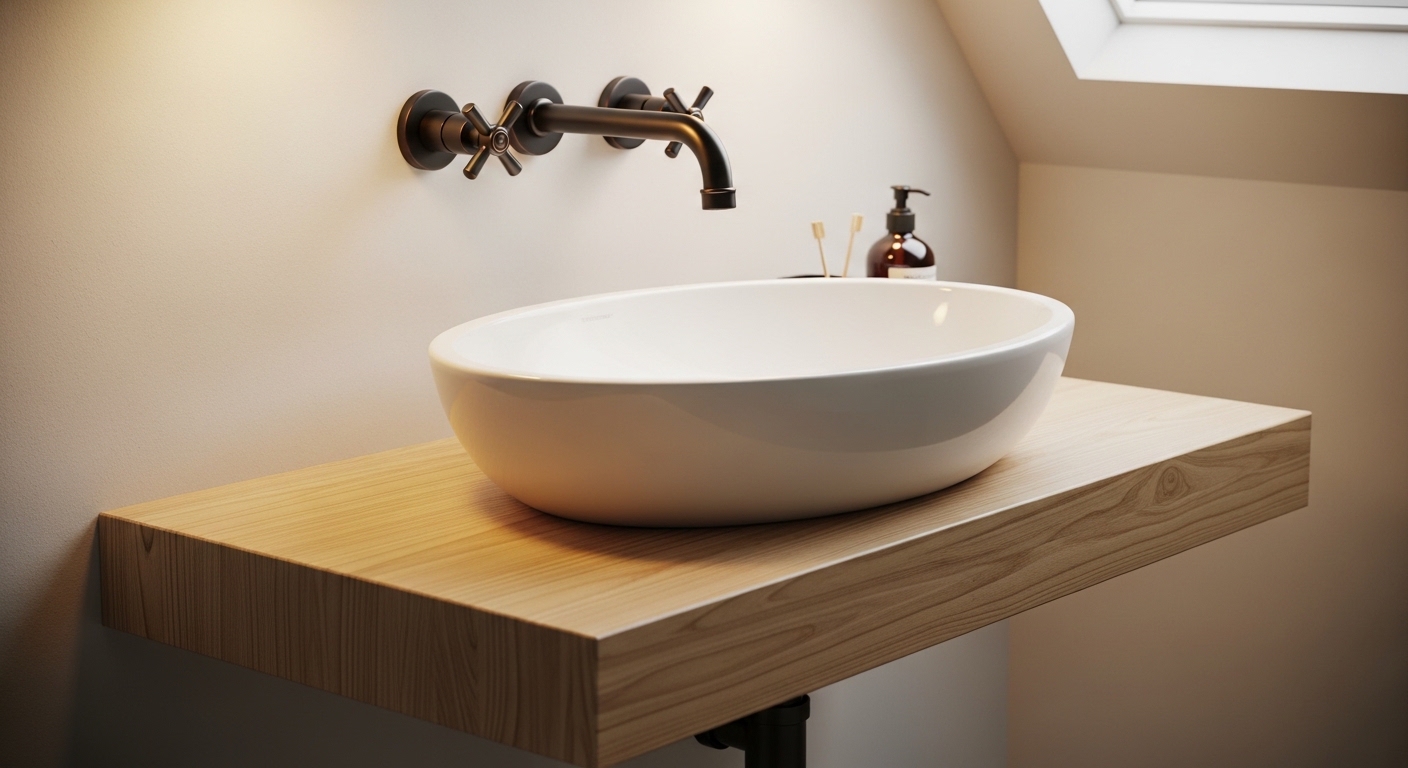
A wall mount faucet oil rubbed bronze setup mounts the spout and handles directly into the wall above your sink instead of through the countertop or basin, and the oil rubbed bronze (ORB) finish gives it a dark, aged-copper warmth that reads as vintage, farmhouse, or industrial depending on the rest of your room. It’s one of the most-searched bathroom looks for a reason: it pairs beautifully with vessel bowls and stone basins, keeps your counter clear and easy to wipe, and the living finish forgives the water spotting that plagues chrome. But it’s also one of the easiest configurations to get wrong at the plumbing stage — so this guide walks through who it’s actually for, how to size it, what to pay, and how to keep the finish looking good for years.
At avovida, we test faucets across finish durability, valve life, and real-world install headaches, and wall mount ORB comes up constantly from readers renovating powder rooms and primary baths. Here’s the honest breakdown.
What exactly is a wall mount faucet, and why choose oil rubbed bronze?
A wall mount faucet is a faucet where the spout and handles come out of the wall rather than the sink deck or countertop. The plumbing (valves and supply lines) lives inside the wall, and only the trim — spout, handles, escutcheons — shows on the finished surface. Oil rubbed bronze is a dark brown-black finish with subtle copper undertones, usually applied over brass, that’s designed to look aged and develop character over time.
People choose this combination for three concrete reasons. First, it clears the counter — nothing is drilled through your vanity top or basin, so cleanup is a single wipe with no faucet base to scrub around. Second, ORB is forgiving: unlike polished chrome, it doesn’t broadcast every water spot, fingerprint, or bit of toothpaste, which is why it’s popular with families and in hard-water regions. Third, it’s a design anchor. A dark faucet floating above a light basin is a deliberate, high-contrast look that pulls a bathroom together far more than a deck faucet blending into a countertop.
The trade-off is commitment. Because the valves are inside the wall, a wall mount faucet is much harder to swap later than a deck-mounted one — you’re opening the wall if the rough-in is wrong. That’s why sizing matters more here than with any other faucet type.
Is a wall mount oil rubbed bronze faucet worth it for a vessel sink?
Yes — a vessel sink is arguably the single best use case for a wall mount ORB faucet, because tall vessel bowls make deck-mounted faucets awkward. Vessel sinks sit on top of the counter, so a standard deck faucet would need an unusually tall body to clear the rim and still pour into the bowl. A wall mount faucet sidesteps that entirely: you set the spout height above the basin rim and let the water fall in cleanly.
The key spec is spout reach and spout height. You want the spout to pour into roughly the center of the bowl, not the back edge, and to sit high enough to fit your hands under it comfortably. As a rule of thumb:
- Spout height above basin rim: 3–6 inches of clearance so you can wash your hands without knocking the spout.
- Spout reach (horizontal): enough to land water past the halfway point of the bowl — for most vessels that’s 5–7 inches, and for wider or deeper bowls up to 9 inches.
- Mounting height: plan the wall valve rough-in so the finished spout sits about 4–6 inches above the top of the basin.
If your basin is especially deep or you’re using a trough-style or oversized bowl, read our deep dive on choosing a long spout reach bathroom faucet for a deep or vessel sink before you commit to a reach measurement — getting this number wrong is the most common vessel-sink regret.
How much does a good wall mount faucet in oil rubbed bronze cost in 2026?
Expect to pay between $60 and $400 for a wall mount faucet oil rubbed bronze trim kit in 2026, with the sweet spot for a durable, solid-brass model around $130–$220. The wide range comes down to what’s under the finish and whether the valve is included. Here’s how the tiers break down:
| Price tier | Typical body material | What you get | Best for |
|---|---|---|---|
| $60–$110 | Zinc alloy or thin brass | ORB coating (often painted), lighter weight, shorter warranty | Rental units, low-use powder rooms |
| $130–$220 | Solid brass | Ceramic disc cartridge, genuine plated/aged ORB, 5+ year warranty | Primary bathrooms, daily use |
| $250–$400 | Heavy solid brass | Premium hand-applied living finish, brand-name valve, lifetime warranty | Design-forward remodels, heirloom look |
A few cost notes worth knowing. Some wall mount faucets sell the trim (what you see) separately from the rough-in valve (what’s in the wall), so a $150 “faucet” may need a $40–$80 valve body on top. Always check whether the listing is trim-only. Also, be wary of very cheap ORB: at the bottom tier the finish is often a sprayed coating rather than a plated or genuinely oxidized surface, and it can chip or wear at the spout tip within a year or two. If you’re weighing a budget metal, our comparison of a zinc bathroom faucet versus spending more on brass explains exactly where the corners get cut.
Oil rubbed bronze vs. other dark finishes: which lasts longest?
Oil rubbed bronze is a “living finish,” meaning it’s meant to change and patina over time, while matte black and bronze-toned PVD finishes are engineered to stay uniform. Neither is objectively better — it depends on whether you want your faucet to age or stay put. Here’s how the popular dark finishes actually compare for a wall mount install:
| Finish | Look | Ages over time? | Hides water spots? | Notes |
|---|---|---|---|---|
| Oil Rubbed Bronze (ORB) | Warm dark brown-black with copper undertones | Yes — high points lighten to copper | Excellent | Classic, vintage/farmhouse; slight color variation between brands |
| Matte Black | Flat, true black | No | Very good | Modern; can show dried water film in hard water |
| Bronze PVD | Consistent dark bronze | No | Excellent | Most durable coating; premium price |
| Champagne/Brushed Bronze | Warm light gold-bronze | No | Good | Softer, lighter look; not the same dark ORB vibe |
The single most important buying tip: match all your metals to the same finish family and, ideally, the same brand. “Oil rubbed bronze” is not a standardized color — one maker’s ORB leans nearly black, another’s shows heavy copper. If your drain, towel bar, and mirror frame are ORB from a different line than your faucet, they may not match. Buy the faucet, drain assembly, and any exposed pop-up together when you can.
How do you install a wall mount faucet without opening the wall twice?
The secret to a clean wall mount install is getting the rough-in valve placement exactly right during the plumbing (rough-in) stage, because once the wall is closed and tiled, moving it means demolition. If you’re building new or opening the wall anyway, this is very doable for a confident DIYer; if the wall is finished and dry, it’s usually a plumber job.
- Confirm hole spacing first. Wall mount faucets come in fixed center-to-center dimensions (commonly 8 inches for widespread-style, or single-hole). Buy the faucet before you rough in so you set the valves to match its exact spacing.
- Set the height off the finished basin. Mark where the top of the sink will sit, then place the spout 4–6 inches above that. Remember to account for the thickness of the finished wall (tile + backer) when you set valve depth.
- Rough in the valves and cap them. Pressure-test before closing the wall — a leak behind tile is the nightmare scenario.
- Close, tile, then install the trim. The escutcheons and spout mount over the finished surface; seal around each penetration with clear silicone.
- Check reach and drainage. Run water and confirm the stream lands where you want in the bowl.
Because valve depth is set relative to the finished wall, this is closely related to the same rough-in logic used elsewhere in the bathroom — the principles in our guide to the correct shower valve rough-in height apply directly to thinking through faucet valve depth and height. Measure twice, rough in once.
Will oil rubbed bronze hold up in a hard-water bathroom?
Yes — oil rubbed bronze is one of the better finishes for hard water because its dark, matte surface hides the white mineral spotting that makes chrome and polished finishes look dirty. That said, hard water doesn’t care what color your faucet is: the minerals still deposit, they’re just less visible. Over months, calcium can build up at the spout tip and around the aerator even if you can’t see spotting on the body.
To keep a wall mount ORB faucet looking its best:
- Wipe the spout dry after heavy use — a quick pass with a soft cloth prevents mineral crust at the tip.
- Never use abrasive pads, scouring powders, or acidic descalers directly on ORB — they can strip the finish, especially on coated (non-living) versions.
- Clean the aerator every few months by unscrewing it and soaking in a mild vinegar solution (keep vinegar off the finish itself; rinse the aerator separately).
- For genuine living-finish ORB, embrace the aging — the lightening at handles and spout is a feature, not a flaw.
Because ORB — particularly budget coated versions — can scratch or wear at contact points, it’s worth reading our tips on how to protect faucet finishes from scratches before your first cleaning. And if you love the finish in the bathroom and are considering it for the kitchen too, our 2026 buyer’s guide to oil rubbed bronze kitchen faucets with a sprayer covers the higher-abuse kitchen environment where finish durability matters even more.
What to look for on the spec sheet before you buy
Before you check out, confirm these specs match your basin and your wall. Skipping any one of them is how people end up returning faucets.
- Configuration: single-hole vs. widespread (two handles + spout). Widespread ORB reads more traditional; single-lever reads modern.
- Hole spacing: the center-to-center dimension must match your rough-in — 8 inches is common for widespread.
- Spout reach & height: sized to your specific basin (see the vessel-sink section above).
- Body material: solid brass for longevity; be cautious with unbranded zinc at the low end.
- Cartridge: ceramic disc valves last longest and drip least.
- Flow rate: 1.2 GPM is standard for bathroom lavatory faucets in most U.S. regions; check local code (WaterSense-labeled models cap at 1.5 GPM or less).
- Warranty: look for a genuine finish-and-function warranty, not just parts.
A note on standards and testing: for U.S. installs, look for faucets certified to NSF/ANSI 61 and NSF/ANSI 372 (lead-free) and, ideally, ASME A112.18.1 / CSA B125.1 — these cover material safety and mechanical durability, and reputable ORB faucets carry them. A finish backed by a multi-year or lifetime warranty is a strong signal the maker trusts its ORB not to peel. At avovida we weight certified, warranty-backed models heavily in our recommendations precisely because wall mount faucets are so costly to replace after the wall is closed.
FAQ
Can I put a wall mount oil rubbed bronze faucet over a regular drop-in sink?
Yes, but you need to plan the height carefully. Wall mount faucets work over drop-in and undermount sinks as long as the spout reach and height are set so water lands in the basin, not on the counter or the back rim. Because the faucet’s height is fixed in the wall, you can’t adjust it later — so mock up the sink position first, then set the valve height to give roughly 4–6 inches of spout clearance above the sink.
Does oil rubbed bronze turn green or corrode over time?
Genuine oil rubbed bronze doesn’t turn green like raw copper; it lightens at high-touch points to reveal warmer copper tones underneath, which is the intended patina. True corrosion or green verdigris is rare on quality brass-bodied ORB. If a cheap coated faucet flakes or discolors unevenly, that’s finish failure, not natural patina — another reason to choose solid brass with a real warranty.
Is a wall mount faucet harder to fix than a deck faucet if it leaks?
The trim is just as easy to service, but the in-wall valve is harder to access. Most drips are cartridge issues, and on many wall mount faucets you can replace the cartridge from the front through the trim without opening the wall. If the actual valve body fails, though, you may need wall access. Our general guide on fixing a leaking tap valve yourself covers the cartridge-swap basics that apply to most wall mount faucets too.
What size spout reach do I need for a wall mount faucet?
For most bathroom basins, a spout reach of 5–7 inches lands water near the center of the bowl. Go longer — up to 9 inches — for wide, deep, or trough-style vessel sinks, and shorter for compact powder-room basins. The goal is water hitting past the halfway point of the bowl so it doesn’t splash off the back rim.
Single-hole or widespread wall mount ORB — which should I pick?
Pick widespread (two handles plus a separate spout) for a traditional, vintage, or farmhouse look, and single-hole with one lever for a modern, minimal look and easier cleaning. Widespread gives you separate hot/cold control and a more classic ORB aesthetic; single-lever is simpler to operate one-handed. Both require matching your rough-in to the faucet’s hole configuration.
Will the oil rubbed bronze faucet match my other bronze fixtures?
Not always — “oil rubbed bronze” isn’t a standardized color, so shades vary between brands. To guarantee a match, buy your faucet, drain, and exposed accessories from the same product line, or at minimum the same manufacturer. When mixing brands, order samples or check return policies, because one company’s ORB can look noticeably lighter or more coppery than another’s.
Author note: This guide was written and reviewed by the avovida fixtures team, who evaluate bathroom and kitchen faucets for finish durability, valve longevity, and install practicality. avovida is an independent faucet and bathroom-fixtures resource focused on giving buyers honest, spec-driven advice — we prioritize certified, warranty-backed products because we’d rather you buy once than replace twice.