
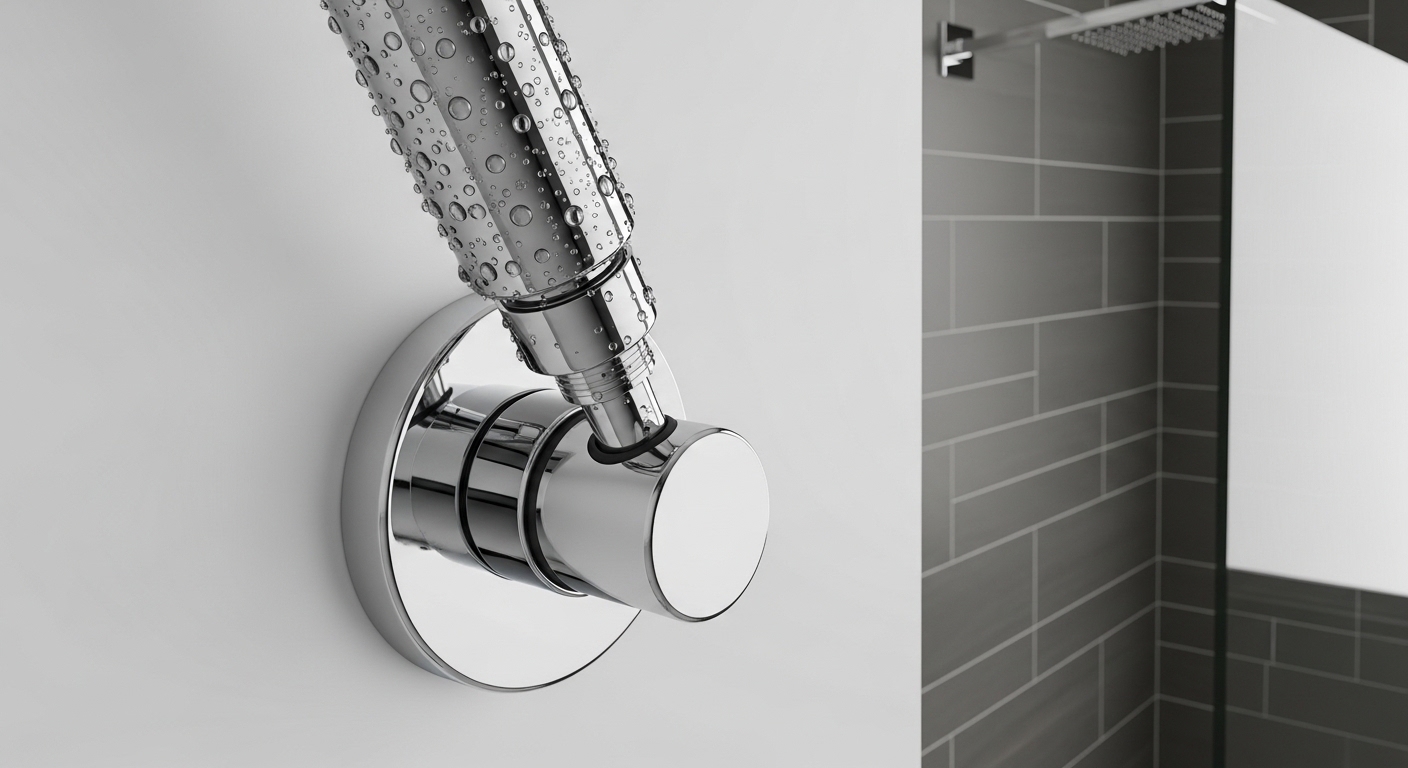
A handheld shower head magnetic dock is a showerhead system where the spray wand attaches to its wall bracket by a strong built-in magnet instead of clipping into a plastic or rubber cradle. You pull the wand off to rinse, scrub the dog, or clean the shower walls, and when you’re done you just bring it close to the bracket — the magnet grabs it and seats it straight, no aiming required. It sounds like a small thing. In daily use it’s the difference between a wand that’s always exactly where you left it and one that slowly sags, twists sideways, or pops out and bangs against the tub.
This guide walks through who actually benefits, what specs matter, how magnetic docks compare to slide bars and standard holders, and the mistakes that make a magnetic showerhead disappointing. By the end you’ll know whether it’s right for your bathroom and exactly what to check before you buy.
What does “magnetic” actually mean on a handheld shower head?
It means the wand and its wall bracket each contain a magnet (or a magnet and a steel plate) that pull together so the wand self-aligns and locks on contact. There’s no clip to line up and no friction collar to wedge the wand into — you just get it within an inch or two of the dock and it snaps home.
Most quality systems use neodymium (rare-earth) magnets, which are far stronger for their size than the cheap ceramic magnets you’ll find in dollar-store products. The magnet sits behind a sealed face on both parts so water never touches the metal — important, because a bare magnet would rust and lose strength. A well-built magnetic handheld shower head will hold the wand even when it’s wet and dripping, and it lets you re-dock the wand at almost any angle, which is the whole point: it works one-handed when your other hand is full of shampoo or a washcloth.
The trade-off is simple. A magnet is a fixed point on the wall, so you generally adjust spray direction by swiveling the wand’s ball joint rather than by sliding the holder up and down. That’s fine for most people but matters if your household has a big height range — more on that below.
Is a magnetic handheld shower head worth it, or is it a gimmick?
It’s worth it for the vast majority of bathrooms — the convenience is real and you feel it every single shower. The “gimmick” reputation comes entirely from weak magnets on cheap units. A strong dock is genuinely better than a standard cradle; a weak one is genuinely worse than a standard cradle. There’s almost no middle ground, which is why the magnet’s pull strength is the single most important spec.
Here’s where a magnetic dock clearly wins:
- One-handed re-docking. You don’t have to look, aim, or twist the wand into a clip. This is the headline benefit and it’s why people who switch rarely go back.
- It stays put. Friction cradles loosen over months as the rubber compresses; the wand starts sagging or pointing at the wrong wall. A magnet doesn’t wear out the same way.
- Kids and shorter users. A child can re-dock a wand they could never wedge into a stiff clip.
- Accessibility. For anyone with limited grip strength or arthritis, “bring it close and let go” beats “press and twist” every time.
- Cleaning the shower. You’ll actually pull the wand down to rinse walls and the tub because putting it back is effortless.
Where it can underwhelm: a unit with a weak magnet, a heavy all-metal wand that overpowers a small magnet, or a household that really needs height adjustment more than one-handed docking. Match the product to your situation and it’s an easy yes.
How strong does the magnet need to be so the wand doesn’t fall off?
Strong enough to hold the wand’s full wet weight with margin to spare — practically, look for a holding force of at least 2–3 pounds of pull, or a manufacturer claim that it holds the wand “fully” or “securely when wet.” A dribble of “lightly holds” language is a red flag.
The reason force matters so much is that the wand’s own weight and the stiffness of the hose are constantly trying to pull it off. A 60–72 inch hose has spring in it; when it’s coiled it tugs sideways on the docked wand. A marginal magnet that “works” in the showroom will start dropping the wand once a real hose is fighting it. So you want headroom, not just barely-enough.
A quick way to sanity-check before buying:
- Wand weight. Heavier all-brass or all-metal wands need a stronger magnet than lightweight ABS ones. Don’t pair a heavy luxury wand with a small budget dock.
- Magnet type. Confirm it’s neodymium/rare-earth, not ceramic.
- Sealed and corrosion-protected. The magnet should be behind a sealed face so water and minerals never reach it.
- Hose length and stiffness. A longer, stiffer hose puts more pull on the dock — favor a stronger magnet if you go 72 inches.
- Reviews that mention “wet.” Look specifically for buyers saying it holds when dripping, not just dry.
Magnetic dock vs. slide bar vs. standard cradle — which should I buy?
Pick a magnetic dock if you value effortless one-handed re-docking; pick a slide bar if multiple people of very different heights share the shower; pick a basic cradle only if you want the cheapest possible option. Here’s how they stack up.
| Feature | Magnetic dock | Slide bar holder | Standard cradle / clip |
|---|---|---|---|
| One-handed re-docking | Excellent — snaps on automatically | Fair — must seat in bracket | Poor — aim and wedge in |
| Height adjustment | Limited (swivel only) | Excellent — slides up/down | None |
| Stays aligned over time | Excellent | Good | Loosens as rubber wears |
| Best for | Most households, kids, accessibility | Tall + short users sharing | Tight budgets, rentals |
| Install difficulty | Easy (screws on or replaces existing holder) | Moderate (longer bar to mount) | Easy |
| Typical price range | $25–$80 | $40–$120 | $10–$30 |
Honestly, many people get the best of both worlds by mounting a magnetic dock on a slide bar, so you keep height adjustment and gain the snap-on convenience. If you’re already planning the wall plumbing, it’s worth confirming your stand up shower valve rough in height so the bar and dock land at a comfortable, code-appropriate level. And whatever finish you choose, it pays to know how to protect faucet finishes from scratches — the wand connector is the part that touches the dock thousands of times, so finish durability there actually matters.
Does a magnetic handheld shower head work with hard water?
Yes — the magnet itself is unaffected by hard water because it’s sealed away from the spray, but hard water still attacks the part you care about most: the spray nozzles. Mineral scale clogs the rubber spray tips and weakens the stream over time, magnet or no magnet.
So if you have hard water, the magnetic dock is a non-issue, but you should prioritize a wand with self-cleaning silicone nozzles (the little rubber nubs you can rub clean with a thumb) and plan on a periodic vinegar soak. If your water is genuinely hard, pairing the showerhead with whole-faucet filtration upstream makes a bigger difference to spray quality and longevity than any single showerhead feature — our wide faucet water filter buyer’s guide covers the filtration side in depth. The magnet keeps working; your job is just keeping the nozzles clear.
What finishes and spray settings should I look for?
Match the finish to your existing shower trim and pick a spray-setting count you’ll actually use — three to six modes covers almost everyone. More settings sounds better on the box but adds little in real use beyond a strong rinse, a gentle rain, and a concentrated massage.
On finish, the popular durable options are:
- Chrome — brightest, cheapest, hides water spots worst but wipes clean easily; matches the most existing trim.
- Brushed nickel — warm, soft sheen, hides water spots and fingerprints best; the safe all-rounder.
- Matte black — bold and modern, but shows hard-water spotting fastest, so it rewards the silicone-nozzle + filtration combo above.
- Brushed gold / champagne bronze — premium look; confirm it’s a PVD-coated finish, which resists wear far better than painted coatings.
For the dock specifically, a metal or metal-faced bracket usually pairs with a stronger, more durable magnet than an all-plastic one. And make sure the wand connector finish is rated for repeated contact — that’s the spot that meets the magnet thousands of times. If you’re coordinating a whole bathroom refresh and weighing premium finishes, the thinking in our deVOL brass faucet guide on when a high-end finish is worth the splurge applies just as well to shower trim.
How do I install a magnetic handheld shower head myself?
You can install one in about 10–15 minutes with no plumber and usually no tools beyond your hands and maybe a screwdriver — it threads onto the same standard ½-inch shower arm any handheld uses, and the magnetic dock either replaces your existing wall holder or screws into the same spot.
- Unscrew your old showerhead from the shower arm by hand or with a wrench wrapped in a cloth to protect the finish.
- Wrap the shower arm threads with a few turns of plumber’s (PTFE) tape, clockwise, to prevent drips.
- Hand-tighten the new diverter/mount or hose connector onto the arm; snug it gently — overtightening cracks plastic fittings.
- Attach the hose to the wand and the supply end, with the rubber washers seated in each connector (this is where most leaks come from — a missing or pinched washer).
- Mount the magnetic dock. If it replaces a screw-in holder, use the existing holes; if it’s an adhesive-and-screw type, follow the height you actually want.
- Run the water and check every joint for drips, then dock the wand to confirm the magnet holds it securely when wet.
That’s it. If you run into older or corroded plumbing behind the wall, that’s a different job — but the showerhead swap itself is firmly DIY territory, on par with the kind of one-handle and two-handle work covered in our leaky two-handle faucet repair guide if you want a sense of comparable difficulty.
How avovida tests and stands behind magnetic shower heads
At avovida, our bathroom-fixtures team evaluates every handheld shower head the way a real household uses it: we dock and re-dock the wet wand hundreds of times to confirm the magnet still seats cleanly and holds, we run the spray under hard-water conditions to watch for nozzle clogging, and we pressure-test hose connections for leaks at typical U.S. residential water pressure (45–80 psi). We favor units whose wetted components meet NSF/ANSI low-lead standards and whose flow rates comply with the federal 2.5 GPM (and WaterSense 2.0 GPM) limits.
We also weight the warranty heavily. A magnetic dock is a long-life mechanism — there’s nothing to wear out if the magnet is properly sealed — so a brand confident enough to back it with a multi-year or limited-lifetime warranty is telling you something real about build quality. We recommend choosing a magnetic handheld shower head backed by at least a 5-year warranty and verifying the magnet is corrosion-sealed before you buy.
FAQ
Will the magnet be strong enough if my shower wand is heavy metal?
Usually yes, but match the dock to the wand. Heavy all-brass or all-metal wands need a higher-rated magnet (look for 3+ lbs of holding force or an explicit “holds metal wands when wet” claim). Pairing a heavy luxury wand with a small budget dock is the most common reason a magnetic showerhead drops the wand.
Can I add a magnetic dock to my existing handheld shower head?
Often, yes — magnetic docks are sold separately, but the wand needs a magnet or steel plate at its connector for the dock to grip. Some aftermarket kits include a small adapter that adds the magnetic interface to a standard wand. If your wand is pure plastic with no metal at the contact point, you’ll get the most reliable result by buying a matched wand-and-dock set.
Does a magnetic handheld shower head reduce water pressure?
No — the magnet has nothing to do with flow. Pressure depends on your home’s supply, the hose diameter, and the spray plate. If anything feels weak, check for a flow restrictor you can clean or (where legal) adjust, clear mineral buildup from the nozzles, and make sure the hose isn’t kinked behind the dock.
Is a magnetic dock safe around pacemakers or electronics?
For everyday use, yes. The neodymium magnets in showerhead docks are small and their field drops off sharply within an inch or two, so they pose no risk to people or to phones and devices used normally in the bathroom. As general guidance, anyone with an implanted medical device should keep strong magnets a few inches from the device — but a wall-mounted shower dock isn’t something you’d hold against your chest.
How long does the magnet last before it weakens?
A properly sealed neodymium magnet keeps essentially all of its strength for decades — these magnets lose only a tiny fraction of their pull over many years at normal bathroom temperatures. The failure mode to avoid is corrosion: if water reaches an unsealed magnet it rusts and weakens fast, which is exactly why a sealed, corrosion-protected dock matters and why warranty coverage is a good signal of quality.
Author note: This guide was written by avovida’s bathroom fixtures editorial team, drawing on hands-on testing of handheld and rain shower systems and years of fielding the same real questions from shoppers. avovida is a specialist faucet and bathroom-fixtures retailer focused on giving straight, conversion-honest advice — we tell you when a feature is worth it and when it isn’t.