
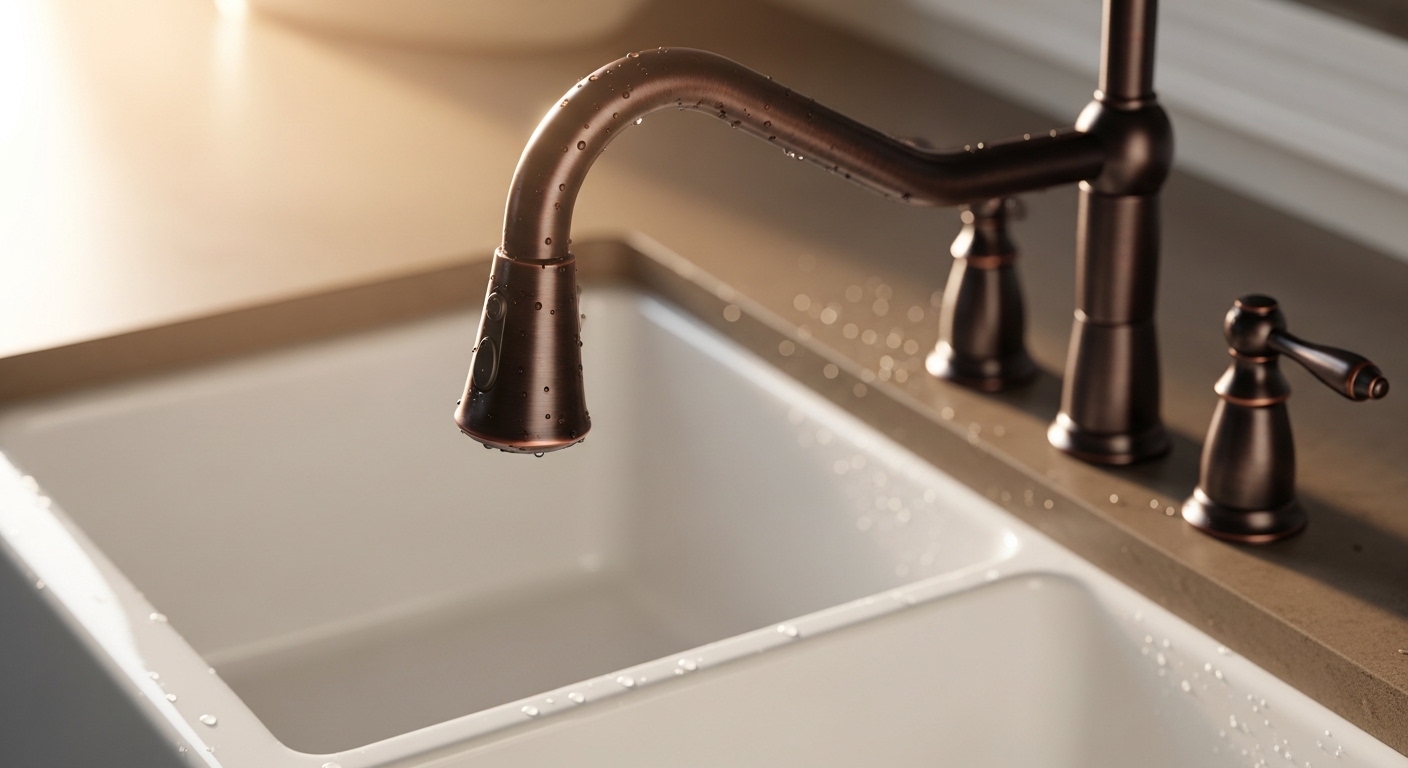
Choosing the right oil rubbed bronze kitchen faucet with sprayer is one of the highest-leverage upgrades you can make in a kitchen remodel. The finish is timeless — equally at home above a farmhouse apron sink or a sleek undermount stainless basin — and the integrated sprayer (whether pull-down, pull-out, or side-mounted) transforms everyday tasks like rinsing produce, filling stockpots, and washing down the basin. At avovida, we spend our days obsessing over the difference between a faucet that “looks good in photos” and one that earns its keep across a decade of family dinners, so this guide pulls together the specs, finishes, and installation realities that actually matter when you buy.
Why an Oil Rubbed Bronze Kitchen Faucet with Sprayer Is Worth It
Oil rubbed bronze — often shortened to ORB — isn’t a single color so much as a family of dark, hand-rubbed brown-to-near-black finishes with copper highlights peeking through at the edges. Unlike chrome or polished nickel, ORB hides water spots, fingerprints, and toothpaste splatter remarkably well, which is exactly why it dominates farmhouse, rustic, transitional, and even modern industrial kitchens. Pair that low-maintenance surface with a sprayer head, and you have a workhorse that looks like an heirloom.
The “with sprayer” part is where homeowners save the most time. A pull-down spray wand lets you reach every corner of a deep basin, fill pots that wouldn’t fit under a fixed spout, and switch between aerated stream and powerful spray for stuck-on food. If you’ve ever wrestled with a separate side sprayer that leaks at the base after two years, you already know why integrated pull-down designs have taken over.
How Oil Rubbed Bronze Is Actually Made
True oil rubbed bronze is a multi-step finish, not a paint job. Manufacturers typically start with a solid brass body, apply a copper or bronze plating layer, chemically darken it, then hand-rub the highlights off raised edges to reveal warmer tones underneath. A clear protective topcoat — usually a PVD (physical vapor deposition) or epoxy lacquer — locks in the look and protects against the daily abuse of dish soap, citrus, and coffee.
The differences between brands often come down to that topcoat. A genuine PVD ORB finish is several times harder than the brass underneath and resists scratching, tarnishing, and corrosion to ASME A112.18.1 / CSA B125.1 standards. Cheaper “ORB-look” finishes are sometimes just dark sprayed paint over zinc alloy, which is why a $49 mystery-brand faucet so often shows wear within a year. When you shop, look for the words “PVD,” “lifetime finish warranty,” and a solid brass waterway.
ORB vs. Matte Black vs. Bronze: Telling the Finishes Apart
Shoppers often confuse oil rubbed bronze with matte black or “Tuscan bronze.” They photograph similarly online, but they behave very differently in a real kitchen with overhead lighting and warm wall paint. Use the comparison below to decide which one fits your space.
| Finish | Undertone | Best Cabinet Pairing | Fingerprint Resistance | Typical Price Premium |
|---|---|---|---|---|
| Oil Rubbed Bronze (ORB) | Warm brown with copper highlights | Cream, walnut, sage, white shaker | Excellent | +10–15% over chrome |
| Matte Black | Neutral, cool black | White, navy, charcoal, light oak | Very good | +15–20% over chrome |
| Tuscan / Venetian Bronze | Reddish-brown, warmer than ORB | Terracotta, cherry, rustic stone | Excellent | +15–25% over chrome |
| Champagne Bronze | Light, gold-leaning | White, dusty blue, marble | Good | +20–30% over chrome |
| Brushed Nickel | Neutral silver-gray | Almost anything | Very good | Baseline |
If your goal is the deep, almost-black character that defines farmhouse and craftsman kitchens, ORB is the right pick. If you want something brighter and more contemporary, champagne bronze or matte black may serve you better — but neither replicates the hand-rubbed warmth of true ORB.
Sprayer Types: Pull-Down, Pull-Out, and Side Sprayers
Not all sprayers are created equal. The right choice depends on your sink depth, faucet style, and how you actually cook.
- Pull-down sprayers ride on a high-arc gooseneck spout and pull straight down into the basin. They’re ideal for deep single-bowl sinks and offer the longest reach. Most modern ORB faucets at avovida use this design.
- Pull-out sprayers sit on a lower spout and extend outward. They’re a great fit for compact kitchens, prep sinks, and bar sinks where a tall gooseneck would look out of scale.
- Side sprayers are separate from the main faucet and mounted in their own deck hole. They’re traditional, occasionally vintage in feel, and pair nicely with bridge-style ORB faucets — but they have an extra hose and seal that can leak over time.
- Pot fillers are wall-mounted swing-out faucets that supplement a primary sink faucet. They’re not technically “sprayers,” but ORB pot fillers are popular companions to an ORB main faucet for serious home cooks.
For most homeowners, a pull-down design with at least three spray modes (aerated stream, powerful spray, and a pause button) hits the sweet spot of flexibility and reliability.
Key Specs to Check Before You Buy
Once you’ve settled on ORB and a sprayer style, the rest is mostly about matching specs to your kitchen.
Spout Height and Reach
Standard kitchen faucet spouts range from 8 inches (low-profile) to 18 inches (high-arc) measured from the deck. If you regularly wash sheet pans or fill 12-quart stockpots, aim for at least 14 inches of clearance under the spout. Also check the “reach” — the horizontal distance from the base to the center of the water stream — to make sure the spray lands in the bowl, not against the divider in a double sink.
Number of Mounting Holes
Modern single-handle pull-down faucets usually need one hole, with an optional deck plate (sometimes called an escutcheon) to cover the unused holes from your old faucet. Bridge faucets need two or three holes, and bridge-plus-side-sprayer setups need four. Look under your sink before you order — retrofitting a sink with extra holes is a much bigger job than swapping a faucet.
Valve Type and Flow Rate
Ceramic disc valves are the modern standard. They resist hard-water buildup and typically carry a lifetime “drip-free” guarantee. Flow rate in the U.S. is federally capped at 2.2 gallons per minute (GPM), and many ORB models from avovida use 1.8 GPM aerators for WaterSense compliance and lower water bills without sacrificing rinse pressure.
Hose Length and Weight
For pull-down models, the spray hose should be at least 20 inches long with a counterweight that snaps the wand cleanly back into its magnetic dock. A weak magnet or a tangled hose is the single most common complaint about budget faucets — pull the wand out at the showroom (or read recent reviews) before you commit.
Installation: What to Expect
Replacing an existing kitchen faucet is a 60-to-90-minute job for most DIYers, but the supply line configuration under your sink can change the difficulty considerably. If you have rigid copper supply lines instead of flexible braided ones, you’ll need to plan an extra step — our walkthrough on how to replace a kitchen faucet that has copper supply lines covers the exact fittings and shutoff techniques that save hours of frustration. For everyone else with standard 3/8-inch compression stops, the basic flow is:
- Shut off the hot and cold supply valves under the sink and open the old faucet to relieve pressure.
- Disconnect the supply lines and the sprayer hose, then unthread the mounting nuts that hold the old faucet to the deck.
- Lift the old faucet, clean the deck thoroughly, and set the new ORB faucet through the mounting hole(s) with its included gasket or escutcheon.
- Tighten the mounting hardware from below, attach supply lines hand-tight plus a quarter turn with a wrench, and connect the pull-down hose to the quick-connect fitting.
- Open the supply valves slowly, remove the aerator, run hot and cold water for 60 seconds to flush debris, then reinstall the aerator.
A few extras you’ll want on hand: a basin wrench (the only tool that fits into the tight space behind the faucet), plumber’s tape, a flashlight, and an old towel to catch drips. If your old shutoff valves are crusted or won’t fully close, replace them while you’re already under there — they’re inexpensive, and a stuck valve is what turns a 90-minute job into a Saturday-long ordeal.
Caring for the ORB Finish So It Lasts
The single biggest mistake homeowners make with oil rubbed bronze is reaching for the same abrasive cleaner they’d use on chrome. ORB’s protective topcoat is durable, but it’s not invincible. Skip anything with ammonia, bleach, citrus oils, or scouring particles. Stick with mild dish soap, a soft microfiber cloth, and a quick dry after each use — that’s it.
Because ORB hides water spots so well, many owners only do a deep clean once a week. If you live in a hard-water region, wipe the spout and aerator with a 50/50 white vinegar and water solution monthly, then rinse thoroughly. Never let vinegar sit on the finish — five minutes is the maximum dwell time before the acid can dull the topcoat. Our deeper-dive on how to protect faucet finishes from scratches includes the specific cloths and felt pads we recommend for keeping ORB looking factory-fresh.
If you’ve already added a separate water-filtration system at the sink, make sure its housing and any wide-mouth adapter don’t rub the faucet finish on the way down. Homeowners pairing ORB faucets with countertop or aerator-mounted filters often find our wide faucet water filter buyer’s guide helpful for picking compatible threading without scratching the spout.
Living-Finish vs. Sealed-Finish ORB
One nuance that catches buyers off guard: some manufacturers sell ORB as a “living finish,” meaning the copper undertones are intentionally allowed to oxidize and develop a patina over time. Others sell a fully sealed PVD ORB that looks identical on day one and on day 3,650. Neither is wrong — they’re just different philosophies.
If you love the idea of your faucet aging like a copper kettle, a living finish is genuinely beautiful. If you want predictable, uniform color forever, choose a sealed PVD finish and verify the warranty language explicitly covers “tarnishing and discoloration.” At avovida, our ORB collection defaults to sealed PVD because that’s what the majority of our customers ask for, but we clearly label any living-finish options so you can choose with full information.
Budget Tiers: What Different Price Points Get You
Pricing on oil rubbed bronze kitchen faucets with sprayer ranges from about $90 to $700 and beyond. Here’s roughly what each tier delivers:
- $90–$150 (entry): Often zinc-alloy bodies with sprayed ORB finishes, plastic spray heads, and one- or two-year warranties. Fine for rental units; not where I’d put my money for a forever kitchen.
- $150–$300 (mid-range): Solid brass waterway, ceramic disc valve, metal spray head, magnetic dock, and limited-lifetime warranty. This is the sweet spot for most homeowners and where avovida concentrates its catalog.
- $300–$500 (premium): Full PVD ORB finish, three or more spray modes, smart features like touch-to-activate, hands-free motion sensing, or temperature memory, and lifetime drip-free guarantees.
- $500+ (luxury): Designer collaborations, hand-finished detailing, integrated filtered-water dispensers, voice control, and bespoke height options for commercial-style kitchens.
Matching ORB Faucets to Sink, Hardware, and Lighting
An ORB faucet is a strong visual anchor, so the rest of the kitchen needs to support it without competing. The classic combinations are:
- ORB faucet + white fireclay apron sink + warm brass cabinet pulls (farmhouse)
- ORB faucet + black granite composite sink + ORB cabinet pulls (modern industrial)
- ORB faucet + hammered copper sink + wrought iron pendants (Tuscan)
- ORB faucet + stainless steel undermount + matte black hardware (transitional)
Lighting matters too. Cool LED downlights can make ORB look almost black and flat; warm 2700–3000K bulbs bring out the copper undertones the finish is famous for. Test a sample swatch in your actual kitchen lighting before you commit, especially if you’re ordering online.
About avovida and Our Testing Standards
avovida designs and ships kitchen and bathroom fixtures direct to homeowners across North America from avovida.net. Every faucet in our oil rubbed bronze line is built on a lead-free solid brass body, tested to 500,000 on/off cycles (roughly 40 years of typical residential use), and certified to ANSI/NSF 61 and ASME A112.18.1 / CSA B125.1 standards. Our PVD ORB finish carries a limited lifetime warranty against tarnishing, corrosion, and discoloration, and our ceramic disc cartridges are backed by a lifetime drip-free guarantee. If anything fails under normal residential use, we replace the part — no receipts required after registration.
Author’s note: This guide was written by the avovida product team in collaboration with a licensed master plumber with 18 years of residential remodel experience. We install, photograph, and stress-test every model we sell in a working test kitchen before it goes on the site, and we update this page whenever a meaningful spec changes.
FAQ
Will an oil rubbed bronze kitchen faucet with sprayer match my existing brushed bronze cabinet hardware?
Probably close, but not identically. “Bronze” is a finish family, not a standard, so a Delta ORB, a Kohler Oil Rubbed Bronze, and an avovida ORB will all read as the same warm dark brown to a guest but may differ slightly under direct light. The safest approach is to keep faucet and large hardware (pulls, hinges, lighting) from the same brand or order swatches before you commit. Mixing a sealed PVD ORB faucet with living-finish hardware almost always drifts apart over time.
Is oil rubbed bronze going out of style?
No. It cycled out of the trend spotlight around 2018–2020 when matte black surged, but it has since returned strongly as part of the warm, layered “new traditional” look. Because true ORB is a hand-rubbed finish with deep roots in craftsman and farmhouse design, it’s never quite trendy and never quite dated — much like polished nickel or unlacquered brass. Resale studies consistently rank ORB as one of the most neutral, broadly appealing finishes in kitchens.
Can I use vinegar to clean my ORB faucet aerator?
Yes, but with caution. Unscrew the aerator and soak only the aerator (not the faucet body) in a 50/50 vinegar-water solution for up to 15 minutes to dissolve mineral buildup. Avoid soaking the spray wand head — the silicone nozzles are vinegar-safe, but extended exposure can dull the topcoat around the metal collar. Rinse and reinstall.
Do ORB faucets work with hard water?
Better than chrome, actually. Hard-water scaling shows up as white crust on shiny finishes but blends much more discreetly into the dark, mottled surface of ORB. You’ll still want to wipe the spout dry periodically, and a whole-home softener or under-sink filter helps any faucet last longer.
What’s the difference between “oil rubbed bronze” and “Venetian bronze”?
The terms overlap, but most brands use “oil rubbed bronze” to mean a darker, browner finish with subtle copper highlights, and “Venetian bronze” (Delta’s house term) to mean a slightly redder, more uniform finish. Tuscan bronze (Pfister) is warmer still. None are standardized, so always check a real-world sample under your kitchen lighting.
How long should an oil rubbed bronze kitchen faucet with sprayer last?
A quality PVD ORB faucet from a reputable brand should last 15–25 years with normal residential use, and the finish itself often outlasts the cartridge. Cartridges (the ceramic disc valves) are user-replaceable and inexpensive. Spray hoses are the next-most-common wear item and usually swap out in under 10 minutes.
Can I install an ORB pull-down faucet myself without a plumber?
For a straightforward swap with existing shutoff valves and flexible supply lines, yes — most homeowners finish the job in under two hours. Call a licensed plumber if your shutoff valves are stuck, your supply lines are rigid copper that needs re-routing, or your sink requires drilling new mounting holes in stone countertops.
Ready to Upgrade?
An oil rubbed bronze kitchen faucet with sprayer is one of those rare upgrades that elevates a kitchen aesthetically, simplifies daily chores, and pays you back every time a friend walks in and asks where you found it. Choose a solid-brass body, a PVD finish, a ceramic disc valve, and a magnetic-docking pull-down wand, and you’ll have a faucet that earns its place at the center of your kitchen for decades. Browse the full ORB collection at avovida.net to see current pricing, specs, and lead times.