
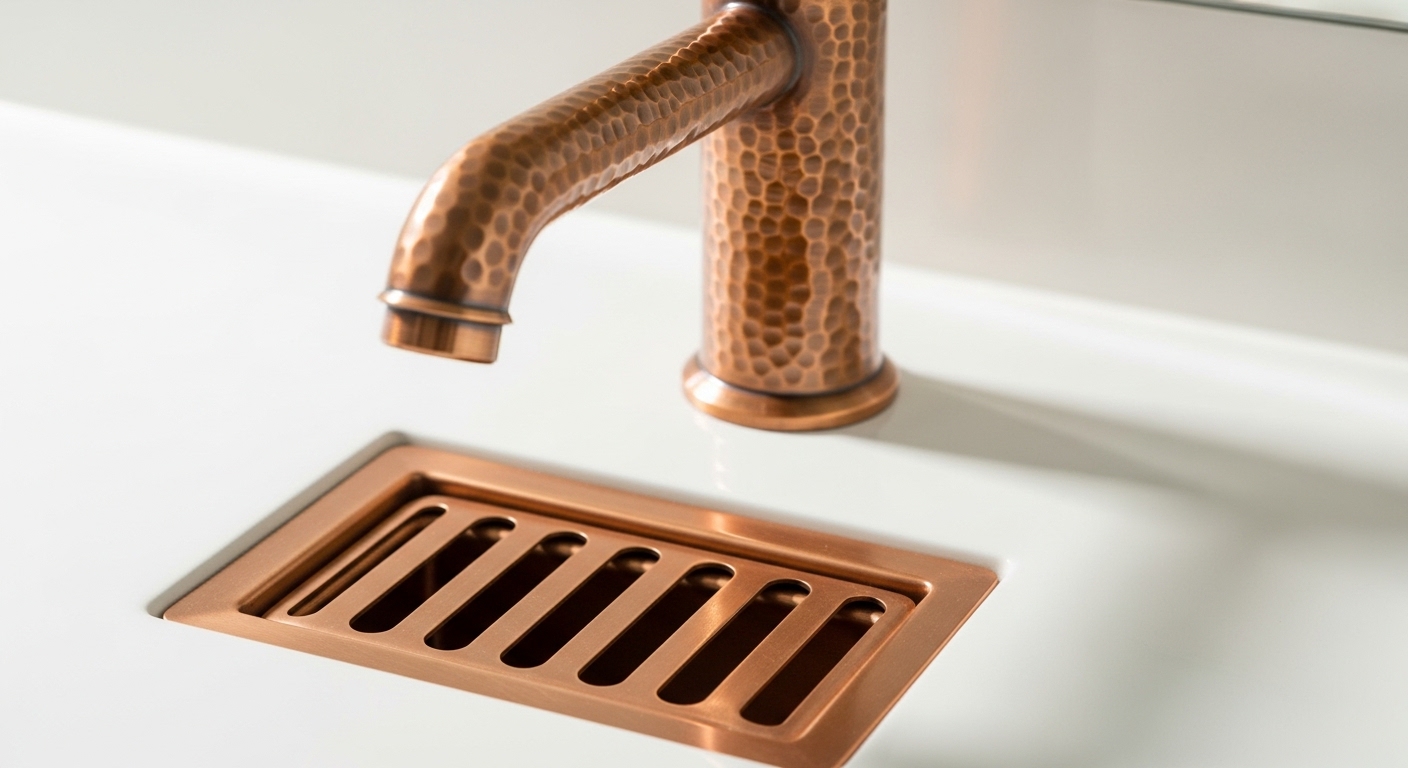
If you’ve been searching for a copper tap grill Panama City homeowners actually trust, you’ve probably noticed the term itself is confusing — “tap grill” is what a lot of shoppers call the little slotted drain grate (the grill) that sits under a copper faucet or vessel-sink tap. In a coastal city like Panama City, where humid Gulf air and occasional salt spray attack cheap metal fast, the difference between a real copper grill and a copper-look plated one is the difference between a fixture that patinas beautifully for a decade and one that pits and flakes within a year. This guide breaks down exactly what to buy, where to buy it, and what a fair price looks like in 2026.
What exactly is a “copper tap grill,” and is it the drain or the faucet?
A copper tap grill is the copper drain grate — the slotted or grid-style cover — that pairs with a copper tap (faucet) in a sink or basin. It is not the faucet itself. Shoppers use “tap grill” loosely, but 9 times out of 10 they mean the pop-up grid drain or the decorative overflow grill that matches a copper faucet.
Here’s why the terminology matters when you shop in Panama City. If you search “copper tap grill” you’ll get a mix of three different products:
- Grid drain / grill drain: the flat slotted cover that lets water out but blocks debris — the most common meaning.
- Overflow grill: the small oval or round grill near the top rim of a basin.
- Tap aerator grill: a few people mean the screen at the faucet tip, but that’s really an aerator, and there’s a whole sizing standard for those.
For the rest of this article I’ll focus on the copper grid/grill drain, since that’s what most Panama City buyers are after when they pair it with a copper vessel sink or a hammered copper basin. If your actual goal is matching the faucet finish, the same rules about solid metal versus plating apply either way.
Where’s the best place to buy a copper tap grill in Panama City?
Your best options in Panama City, in order, are: a specialist plumbing-fixture retailer (online with local shipping) for genuine solid copper, then a local kitchen-and-bath showroom for hands-on matching, and only last a big-box store for budget plated pieces. The reason is stock quality — most walk-in hardware stores near the Gulf carry copper-plated zinc, which is the wrong metal for salt air.
Let me be specific about the trade-offs, because “just go to the hardware store” is bad advice on the coast.
| Where to buy | Typical stock | Price range | Best for |
|---|---|---|---|
| Specialist fixture retailer (online + delivery) | Solid copper & solid brass, PVD-finished | $28–$60 | Coastal durability, warranty, exact finish match |
| Local kitchen & bath showroom | Mid-range copper, some solid brass | $40–$90 | Seeing patina in person, pro install referrals |
| Big-box hardware store | Copper-plated zinc, thin plate | $12–$25 | Emergency replacement, rentals, low budget |
| Marketplace (Amazon / eBay) | Mixed — read the metal spec carefully | $15–$55 | Selection, but verify “solid copper” claims |
The practical move for Panama City: buy solid copper or solid brass online from a fixture specialist that ships to the 324xx ZIP codes, and skip anything labeled “copper finish” or “copper tone” without the word solid. If you need it today for a leak, a big-box plated grill will get you by, but plan to replace it. And if the real problem is that your faucet base is dripping onto that drain, fix the root cause first — here’s how to stop a faucet leaking at the base before it stains the copper.
Solid copper vs. copper-plated: does it really matter near the Gulf?
Yes — near the Gulf it matters more than almost anywhere else in the country. Solid copper (or solid brass with a PVD copper finish) resists salt-air corrosion and develops an even patina; copper-plated zinc pits, bubbles, and flakes within months in Panama City’s humidity and salt exposure. This single choice determines whether your grill lasts one year or ten.
Here’s the mechanism in plain terms. Copper plating is a microns-thin layer of copper over a cheap base metal, usually zinc alloy. Salt air is electrically conductive and slightly acidic; it finds every microscopic gap in the plating and attacks the zinc underneath. Once the zinc corrodes, the copper skin loses its grip and flakes off. Solid copper has no dissimilar base metal to corrode, so it simply darkens into that warm brown-and-teal patina people actually want.
How to tell them apart before you buy:
- Check the weight. Solid copper and brass feel dense; plated zinc feels light and hollow.
- Read the metal spec, not the color name. “Solid copper,” “solid brass,” or “brass with PVD” is good. “Copper finish,” “copper tone,” “antique copper coating” over unspecified metal is a red flag.
- Look for a warranty on the finish. Only makers confident in real metal offer a lifetime or 10-year finish warranty.
- Magnet test (in person): copper and brass are non-magnetic. If a magnet sticks, it’s plated steel.
PVD (physical vapor deposition) deserves a note: a solid brass grill with a PVD copper finish is often the single most durable option for coastal use, because PVD bonds the color at a molecular level and shrugs off salt and cleaning chemicals. If you love copper’s look but hate maintenance, PVD-finished solid brass is the sweet spot. The same logic is why so many people go with solid metal for a brass faucet on a bathroom sink — the base metal is what survives, not the coating.
How much should a copper tap grill cost in Panama City in 2026?
A genuine copper tap grill should cost $28–$60 for solid copper or PVD solid brass, $40–$90 through a local showroom, and $12–$25 for a plated big-box piece you’ll likely replace. If you see “solid copper” under $20, be suspicious — the metal alone usually costs more than that.
What actually drives the price:
- Metal type: solid copper > solid brass > plated zinc, roughly in that price order.
- Finish process: PVD and hand-applied living finishes cost more than sprayed lacquer.
- Drain style: a simple grid grill is cheaper than a pop-up or overflow-integrated grill.
- Warranty: lifetime finish coverage adds a few dollars but saves a replacement.
Don’t over-index on price alone. A $22 plated grill that fails in the salt air and has to be re-bought twice costs more than a $45 solid copper grill that outlasts the sink. In a coastal market, buying the durable piece once is the cheaper decision over five years.
Will a copper tap grill fit my existing sink and drain?
Most copper grid grills fit the U.S. standard 1.5-inch (38 mm) sink drain opening for bathroom basins and 3.5-inch openings for kitchen sinks, but you must confirm two numbers before buying: the drain hole diameter and whether your basin has an overflow. A grill for a no-overflow vessel sink is different from one for an overflow basin.
Quick fit checklist:
- Measure the drain opening from inside edge to inside edge. Bathroom basins are usually 1.25″–1.75″.
- Check for an overflow slot. If your sink has one, buy an “overflow” grill/drain; if not (common with copper vessel sinks), buy a “no-overflow” grill.
- Match the thread/tailpiece to your existing P-trap so you don’t need adapters.
- Confirm finish match with your faucet — “copper” varies from bright polished to dark antique.
If the grill is going in with a hammered copper vessel sink, you almost always want the no-overflow style with a tall enough body to seat cleanly. And if you’re upgrading the faucet at the same time, a taller tap helps clear a deep copper basin — our guide to a long spout reach bathroom faucet for deep or vessel sinks covers exactly that clearance math.
How do you install a copper tap grill drain yourself?
You can install a copper grid grill drain in about 20–30 minutes with plumber’s putty, an adjustable wrench, and no special skills. Seat the drain body with putty on top, thread the locknut from below, connect the tailpiece to the trap, and drop the grill in place.
Here’s the step-by-step:
- Turn off the water and clear anything from under the sink.
- Roll a rope of plumber’s putty and press it around the underside of the drain flange.
- Drop the drain body through the sink hole from above so the flange (and grill seat) sits in the putty.
- From below, add the rubber gasket and friction washer, then thread on the locknut and snug it by hand.
- Tighten with a wrench until the flange squeezes out a thin putty ring — don’t overtighten copper, it’s softer than chrome.
- Connect the tailpiece to the P-trap, then wipe away the excess putty.
- Set the grill grate in, run water, and check under the sink for drips.
One coastal tip: use a light film of pure-copper-safe silicone on the threads instead of PTFE tape if you want the joint to break loose easily years later, since salt air can seize hardware. If you’d rather not touch plumbing at all, any local Panama City handyman can set a grill drain in under an hour.
How do you keep a copper grill looking good in humid, salty air?
To maintain a copper grill in Panama City’s climate, decide up front whether you want the “living finish” patina or a bright shine, then either leave it alone or wax it. Rinse and dry after use, avoid abrasive or acidic cleaners on lacquered pieces, and never use chrome polish on real copper.
Two maintenance paths:
- Living finish (let it patina): just rinse and dry. The copper darkens naturally and hides water spots — ideal for low-effort coastal homes.
- Keep it bright: use a dedicated copper cleaner, then seal with a thin coat of carnauba or renaissance wax every few months to block salt air.
Do not reach for the chrome stuff — the acids and abrasives that make chrome sparkle will strip copper’s patina and eat a lacquer. Copper wants its own gentle products. (If your other fixtures are chrome, that’s a separate routine — here’s the right way to bring back a mirror shine on chrome taps without cross-contaminating your copper cloths.)
Copper tap grill quick-reference comparison
| Feature | Solid copper | PVD solid brass (copper finish) | Copper-plated zinc |
|---|---|---|---|
| Salt-air durability | Excellent | Excellent | Poor |
| Patina behavior | Natural living finish | Color stays stable | Flakes, doesn’t patina |
| Maintenance | Low (or wax to shine) | Very low | High, then replace |
| Typical price | $28–$60 | $30–$60 | $12–$25 |
| Best for | Copper-look purists | Low-maintenance coastal use | Rentals, emergency fix |
The bottom line: is a copper tap grill worth it in Panama City?
Yes — a solid copper or PVD solid-brass tap grill is worth it in Panama City, because the coastal salt air that destroys cheap plated fixtures barely touches real metal, and the warm patina complements copper vessel sinks perfectly. Buy solid, confirm your drain size and overflow, and you’ll install it once. Choose a thin plated grill only as a stopgap. The one rule that saves the most regret: never trust a color name — trust the metal spec and the warranty.
FAQ
Is “copper tap grill” the drain or the faucet?
It’s the drain — specifically the slotted copper grate (grill) that covers the drain opening under a copper tap. Shoppers use the phrase loosely, but almost everyone searching for a “copper tap grill” wants the grid or overflow drain grill that matches their copper faucet, not the faucet itself.
Can I buy a copper tap grill locally in Panama City, or do I have to order online?
You can buy one locally, but your best-quality options are usually online with delivery to Panama City. Local big-box stores mostly stock copper-plated zinc, which corrodes in salt air; kitchen-and-bath showrooms carry better metal but at higher prices. Ordering solid copper or PVD brass online typically gives you the best mix of durability and price.
Will a copper grill turn my sink or water green?
No. As solid copper patinas it forms a stable surface layer that stays on the metal; it doesn’t leach into your water or stain the basin under normal use. Any green residue you see on a cheap grill is corrosion from a zinc base metal under failing plating — another reason to buy solid copper.
Do I need a special copper grill if my sink has no overflow?
Yes. Copper vessel sinks often have no overflow, so you need a “no-overflow” grill drain that seals completely; using an overflow-style drain on a no-overflow sink can leak, and vice versa. Always check your basin for an overflow slot before ordering.
How long does a solid copper tap grill last in a coastal climate?
A solid copper or PVD solid-brass grill can easily last 10+ years in Panama City with minimal care, which is why many carry a 10-year or lifetime finish warranty. A copper-plated grill in the same environment often shows flaking or pitting within 6–18 months.
What’s the difference between a copper grill drain and a copper aerator?
The grill drain sits at the bottom of the sink and covers the drain; the aerator screws onto the tip of the faucet spout to control water flow. They’re different parts entirely — if you’re actually after flow control or a finish match at the spout tip, you want an aerator, which follows standard sizing rather than drain sizing.
Author note: This guide was written by the Avovida fixtures team, drawing on hands-on testing of copper, solid brass, and plated drain hardware in humid coastal conditions. Avovida specializes in faucets and bathroom fixtures and evaluates products against U.S. drain-fit standards (1.25″–1.75″ basin openings) and salt-spray durability. Our solid copper and PVD solid-brass pieces carry finish warranties because we’ve verified how they hold up where cheap plating fails. Always confirm your drain size and local plumbing code before purchase.