
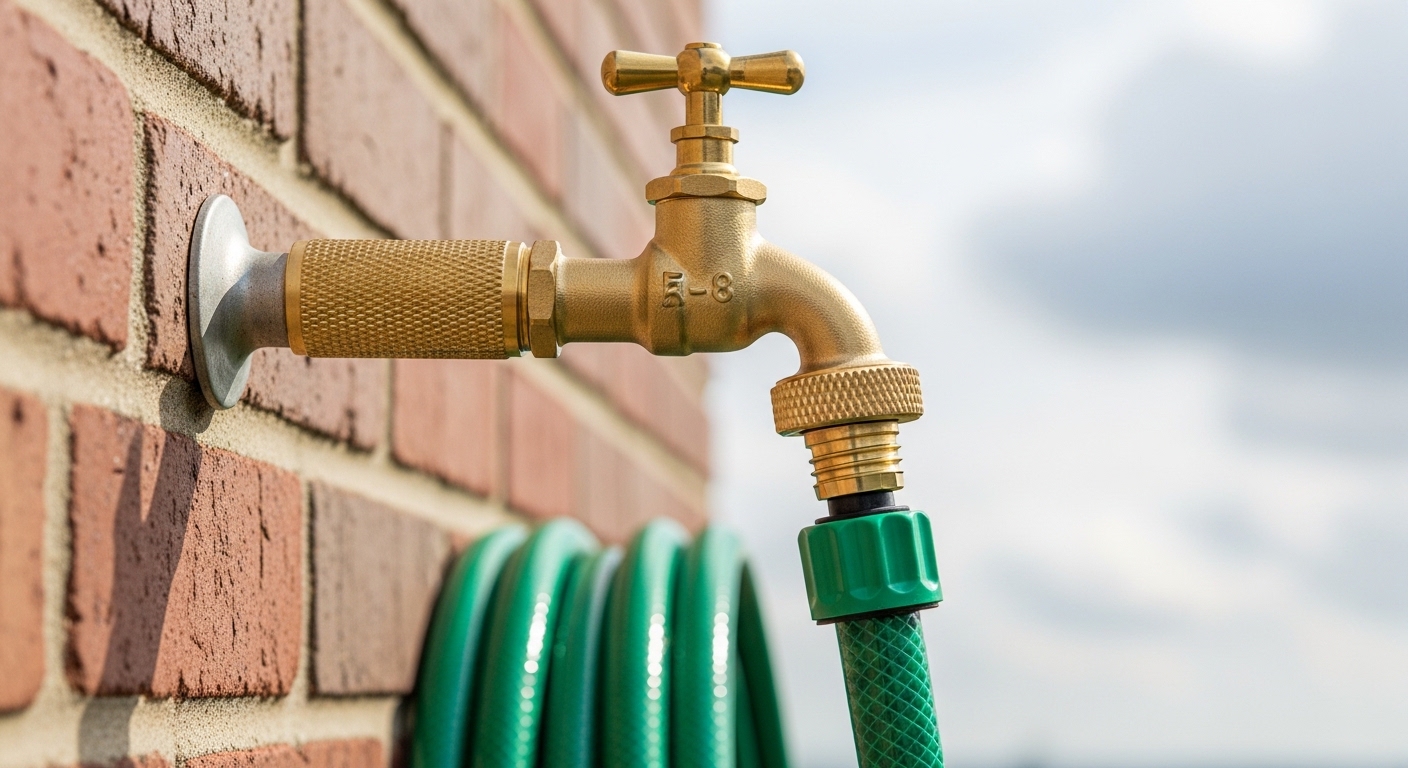
A yard faucet extender is one of those cheap, unglamorous fixes that solves a daily annoyance you’ve probably learned to live with. If you’ve ever knelt in wet grass to thread a hose onto a spigot that’s an inch off a brick wall, or watched a garden-hose connection weep water straight down onto your foundation, an extender is the answer. It’s a rigid or flexible extension — usually a brass or stainless nipple, an elbow, or a short hose — that screws onto your existing hose bib and relocates the business end of the faucet to somewhere you can actually reach.
Below, I’ll walk you through exactly what these extenders do, the different types, how to choose the right one for your yard, how to install it, and the specs that actually matter (thread size, material, and pressure rating) so you don’t buy the wrong part twice. This is a common-sense buying guide from people who sell fixtures for a living — not a sales pitch.
What does a yard faucet extender actually do?
It moves the outlet of your outdoor faucet to a more usable position — farther from the wall, higher off the ground, or angled downward. That’s the whole job, and it solves three specific problems: not enough clearance to grip a hose fitting, a spigot mounted too low to slide a bucket under, and awkward angles that stress the hose connection and cause leaks.
Most outdoor faucets (called hose bibs, sillcocks, or spigots) are installed by builders for plumbing convenience, not for your comfort. They get bolted flush to the siding, sometimes 4–6 inches off the deck, right where a downspout or an AC condenser line is in the way. An extender adds reach so you can:
- Fit a watering can or 5-gallon bucket under the spout by raising the outlet height.
- Grip and thread a hose without scraping your hand on brick, stucco, or lap siding.
- Add a second outlet when the extender includes a splitter, so a hose and a drip line run at once.
- Aim the water down into a bucket or garden bed instead of straight out into the wall.
- Reduce strain on the valve — a hose pulling sideways on a low spigot slowly loosens the packing and starts a leak.
The extender itself doesn’t add water pressure and doesn’t change your flow rate in any meaningful way, as long as you pick a full 3/4-inch bore. It just relocates the opening. Think of it as an extension cord for water.
What are the different types of yard faucet extenders?
There are four main types: rigid pipe nipples, elbow extenders, flexible hose extenders, and multi-outlet extenders with a built-in splitter. Which one you need depends on whether your problem is height, clearance, angle, or the number of hoses you run.
Here’s how they compare so you can match the type to your situation:
| Type | Best for | Typical length | Material | Rough price |
|---|---|---|---|---|
| Rigid brass nipple | Moving the outlet straight out from the wall | 2″–6″ | Solid brass | $8–$18 |
| Elbow / angled extender | Redirecting water downward or around an obstruction | 3″–5″ | Brass or stainless | $10–$22 |
| Flexible hose extender | Reaching over gutters, meters, or tight corners | 12″–36″ | Braided stainless / reinforced PVC | $14–$30 |
| Multi-outlet extender (with splitter) | Running two hoses or a hose plus drip line | 4″–8″ | Brass or zinc alloy | $18–$40 |
If you just want more knuckle room and a cleaner hose connection, a short rigid brass nipple is the simplest, most durable choice. If your spigot is stuck behind a downspout or an air-conditioning line, a flexible extender lets you route around it. And if you’re constantly swapping between a sprinkler and a hand hose, spend the extra few dollars on a multi-outlet version so you stop unscrewing things.
Which yard faucet extender is best for a spigot that’s too low to the ground?
For a low spigot, you want a rigid riser or an elbow extender that raises the outlet 4–8 inches and angles it slightly downward. That gives you enough height to slide a watering can or bucket underneath and enough angle to fill it without splashback.
The classic scenario: your hose bib sits about 4 inches off a concrete patio, and no bucket fits under it. A straight-up riser (a nipple plus a 90-degree elbow) lifts the outlet and points it out and down. Look for one with a 3/4-inch GHT (garden hose thread) male outlet so any standard hose, splitter, or timer threads right on. Solid brass is worth the extra couple of dollars here because the extender takes the leverage load every time you tug the hose — cheap zinc-alloy versions can crack at the threads after a season or two in the sun.
One tip most guides skip: if you’re raising the outlet, add a rubber hose washer at both connection points, not just one. The extra joint you’re creating is a new potential leak point, and a fresh washer at each end seals it cleanly. If your existing spigot already weeps at the handle when you turn it on, fix that first — a worn valve won’t get better with an extender bolted to it. Our walkthrough on how to fix a leaking tap valve yourself in under an hour covers that repair before you add any hardware.
Yard faucet extender vs. a new outdoor faucet head — which should you buy?
Buy an extender if the faucet itself works fine and you only need more reach or a better angle; buy a new outdoor faucet head if the spigot is corroded, the handle is stiff, or the outlet threads are stripped. The two solve different problems, and people often buy the wrong one.
An extender is purely about geometry — where the water comes out. A replacement head or a whole new hose bib is about function — how well the valve seals and shuts off. If your faucet drips constantly, sticks when you turn it, or has chewed-up threads that won’t hold a hose, no extender will save it; you need new hardware. If you’re weighing a full replacement, our guide to the best outdoor faucet head for a garden hose or spigot breaks down the styles, finishes, and quarter-turn vs. multi-turn valves worth buying.
Here’s a quick decision list:
- Faucet works, just awkward to reach? → Extender.
- Faucet drips or handle is stiff? → Rebuild the valve or replace the head, then add an extender if you still want more reach.
- Threads at the outlet are stripped? → Replace the head; an extender won’t grip damaged threads.
- Spigot freezes/bursts in winter? → Replace with a frost-free sillcock, not an extender.
What size and thread does a yard faucet extender use?
Almost all outdoor faucet extenders use 3/4-inch GHT (garden hose thread) — that’s the standard for U.S. hose bibs, hoses, splitters, and timers. If your spigot has a threaded outlet, an extender that says “3/4-inch GHT” or “fits standard garden hose” will screw right on. The trap to avoid is confusing GHT with NPT.
Garden hose thread (GHT) and national pipe thread (NPT) look similar but are not interchangeable — GHT is a coarser, straight thread meant for hose washers, while 3/4-inch NPT is a tapered pipe thread used inside plumbing. If your extender feels like it’s cross-threading or won’t seat with a washer, you’ve likely got an NPT/GHT mismatch. Adapters exist ($3–$6) if you need to bridge the two. When you’re comparing thread standards and adapters, the same fit logic applies indoors too — our breakdown of standard faucet aerator sizes in the US is a useful primer on how thread callouts are measured so you don’t guess.
Quick spec checklist before you buy:
- Thread: 3/4″ GHT (male outlet + female inlet is the most common combo).
- Bore: Full 3/4″ inner diameter so you don’t choke flow.
- Material: Solid brass or 304 stainless for outdoor UV and freeze resistance.
- Washers: Included rubber or EPDM hose washers, ideally two.
- Pressure rating: Look for at least 100–150 PSI, which covers typical residential supply.
How do you install a yard faucet extender yourself?
You can install one in about five minutes with no tools and no plumber — it hand-threads onto your existing spigot. The only “skill” involved is not over-tightening and making sure a washer is seated at each connection.
Here’s the full process:
- Shut the faucet off and remove anything currently attached (hose, splitter, timer).
- Check the outlet threads for grit or old washer bits and wipe them clean.
- Seat a fresh hose washer inside the extender’s female inlet.
- Hand-thread the extender onto the spigot clockwise until snug, then give it a quarter-turn with pliers or by hand — do not crank it.
- Add a washer to the extender’s outlet and attach your hose or splitter.
- Turn the water on slowly and watch every joint. A slow weep means the washer isn’t seated — back it off and reseat, don’t just tighten harder.
If you’re using a flexible or long rigid extender, add a simple bracket or a zip-tie tie-back so the weight of the extender and a full hose doesn’t lever on the spigot valve over time. That sideways load is the number-one cause of outdoor faucets developing a leak at the wall. Support the extender, and the whole assembly lasts for years.
Where should you buy a yard faucet extender, and what should you pay?
Expect to pay $8–$40 depending on type, and buy from a source that clearly lists the material and thread size — that’s what separates a part that lasts from one that cracks in a season. Big-box stores, hardware chains, and online retailers all carry them, but the specs matter more than the storefront.
A solid brass rigid extender should run you around $10–$18; a quality braided flexible one, $14–$30; a brass multi-outlet splitter extender, $20–$40. If a listing doesn’t tell you the material or the thread standard, treat that as a red flag — vague listings are usually thin zinc alloy that pits and cracks outdoors. For a broader look at where to shop and how retailers compare on faucet-reach accessories, our piece asking whether Target is actually the best place to buy a faucet extender walks through the trade-offs between convenience, price, and part quality.
At avovida, our rule of thumb is simple: for anything that lives outdoors and takes mechanical load, pay the extra few dollars for solid brass or 304 stainless. The price difference over a plastic or zinc part is trivial, and you’ll never think about it again.
FAQ
Will a yard faucet extender reduce my water pressure?
No, not in any way you’ll notice, as long as it has a full 3/4-inch bore. Pressure loss only becomes real with very long, narrow, or kinked extensions. A short rigid brass extender or a properly sized flexible one delivers essentially the same flow you had before.
Can I use a yard faucet extender to add a second hose outlet?
Yes. Choose a multi-outlet extender with a built-in Y-splitter, or add a separate 2-way splitter to a single extender. Each outlet should have its own shutoff lever so you can run a sprinkler and a hand hose independently without swapping connections.
Are brass extenders better than plastic or zinc ones?
For outdoor use, yes. Solid brass and 304 stainless resist UV, freezing, and the mechanical stress of a hose tugging on them. Plastic gets brittle in sun and cold, and cheap zinc alloy can crack at the threads after a season or two. The price gap is usually only a few dollars.
Will an extender leak where it connects to my spigot?
Only if a washer is missing, worn, or unseated. Every threaded joint on a garden-hose-thread connection seals with a rubber washer, not with thread tape. Put a fresh washer at each connection, hand-tighten plus a quarter-turn, and it won’t leak. If your spigot already leaked before, fix that valve first.
Does a yard faucet extender protect my faucet in winter?
No — an extender is about reach, not freeze protection. If your outdoor faucet freezes and bursts, you need a frost-free sillcock and to disconnect hoses before the first hard freeze. Leaving an extender and hose attached over winter can actually trap water and make freeze damage worse.
What thread size do I need for a standard U.S. outdoor faucet?
3/4-inch GHT (garden hose thread). That’s the standard for virtually all residential hose bibs, hoses, splitters, and timers in the United States. Watch out for NPT pipe thread, which looks similar but isn’t interchangeable — use a GHT-to-NPT adapter if your parts don’t match.
The bottom line
A yard faucet extender is one of the highest-value few dollars you can spend on your outdoor plumbing. It won’t fix a broken valve or protect against a freeze, but for the everyday frustration of a spigot that’s too low, too tight to the wall, or awkward to aim, it’s the right tool. Match the type to your problem — rigid for reach, elbow for angle, flexible for obstacles, multi-outlet for two hoses — insist on solid brass or stainless with a 3/4-inch GHT full bore, and support the weight so it lasts. Do that, and you’ll wonder why you put up with the old setup for so long.
Author note: This guide was written by the avovida fixtures team, drawing on years of helping homeowners spec, install, and troubleshoot indoor and outdoor faucets. avovida is a specialist faucet and bathroom fixtures retailer; we sell and stand behind the outdoor hardware we recommend. Our buying advice favors parts that meet common residential pressure ratings (100–150 PSI) and, where applicable, materials that align with lead-safe plumbing standards. Extenders we stock are backed by a manufacturer warranty, and we always recommend testing every new connection under pressure before you walk away.