
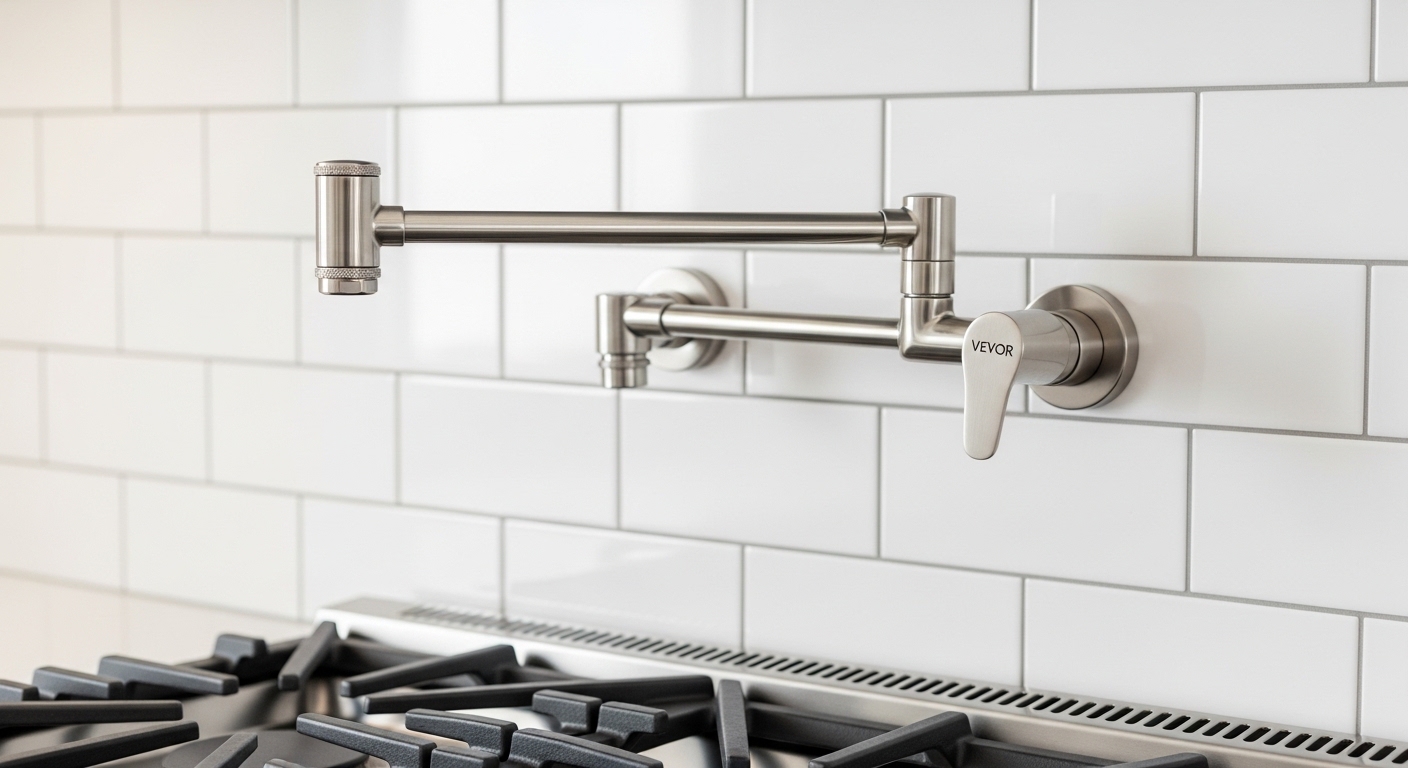
The VEVOR pot filler faucet sits in a very specific sweet spot: it gives you the same folding, double-jointed reach-over-the-stove convenience as a $250 designer filler, but at a price that usually lands between $45 and $85. For a lot of home cooks, that trade is completely reasonable. The question isn’t really “is VEVOR good or bad” — it’s “does a budget pot filler make sense for how *you* cook, how hard your water is, and how long you plan to stay in the house?” That’s what this guide answers, with real specs, a side-by-side comparison, and the failure points to check before you buy.
We’ll cover who should buy it, who shouldn’t, how it compares to Ferguson-counter brands like Delta and Kohler, how to install one over an existing range, and the exact things that tend to go wrong on cheap fillers so you can dodge them.
What exactly is a pot filler, and do you even need one?
A pot filler is a long, folding cold-water faucet mounted on the wall (or deck) right above your stove, so you can fill a big stockpot where it sits instead of hauling it, full and heavy, from the sink. You need one if you regularly cook pasta, stock, canning batches, or anything in a pot heavier than about 8 pounds when full — otherwise it’s a luxury, not a necessity.
Here’s the honest version: a pot filler solves exactly one problem, but it solves it well. A full 12-quart stockpot weighs roughly 25 pounds. Carrying that from a sink across the kitchen, sloshing, is how people burn wrists and strain backs. A pot filler lets you fill it on the burner and never lift the water at all. The VEVOR version does this job the same way a premium one does — the mechanism is nearly identical.
What a pot filler does not do: it’s cold-water only (no hot side), it has no drain, and it should never sit “on” over an unattended stove. If you were hoping to rinse dishes there, that’s not what it’s for.
Who should skip a pot filler entirely?
Skip it if your stove is on an island with no wall behind it and you don’t want to run plumbing into the floor, if you rarely cook with pots bigger than a saucepan, or if you’re renting. The plumbing rough-in behind the wall is the real cost and commitment — the faucet itself is the cheap part. If any of those apply, your money is better spent elsewhere in the kitchen.
Is a VEVOR pot filler faucet actually worth it, or is it too cheap to trust?
Yes, a VEVOR pot filler is worth it for most casual-to-moderate cooks — the core function (folding reach, on/off valves, standard 1/2″ NPT connection) works reliably out of the box. The compromises are in the metal thickness, the cartridge quality, and the warranty length, not in whether it fills a pot. If you cook every day and have very hard water, those compromises matter more.
Let’s be specific about what you’re actually getting and giving up:
- Build: Most VEVOR fillers use stainless steel or a brass/zinc-alloy body. They feel lighter than a Delta or Waterstone. That’s fine on a wall — it’s not load-bearing — but it’s a tell about internal parts.
- Two valves: The good ones have two shut-off handles: one at the wall and one at the spout tip. This double-valve design is a genuine safety feature — the spout-tip valve gives you flow control at the pot, and the wall valve is your backup shutoff. Buy the two-valve version, not the single.
- Reach: Typical extended reach is 20–24 inches, enough to clear a standard 30″ range and hit both front and back burners. Confirm the number for your exact model before buying.
- Finish options: Usually brushed nickel, chrome, matte black, and sometimes oil-rubbed bronze. Matte black hides water spots best in a hard-water home.
- Warranty: This is the real gap. VEVOR typically offers a limited warranty measured in months to a couple of years, versus lifetime coverage on premium brands. Register it and keep your receipt.
Bottom line: at roughly a third of the price of a name brand, a VEVOR pot filler is a smart buy for a rental-to-own, a first home, a rental unit you’re upgrading, or anyone who wants the convenience without the designer markup. It’s a weaker bet as a “forever fixture” in a house you’ll keep for decades.
How does a VEVOR pot filler compare to Delta, Kohler, and the ones at Ferguson?
VEVOR wins on price by a wide margin but loses on warranty, cartridge longevity, and finish durability. Delta and Kohler cost 3–5× more and back it with lifetime warranties and ceramic-disc cartridges rated for hundreds of thousands of cycles; VEVOR gets you 80% of the daily experience for a fraction of the cost. If you’re standing at a plumbing counter deciding, the table below is the short version.
| Feature | VEVOR Pot Filler | Delta / Kohler | Premium (Waterstone, etc.) |
|---|---|---|---|
| Typical price | $45–$85 | $180–$350 | $500–$1,200 |
| Body material | Stainless / brass-zinc alloy | Solid brass | Solid forged brass |
| Cartridge | Ceramic disc (budget) | Ceramic disc (rated 500k cycles) | Ceramic disc, replaceable |
| Dual shut-off valves | Yes (on 2-valve models) | Yes | Yes |
| Reach | 20–24 in | 20–24 in | Up to 27 in |
| Warranty | Limited, ~1–2 yrs | Lifetime | Lifetime |
| Finish durability | Good, not lifetime | Excellent (PVD) | Excellent |
If you want the full breakdown on where a plumbing-supply counter actually beats online pricing, our guide on whether it’s worth buying a pot filler faucet at Ferguson or shopping around first walks through the exact trade-offs, including which brands the pros actually stock. And if you’re weighing budget-vs-name-brand more broadly in the kitchen, the crowd-sourced verdict in our Moen vs Kohler kitchen faucet Reddit breakdown is a useful reality check on what “premium” actually buys you long-term.
Will a cheap pot filler leak or fail faster than a name brand?
It can, but usually not where people expect — the spout and joints rarely fail; the wall connection and the cheaper cartridge are the weak points. The single biggest cause of a leaking pot filler is a bad install at the rough-in, not the faucet itself. If the in-wall connection isn’t properly sealed and supported, any faucet — VEVOR or Delta — will weep behind the drywall where you can’t see it until there’s a stain.
The internal cartridge is the second wear point. A budget ceramic-disc cartridge will still last years of normal use, but in a hard-water home it can start to drip sooner as mineral scale scores the discs. The good news: it’s a cold-water-only fixture with simple internals, so a drip is usually an easy fix. If yours starts weeping, the same principles in our walkthrough on how to fix a leaking tap valve yourself in under an hour apply directly to a pot filler cartridge.
How do you install a VEVOR pot filler faucet over an existing stove?
You install a wall-mount pot filler by tapping into a cold-water line behind the wall, running it to a 1/2″ NPT drop-ear elbow anchored to solid blocking, and threading the faucet onto that elbow at 42–48 inches off the floor, centered over the range. The faucet install itself takes 20 minutes; the in-wall plumbing is the real job and is where you should slow down or call a pro.
Here’s the sequence most installs follow:
- Shut off the cold-water supply to that side of the kitchen and open a lower faucet to drain the line.
- Open the wall behind the intended spot. You need access to run a new cold line and to add solid blocking (a 2x wood brace) between studs so the drop-ear elbow has something rigid to anchor to. A filler bolted only to drywall will loosen.
- Run the cold line to a drop-ear (winged) elbow and screw the elbow firmly to the blocking. Height matters: aim for the spout to sit roughly 4–6 inches above the tallest pot you’ll fill on the burner.
- Pressure-test the connection before you close the wall. Turn the water back on and watch the elbow and joint for 15–20 minutes. This is the step people skip and regret.
- Close and finish the wall, install the escutcheon (trim plate), wrap the faucet threads with PTFE (plumber’s) tape, and hand-tighten the filler onto the elbow, then snug it a quarter-turn with a wrench. Don’t overtighten — you’ll crack the alloy.
One field tip specific to budget fillers: use PTFE tape and check the rubber washers VEVOR includes are seated flat, not pinched. A pinched washer is the number-one cause of a brand-new pot filler dripping on day one. If you’d rather leave the rough-in to a pro and only handle the trim, that’s the smart split for a DIYer — the visible faucet is genuinely easy; the in-wall work is not.
What height and reach should a pot filler be for a 30-inch range?
Mount the faucet so the spout centerline lands about 42–48 inches off the finished floor and gives you at least 4 inches of clearance above your tallest stockpot on the back burner. For reach, a 20–22 inch extended arm comfortably covers a standard 30-inch, four-burner range and reaches the front burners without straining the joint. Go longer (24 inches) only for a 36-inch pro range or if your cooktop sits deep in the counter.
Does hard water ruin a budget pot filler faster?
Hard water doesn’t ruin the faucet body, but it scales the aerator and cartridge faster on a budget model, which shows up as reduced flow and eventual dripping. In a home with water above ~7 grains per gallon of hardness, plan to clean the spout tip and, eventually, swap the cartridge — both are cheap and easy on a pot filler.
Because a pot filler is cold-water only and used in short bursts, it actually fares better in hard water than a constantly-running kitchen faucet — less total water passes through it. The mineral spotting you’ll see is cosmetic and wipes off. A matte black or brushed finish hides it far better than polished chrome. If scale does slow the flow, unscrew the spout tip, soak it in white vinegar for an hour, and rinse. That restores most budget fillers to full flow without any parts.
Where does the VEVOR pot filler make the most sense to buy?
It makes the most sense for a rental upgrade, a starter home, a garage or outdoor kitchen, or a budget-conscious remodel where you want the convenience without a $300 line item. In those scenarios the price-to-function ratio is excellent, and the warranty gap matters less because you’re not banking on a 20-year lifespan.
Where it makes the least sense: a high-end custom kitchen where every other fixture is solid-brass designer hardware. There, a budget filler is the one part that will visibly and functionally lag the rest — and since the expensive part of a pot filler is the in-wall plumbing you’re paying for either way, “saving” on the faucet is a smaller win than it looks. In a forever kitchen, spend the extra $150 once.
Author note: This guide was written by the Avovida fixtures team, who spec, install, and pressure-test pot fillers and kitchen faucets for real remodels. We’ve mounted budget and premium fillers side by side and stand by the trade-offs above — the recommendation to buy the two-valve version and to over-invest in the in-wall blocking comes from fixing the ones that were done wrong.
About Avovida: Avovida (avovida.net) is a specialist in faucets and bathroom & kitchen fixtures. We evaluate products against real installation standards — connections should be 1/2″ NPT, cartridges should meet ceramic-disc durability norms, and any fixture we recommend should carry a stated manufacturer warranty. Always check that the model you buy is certified to the relevant plumbing standard (look for cUPC/NSF marking) and register the warranty on the day it arrives.
FAQ
Is a VEVOR pot filler faucet good quality for the price?
Yes — for $45–$85 it delivers the same folding, double-jointed reach and dual shut-off valves as fillers costing three times more. The quality gap is in cartridge longevity, metal thickness, and warranty length, not in whether it fills a pot reliably. For casual-to-moderate cooks it’s a genuinely good value.
Do pot fillers have hot water too?
No. Nearly all pot fillers, including VEVOR’s, are cold-water only. They tap a single cold supply line, which is why the install is simpler than a two-line faucet. If you want boiling water at the stove, that’s a separate instant-hot appliance, not a pot filler.
Can I install a VEVOR pot filler myself?
You can install the visible faucet yourself in about 20 minutes with PTFE tape and a wrench. The in-wall plumbing — running the cold line, anchoring the drop-ear elbow to blocking, and pressure-testing — is the harder part, and many DIYers hire a plumber for just that rough-in, then trim it out themselves.
Why is my new pot filler dripping already?
A brand-new pot filler that drips almost always has a pinched or misseated rubber washer, or PTFE tape that wasn’t wrapped properly at the wall connection. Shut off the water, unthread it, reseat the washer flat, re-tape the threads, and re-tighten. If it still drips from the spout, the cartridge needs seating or replacing.
What size connection does a VEVOR pot filler use?
Standard 1/2″ NPT (National Pipe Thread), which is the universal size for pot filler drop-ear elbows. That means a VEVOR filler threads onto the same rough-in as a Delta or Kohler — so you’re not locked into the brand, and you can upgrade the faucet later without touching the in-wall plumbing.
How long will a budget pot filler last?
With normal use, expect several years to a decade before the cartridge might need a cheap swap; the body itself lasts far longer. Hard water shortens the cartridge interval. Because a pot filler runs in short cold-water bursts rather than constantly, it typically outlasts a same-tier everyday kitchen faucet.