
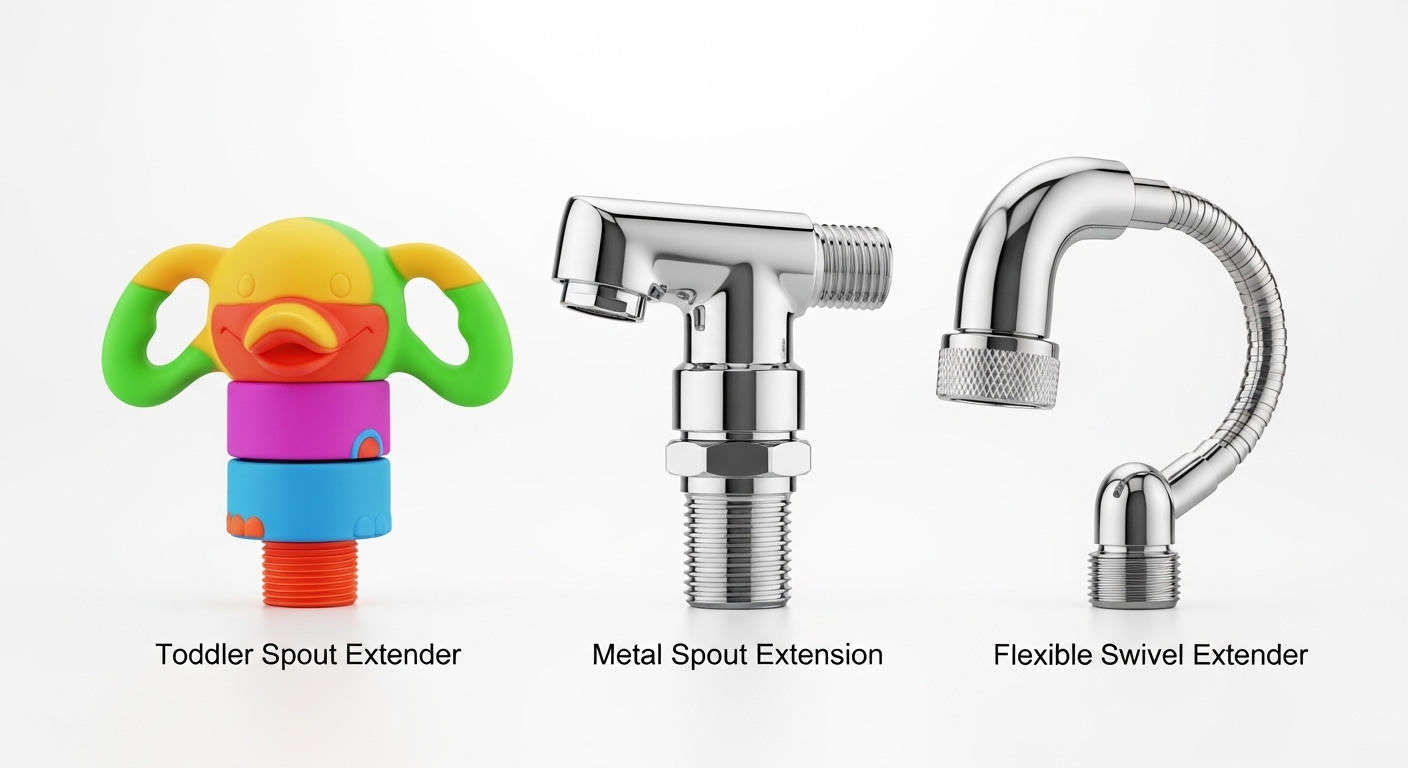
Search for a faucet extender target shoppers can grab on a weekend run, and you’ll mostly find one thing: brightly colored silicone spouts that snap onto a bathroom faucet so a two-year-old can actually reach the water. Those exist, they’re cheap, and for their one job they work. But “faucet extender” is one keyword covering three very different products, and Target’s shelves only carry one of them well. Below, we’ll sort out exactly what you’re likely trying to solve, what Target actually stocks versus what it doesn’t, and where each type is genuinely worth buying in 2026.
At avovida we test faucets, adapters, and add-on hardware in our own workshop against real US plumbing threads and daily-use abuse, so this isn’t a rewrite of a retail listing — it’s what we’d tell a friend who texted us from the aisle.
What Exactly Is a Faucet Extender, and Which Kind Do You Actually Need?
A faucet extender is any add-on that moves the water stream further out, further down, or further from the faucet body — but there are three distinct types, and buying the wrong one is the #1 reason people return them. Figure out your problem first, then pick the type.
- Toddler/silicone spout extenders — soft rubber covers that clip over a bathroom faucet and push the stream forward and down so small kids can reach it without climbing. This is what Target sells.
- Threaded spout extensions — a small metal tube that screws into your faucet’s aerator threads to add 1–3 inches of reach, usually to clear a deep or vessel sink. This is a plumbing-hardware item, not a big-box baby-aisle item.
- Swivel/flexible extender arms — a bendable or 360° pivoting attachment that redirects the stream, handy for filling buckets, watering cans, or washing hair in a shallow sink.
If your goal is helping a kid wash hands, you want type one, and Target’s the easy answer. If your spout is too short and water hits the back rim of your basin, you want type two — and honestly, a short spout is often better solved by upgrading the faucet itself. We walk through that trade-off in our guide to the best long spout reach bathroom faucet for a deep or vessel sink, which is worth reading before you spend money on a band-aid.
Does Target Actually Sell Faucet Extenders — and Which Ones?
Yes, Target reliably stocks silicone toddler faucet extenders — in-store in the baby/bath section and online — but it rarely carries threaded metal spout extensions or heavy-duty swivel arms. So a “faucet extender target” search is really a search for the kid-friendly kind.
In our experience checking availability, Target’s assortment leans toward brands like Munchkin, PandaEar, and various house-brand silicone spouts in the $5–$12 range. They’re food-grade silicone, animal-shaped or plain, and clip on with a friction fit. What you will almost never find at Target is a machine-threaded brass or stainless spout extender — those live at plumbing suppliers, hardware stores, and specialty faucet retailers. If you need the plumbing kind and want to see how add-on threaded hardware is sized and sold, our breakdown of the faucet adapter you actually need to connect a hose or filter to your tap explains the thread standards you’ll be matching.
How Much Does a Faucet Extender Cost at Target vs. Elsewhere in 2026?
Expect $5–$12 for a silicone toddler extender at Target, $8–$25 for a quality threaded metal spout extension from a hardware or plumbing source, and $15–$40 for a well-built swivel/flexible extender arm. Price tracks with material and durability, not brand hype.
| Extender Type | Typical Price | Best Source | Lifespan | Best For |
|---|---|---|---|---|
| Silicone toddler spout | $5–$12 | Target, Amazon, big-box | 6–18 months | Kids reaching the sink |
| Threaded metal spout extension | $8–$25 | Hardware / plumbing / specialty | 5+ years | Adding reach over a deep sink |
| Swivel / flexible arm | $15–$40 | Specialty, online plumbing | 3–5 years | Filling buckets, redirecting flow |
| New long-reach faucet (alternative) | $60–$220 | Faucet retailer | 10+ years | Permanent fix for short spout |
The honest takeaway: the cheapest option is also the shortest-lived. A $6 silicone clip is perfect while your child is small, but it’s a consumable — chlorine, heat, and daily tugging break down the silicone within a year or two. If you’re solving an adult plumbing problem, spending a little more on a threaded metal unit (or fixing the root cause) saves you the repeat purchase.
Will a Silicone Faucet Extender From Target Fit My Faucet?
Most silicone toddler extenders fit standard household bathroom faucets because they clip on by friction rather than threading in — but they struggle with very wide spouts, square/architectural spouts, and touchless faucets with sensors near the tip. Measure your spout’s outer width before buying; if it’s over about 1.25 inches or an unusual shape, the universal clip may not grip.
A few fit realities worth knowing:
- Round, tapered chrome spouts are the easy case — nearly every silicone extender grips these fine.
- Wide or flat “waterfall” spouts often leak around the clip because the silicone can’t seal the shape.
- Touchless/sensor faucets can misread the extender or block the sensor — check that the clip sits below the sensor window. If your touchless unit is already acting up, that’s a separate issue we cover in what a blinking touchless faucet light means and how to fix it.
- Threaded metal extenders are the opposite — they only fit if your aerator unscrews and matches the standard US sizes (15/16″-27 male or 55/64″-27 female). Bring the old aerator to match threads.
If you’re going the threaded route, remember that the aerator on the end of your faucet is a wear part anyway. Understanding how those small components come apart makes any extender install painless — our overview of the essential chrome faucet parts to know before you repair or replace one is a good primer on threads, washers, and aerator sizing.
Do Faucet Extenders Reduce Water Pressure or Splash More?
A quality extender barely changes pressure, but a poorly fitted silicone one will splash — because it widens and redirects the stream without an aerator to soften it. If splashing is your complaint, look for an extender with a built-in aerator or flow straightener rather than a plain open spout.
Threaded metal extenders usually preserve your existing aerator (you screw the extender in, then the aerator onto the extender), so pressure and stream quality stay basically identical. Silicone toddler extenders remove the aerator’s smoothing effect on purpose — the goal is an easy stream for little hands, not a tidy one — so a bit more splash is normal and not a defect.
Is a Cheap Target Faucet Extender Worth It, or Should You Spend More?
For a toddler learning to wash hands, a $6 Target silicone extender is absolutely worth it — it’s the right tool at the right price for a short-lived need. For any adult plumbing problem (short spout, deep sink, bucket filling), a cheap silicone clip is the wrong tool, and you’ll be happier spending $15–$25 on a threaded metal extender or fixing the faucet itself.
Here’s the mental model we give buyers: match the durability of the product to the durability of the need. A child outgrows the reach problem in a year or two, so a consumable silicone part is a perfect match. A short spout over a vessel sink is a permanent condition, so a permanent-grade solution — solid brass hardware, or a new faucet — is the match. Buying a $6 part to solve a permanent problem just means buying it four times.
And if the real issue is that your whole faucet is dated or too short, an extender is lipstick on a problem. In that case it’s often smarter to replace. Our guide to the best Delta bathroom faucet to buy in 2026 and our roundup of the kitchen faucet reviews buyers actually trust both list models with genuinely long, well-aerated spouts that make extenders unnecessary.
What Are the Best Faucet Extender Alternatives if Target Doesn’t Have What I Need?
If Target only stocks the toddler kind and you need real reach, your best alternatives are: a solid brass threaded spout extension from a plumbing supplier, a swivel aerator that pivots the existing stream, or a pull-down/pull-out faucet that eliminates reach problems entirely. Each solves a different flavor of the “water doesn’t go where I need it” problem.
- Solid brass threaded extension — the durable fix for adding 1–3 inches over a deep basin. Look for brass over plastic; it won’t crack under repeated wrenching.
- Swivel aerator — screws onto your existing threads and pivots up to 360°, great for directing water to the sides of a large sink.
- Pull-down or pull-out spray head — for kitchens, this beats any extender because the head comes to the mess. If you’re weighing that route, see whether you can even connect a pull-down kitchen faucet to a hose adapter for outdoor filling.
How Do You Install a Faucet Extender Correctly?
Installation depends on the type, but both are tool-light. A silicone toddler extender just clips on; a threaded metal extender screws into the aerator threads in under five minutes. Here’s the reliable method for the threaded kind, which is where people usually go wrong.
- Unscrew the existing aerator by hand, turning counter-clockwise (facing up into the spout). If it’s stuck, wrap a cloth around it and use pliers gently — don’t scratch the finish.
- Check the thread direction and size. Male threads (on the outside) are typically 15/16″-27; female (inside) are 55/64″-27. The extender must match.
- Wrap the extender’s threads with plumber’s tape — two or three turns clockwise — to seal against drips.
- Screw the extender into the spout hand-tight, then a quarter turn more with a cloth-wrapped wrench.
- Screw your aerator onto the bottom of the extender so you keep the smooth, splash-free stream.
- Run the water and check for leaks at both joints. A weep at the top means re-tape and re-seat.
For a silicone clip, just push it firmly onto the spout, tug to confirm it’s gripping, and run warm (not scalding) water. If it slides off, your spout is likely too wide or the wrong shape for that model.
Quick Buyer’s Recap
To close the loop on the original question — is a faucet extender target shoppers can buy the best choice? For a toddler’s reach, yes, and it’s the cheap, sensible pick. For anything else, Target isn’t the right store, and a threaded metal extender or a new long-reach faucet is the better spend. Buy for the durability of the problem, not the lowest sticker price.
FAQ
Does Target sell faucet extenders in store or only online?
Target sells silicone toddler faucet extenders both in store (baby/bath section) and online. It rarely stocks threaded metal spout extensions or heavy-duty swivel arms, so for those you’ll want a hardware store, plumbing supplier, or specialty faucet retailer.
Are Target faucet extenders safe for kids?
Yes — the silicone toddler extenders sold at Target are made from food-grade, BPA-free silicone and are designed specifically to help small children reach the water safely. Replace them when the silicone shows cracks, stiffening, or discoloration, typically every 6–18 months.
Will a faucet extender work on a touchless or motion-sensor faucet?
Sometimes. A silicone extender can work if it clips on below the sensor window without blocking it, but it may interfere with detection on some models. Threaded extenders generally aren’t compatible with sealed touchless spouts. Test carefully, and if your sensor faucet starts misbehaving, check the sensor and batteries before blaming the extender.
How long do faucet extenders last?
Silicone toddler extenders last roughly 6–18 months with daily use before the material degrades. Solid brass threaded extensions last 5+ years, and quality swivel arms 3–5 years. Material is the biggest factor — brass and stainless far outlast plastic and silicone.
Should I buy a faucet extender or just replace my short faucet?
If the short reach is permanent and bothers you daily, replacing the faucet with a longer-spout model (around $60–$220) is usually the better long-term value than a series of cheap extenders. If the need is temporary — like a child growing — an inexpensive extender is the smarter buy. Match the fix to how long the problem will last.
Author note: This guide was written and tested by the avovida fixtures team, who bench-test faucets, aerators, and add-on hardware against US standard plumbing threads (15/16″-27 and 55/64″-27) and everyday use. avovida is an independent faucet and bathroom-fixtures specialist; we recommend products based on hands-on durability testing, not retail commissions. As with any plumbing add-on, check the manufacturer’s warranty and fit specifications before you buy, since threaded parts must meet ASME/ANSI faucet standards to seal correctly.