
If you’ve been typing “touchless faucet kitchen reddit” into Google at 11pm trying to figure out whether these things are a gimmick or genuinely useful, you’re in good company — it’s one of the most-searched faucet questions out there, precisely because people trust real owners over marketing copy. So let’s do exactly that: pull together what actual redditors in r/HomeImprovement, r/Plumbing, and r/DIY consistently say, cut the noise, and give you a straight answer with real numbers, real failure modes, and real buying advice.
Short version, and then we’ll get specific: the technology has matured. The complaints you’ll read from 2015 (constant false triggers, dead sensors after a year) are far less common on today’s mid-to-premium models. The complaints that remain are about batteries, price, and buying junk.
Is a touchless kitchen faucet actually worth it, or is it just a gimmick?
For most home cooks, yes — it’s worth it, and the redditors who use one daily rarely go back. The single most repeated line across threads is some version of “I didn’t think I’d care, now I’m annoyed when I use a normal faucet at someone else’s house.” That’s not marketing; that’s habituation to a genuinely useful feature.
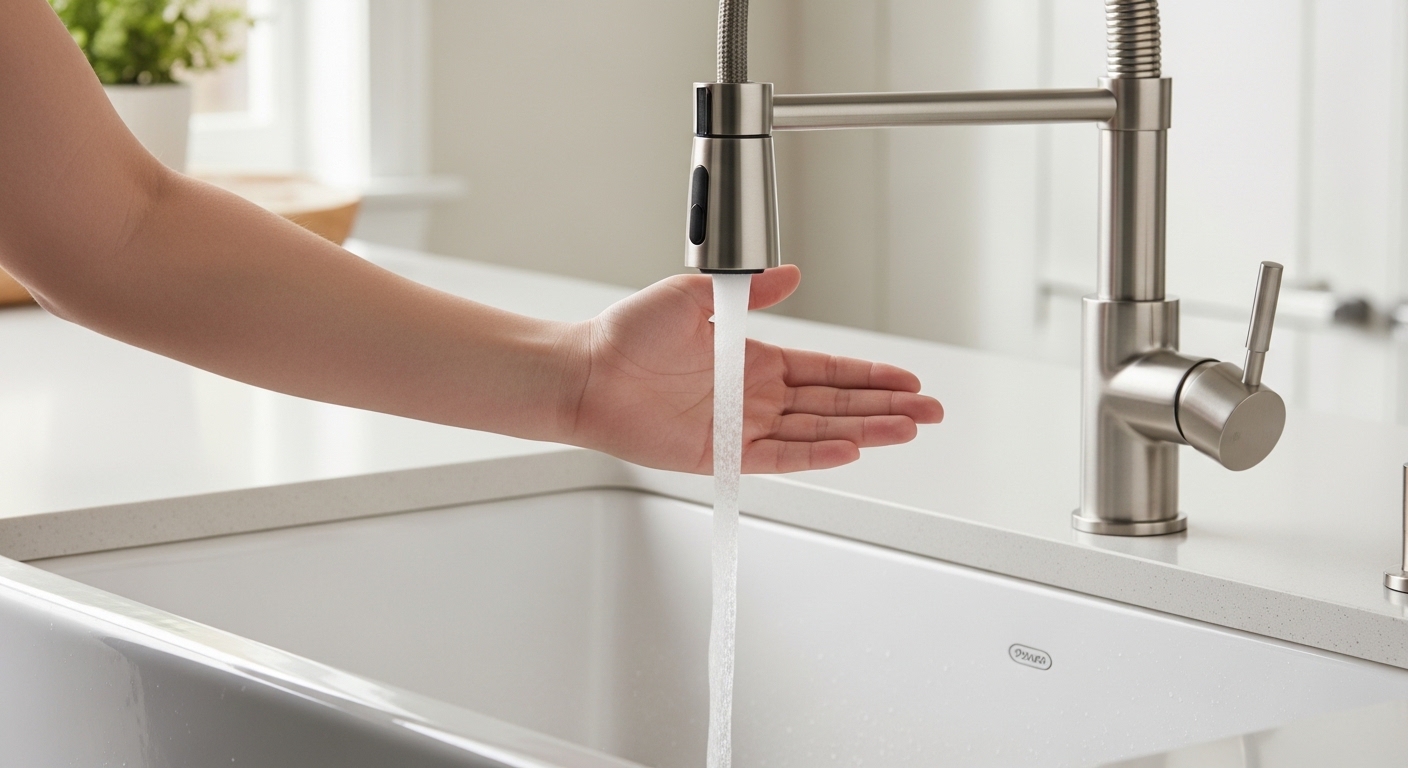
The real-world value shows up in specific moments: raw chicken juice on your hands and you need water now without smearing salmonella on the handle; hands full of soapy dishes; a pot of pasta water you need to top off with one elbow. You wave, water runs. You wave again, it stops. Redditors who cook a lot, have kids, or hate cleaning gunk off faucet handles are the happiest owners.
Who’s underwhelmed? People who bought it as a novelty and don’t cook much. If your sink mostly holds a single coffee mug a day, you’re paying a premium for a feature you’ll shrug at. The tech isn’t a gimmick — but for a light-use kitchen, the value proposition is thin.
What are the most common complaints redditors have about touchless faucets?
The three complaints that dominate every thread are batteries, price, and cheap-brand unreliability — in that order. Almost none of the frequent complaints are about the touchless concept itself; they’re about implementation and buying decisions.
- Battery life anxiety. Most models run on 4–6 AA batteries in a box under the sink. Owners report anywhere from 1 to 3 years, depending on how heavily the faucet is used and whether it also has manual handle operation. The fix redditors love: a hardwired AC adapter/transformer, sold by most brands, so you never think about batteries again.
- Occasional false triggers. On good units this is rare, but a few owners mention the sensor catching a dish towel, a passing pet, or their own body as they load the dishwasher. Well-designed faucets let you choose whether the sensor is on the spout, the base, or both, which cuts this way down.
- Cheap brands failing early. This is where the one-star Reddit rants live. Sub-$120 no-name touchless faucets show up repeatedly with dead sensors, leaking solenoids, and no replacement parts. Nearly every experienced commenter says the same thing: buy Moen, Delta, or Kohler, or don’t buy touchless at all.
Which touchless kitchen faucet brands does Reddit actually recommend?
Reddit overwhelmingly recommends the big three American brands — Moen, Delta, and Kohler — because of parts availability, real warranties, and solenoids that don’t die. If you want the safest “won’t regret it” pick, redditors point to Moen (MotionSense) and Delta (Touch2O / VoiceIQ) most often.
The reasoning is consistent and worth understanding, because it’s the same logic that shows up in the popular Moen vs Kohler kitchen faucet Reddit debate: these brands stock replacement cartridges, solenoids, and sensor modules for a decade, honor lifetime warranties without a fight, and their touchless mechanisms have millions of units in the field. A no-name faucet might photograph identically for half the price, but when the solenoid clicks and no water comes, there’s no part to order and no one to call.
| Brand / System | Typical price (single-handle) | Activation | What redditors say |
|---|---|---|---|
| Moen MotionSense | $280–$450 | Wave over top sensor + wave at base | Most-recommended; reliable, easy parts, lifetime warranty |
| Delta Touch2O / VoiceIQ | $260–$500 | Tap anywhere + optional touchless + voice | Loved for tap-to-run; TempSense LED and voice are polarizing extras |
| Kohler Sensate | $400–$650 | Wave over sensor | Premium feel, fast response; priciest of the three |
| No-name / marketplace | $80–$140 | Wave over base sensor | Where most Reddit horror stories originate; avoid |
One nuance redditors raise: Moen’s “MotionSense” is fully touchless (wave, no contact), while Delta’s flagship is “Touch2O” — you tap the spout or handle with a wrist or forearm. Both solve the dirty-hands problem, but they’re not identical. If you literally don’t want to touch anything, you want wave-activated (Moen/Kohler); if you don’t mind a wrist bump, Delta’s tap tech is what many owners actually prefer because it false-triggers less.
Do touchless faucets waste water or actually save it?
They generally save water, not waste it, as long as you’re not fighting false triggers. Because the flow stops the instant you step away, you eliminate the classic habit of leaving the tap running while you scrub, rinse dishes, or grab something. Several redditors mention lower water bills after switching.
The flow rate itself is governed by the aerator, not the sensor — U.S. kitchen faucets are typically capped at 1.8 GPM (gallons per minute) under WaterSense-aligned standards, and many touchless models ship at 1.5 GPM. That’s the same as any modern faucet. If yours ever feels weak, the culprit is usually the aerator, and swapping to the right insert is a two-minute fix — our guide to standard faucet aerator sizes in the US walks through exactly which one fits so you don’t over- or under-tighten flow.
The one genuine water-waste scenario is a faucet that false-triggers when you walk past. On a quality unit with adjustable sensor zones, this is a non-issue. On a cheap one parked next to a busy walkway, it can nag — another reason the brand you pick matters more than the feature itself.
How hard is it to install a touchless kitchen faucet yourself?
It’s a moderate DIY job — harder than a standard faucet but very doable in an afternoon if you can turn a wrench and follow a diagram. The extra steps versus a normal faucet are the electronics: a battery box or transformer to mount, a sensor/data cable to connect, and a solenoid valve to seat in the supply line. No soldering, no special tools beyond an adjustable wrench and a basin wrench.
- Shut off the hot and cold supply valves under the sink and open the faucet to release pressure.
- Remove the old faucet (this is often the annoying part — corroded mounting nuts).
- Drop the new faucet through the deck hole; secure it with the mounting hardware from below.
- Connect the supply lines, then the solenoid valve inline, then the sensor cable — everything is keyed and click-fit, so it only goes one way.
- Mount the battery pack or plug in the AC transformer, restore water, and run through the calibration steps in the manual.
Where people get stuck is almost never the electronics — it’s the same old-faucet-removal and basin-nut fight anyone faces. If your existing faucet is weeping around the base, address that first; a wobbly or leaking mount will haunt the new install, and our breakdown of why a kitchen faucet leaks at the base covers the usual suspects (worn O-rings, loose mounting nut) before you swap in the new unit.
Why is my touchless faucet acting up — and can I fix it myself?
Most touchless faucet misbehavior comes down to three fixable things: dying batteries, a dirty or blocked sensor, or a mineral-clogged solenoid — and you can usually solve all three at home. Random on/off cycling, sluggish response, or a blinking indicator light are classic low-battery symptoms, not a dead faucet.
Start simple: fresh batteries (or verify the transformer connection), then wipe the sensor lens with a soft cloth because grease and toothpaste-like water spotting can scatter the infrared beam. If water flow is weak or won’t start, hard-water scale in the solenoid or aerator is the likely offender. Blinking-light patterns each mean something specific per brand — if that’s what you’re seeing, our dedicated guide on a touchless faucet light blinking decodes what each pattern is telling you before you assume the worst.
The reassuring news from Reddit: outright sensor-module deaths on major brands are uncommon, and when they do happen, Moen/Delta/Kohler will typically ship the replacement electronics under warranty. That’s the whole argument for spending more up front — the failure is recoverable instead of terminal.
Touchless vs. touch vs. standard pull-down: which should you actually buy?
Buy touchless if hands-free hygiene is your priority, touch (tap) if you want most of the benefit with fewer false triggers, and a standard pull-down if you want maximum reliability and the lowest price. All three can be excellent faucets; the sensor is an add-on, not the whole product.
| Type | Best for | Trade-off | Price premium vs. standard |
|---|---|---|---|
| Touchless (wave) | True hands-free, messy cooking, kids | Batteries/power; rare false triggers | +$100–$200 |
| Touch (tap with wrist) | Convenience with fewer false triggers | You still make contact | +$80–$180 |
| Standard pull-down | Reliability, budget, simplicity | Handle gets dirty; must be turned off manually | Baseline |
A point worth making that redditors often overlook: the finish and the spray head matter just as much day-to-day as the sensor. A touchless faucet is still a faucet — you’ll live with its reach, its spray/stream toggle, and how the finish holds up to water spots for the next decade. If you’re torn between finishes, the same durability logic in our comparison of a stainless steel faucet versus chrome applies directly here: spot-resistant stainless/brushed finishes hide fingerprints and mineral marks better than polished chrome, which matters more once you’re not touching the faucet to turn it on anyway.
Avovida’s take: who should buy a touchless kitchen faucet in 2026?
Buy one if you cook regularly, care about kitchen hygiene, and are willing to spend $250+ on a Moen, Delta, or Kohler. Skip it if your budget forces you toward a no-name unit — in that case a quality standard pull-down will make you far happier than a cheap touchless one.
That’s the same conclusion the Reddit hive mind lands on after the arguing settles: the technology is good now, the brand is what determines whether you love it or return it, and batteries are a solvable annoyance (hardwire it and forget it). Match the faucet to how you actually use your kitchen, not to how futuristic it looks in the listing photo.
FAQ
How long do the batteries last in a touchless kitchen faucet?
Typically 1–3 years on 4–6 AA batteries, depending on usage. Heavy cooking households land on the shorter end. Most major brands sell an AC adapter/transformer so you can hardwire the faucet under the sink and eliminate battery changes entirely — a popular Reddit recommendation.
Will a touchless faucet still work if the power or batteries die?
On most models, yes. Quality touchless faucets from Moen, Delta, and Kohler retain a manual handle for temperature and flow, so even with dead batteries you operate it like a normal faucet — you just lose the hands-free wave feature until you swap batteries or plug in the transformer.
Do touchless faucets false-trigger and waste water?
Rarely, on a well-designed unit with adjustable sensor zones. False triggers mostly plague cheap faucets or ones installed right next to a busy walkway. On reputable brands you can choose which sensor is active (spout, base, or both), which nearly eliminates accidental activation.
Are touchless faucets worth the extra money over a regular pull-down?
For frequent cooks and families, most owners say yes — the hands-free hygiene during messy food prep is the payoff. For light-use kitchens, the $100–$200 premium buys a feature you won’t use much, and a standard pull-down is the smarter spend.
What’s the difference between “touchless” and “touch” faucets on Reddit?
Touchless (like Moen MotionSense) activates when you wave near a sensor — zero contact. Touch (like Delta Touch2O) starts flow when you tap the spout or handle with a wrist or forearm. Touch tech false-triggers less; touchless is truly hands-free. Both solve the dirty-handle problem.
Can I install a touchless kitchen faucet myself?
Yes, if you’re comfortable with basic plumbing. It’s a moderate DIY job — the extra steps are a battery box or transformer, a click-fit sensor cable, and an inline solenoid valve. No soldering. The hardest part is usually removing the old, corroded faucet, not the electronics.
About the author: This guide was written by the Avovida fixtures team, who have specified, installed, and tested touchless, touch, and standard kitchen faucets across hundreds of residential projects. We cross-reference real owner reports on Reddit and manufacturer engineering data rather than repeating spec sheets.
Why trust Avovida: Avovida (avovida.net) is a dedicated faucet and bathroom-fixtures retailer. We evaluate products against U.S. plumbing standards — WaterSense flow limits, NSF/ANSI 61 lead-safety compliance, and CSA/UPC listings — and we always factor in the manufacturer’s warranty (Moen, Delta, and Kohler all back their touchless kitchen faucets with limited lifetime warranties on finish and function, including the electronic components). A faucet is only as good as the parts and support behind it, and that’s exactly what we weigh in every recommendation.