
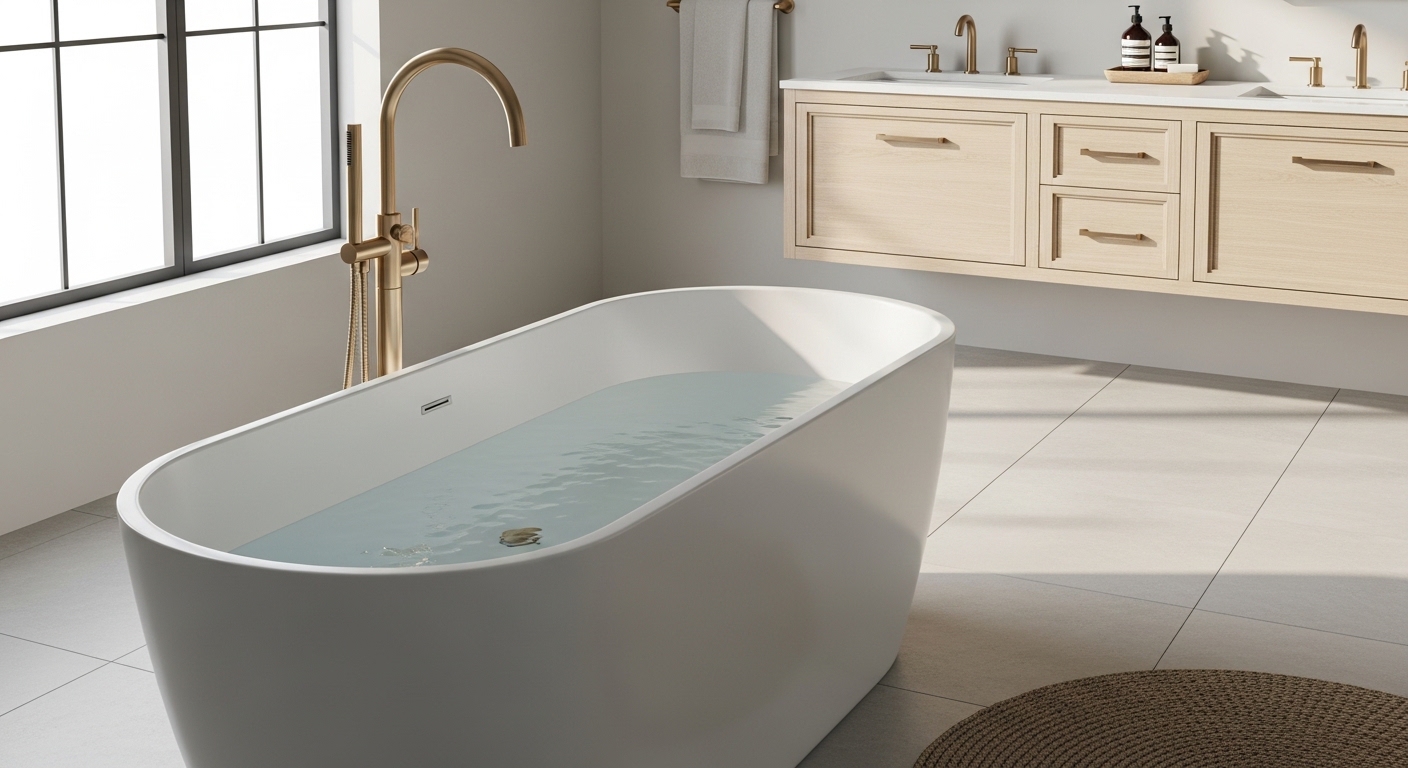
Finding a freestanding tub filler that matches Delta Champagne Bronze is trickier than it sounds, because “champagne bronze” isn’t a regulated color — it’s a Delta marketing name for a specific warm, slightly pinkish-gold brushed finish. Two faucets can both say “champagne bronze” on the box and still look noticeably different side by side. This guide walks you through exactly how to match the finish, whether to stay in-brand, what specs actually matter on a floor-mounted filler, and how to avoid the single most common (and expensive) mistake people make when buying one.
At avovida, we install, photograph, and finish-test bathroom fixtures for a living, so the advice below is about getting a real-world match in your bathroom light — not a color swatch that only looks right on a screen.
What exactly is Delta Champagne Bronze, and why is it hard to match?
Delta Champagne Bronze is a warm brushed gold-bronze finish with a faint rosy undertone — lighter and pinker than “brushed gold,” warmer than “brushed nickel,” and far softer than the near-yellow of polished brass. That specific undertone is why matching it is hard: most competing “gold” faucets skew either too yellow (looks brassy) or too cool (looks like dirty nickel) next to it.
Delta’s Champagne Bronze uses a PVD (physical vapor deposition) coating over the finish. PVD is worth understanding because it’s the real reason the color stays consistent: it bonds the finish molecularly to the metal, so it resists tarnishing, scratching, and the color-shift you get with cheap electroplated golds. A filler that isn’t PVD-coated may match on day one and drift toward a duller, greener tone within a year or two of steam and water contact.
- Undertone: warm gold with a subtle rose/pink cast — not yellow, not gray.
- Texture: brushed (satin), not polished/shiny — this hides water spots and fingerprints.
- Coating: PVD on genuine Delta pieces, which is what keeps the color stable.
- Closest cousins: Moen “Brushed Gold,” Brizo “Luxe Gold,” Kohler “Vibrant Brushed Moderne Brass” — related, but each is a slightly different hue.
Should you just buy Delta’s own champagne bronze tub filler for a guaranteed match?
Yes — if a flawless, no-guesswork match is your priority, buy Delta’s own freestanding tub filler in Champagne Bronze. It is the only way to be 100% certain the filler matches your existing Delta faucets, shower trim, and accessories, because it’s the exact same finish formula and PVD process across the product line. When your tub filler sits three feet from a matching Delta widespread lavatory faucet, even a small mismatch is glaring, and in-brand is the safe move.
That said, Delta’s floor-mount fillers run roughly $600–$1,300, which is a real chunk of a bathroom budget. If your tub is in a separate zone — say, a freestanding soaker in the corner with no other champagne bronze fixture within eyeshot — a well-chosen third-party filler labeled “champagne bronze” or “brushed gold” can save you $200–$500 and look completely at home. The rule of thumb: the closer the filler sits to another Delta piece, the more you should stay in-brand.
If you’re still deciding on the rest of your Delta fixtures, our guide to the best Delta bathroom faucet to buy in 2026 is a good companion read for keeping your whole suite consistent.
How do you check a third-party finish match before you commit?
Order the filler (or a sample handle) and hold it against your existing Delta piece under three light sources before you install anything. Finish is the one spec you cannot judge from a product photo — screens shift color, and studio lighting is nothing like your bathroom.
- Daylight by a window — reveals the true undertone (this is where “too yellow” shows up).
- Warm LED / incandescent (2700–3000K) — how it’ll look most evenings; warm bulbs make gold read richer.
- Cool white LED (4000K+) — worst case for gold finishes; if it still matches here, you’re safe.
If it matches in all three, buy it. If it only matches under warm light, you’ll regret it every morning. Keep the packaging until you’ve done this test — a smart return policy is your best insurance against a finish that photographed perfectly and arrived wrong.
Delta champagne bronze vs. third-party “brushed gold” fillers: which should you pick?
Pick genuine Delta Champagne Bronze when you need an exact match near other Delta fixtures; pick a quality third-party brushed-gold filler when the tub stands alone and you want to save money. Here’s how the realistic options stack up.
| Option | Typical price | Finish match to Delta CB | Coating | Best for |
|---|---|---|---|---|
| Delta floor-mount filler, Champagne Bronze | $600–$1,300 | Exact (same finish) | PVD | Tub near other Delta pieces |
| Brizo Luxe Gold filler | $900–$1,600 | Very close, slightly richer | PVD | Upgrade look, budget flexible |
| Moen Brushed Gold filler | $500–$1,000 | Close, slightly cooler | PVD | Standalone tub, mixed brand bath |
| Mid-range “champagne bronze” filler | $250–$450 | Varies — verify in person | Often PVD, check specs | Budget builds, isolated tub |
| Budget import filler (unbranded) | $120–$220 | Unpredictable, often too yellow | Frequently electroplated | Rentals, short-term use |
The pattern is clear: the money you spend buys finish consistency and coating durability, not just the pour rate of the spout. A $150 filler can look identical to a $700 one in a listing photo — the difference shows up two winters later when one has held its color and the other has gone dull and blotchy where the water hits.
What specs actually matter on a freestanding tub filler besides the finish?
Beyond color, the four specs that make or break a floor-mounted filler are height, spout reach/flow, the rough-in valve, and whether it includes a hand shower. Get these wrong and even a perfect finish match will be frustrating to use.
- Height: Most floor-mount fillers stand 38–43 inches tall. The spout should clear your tub’s rim and arc into the basin, not spill over the edge. Measure your tub’s rim height and add clearance before buying.
- Flow rate (GPM): Look for 5–7 GPM. A deep 60–70 gallon soaking tub filling at a stingy 4 GPM feels like waiting forever; a higher flow rate fills it fast.
- Rough-in valve: The freestanding filler mounts to a floor rough-in that’s set during the plumbing stage. Many fillers sell the trim and the rough-in valve separately — confirm you’re buying both, or that your rough-in is compatible.
- Hand shower: Most freestanding fillers include a handheld sprayer on a swivel — great for rinsing hair, kids, and cleaning the tub itself. Make sure the hand shower is the same champagne bronze finish (some kits ship it in a mismatched finish).
If you’re weighing floor-mount versus a deck- or wall-mounted setup, the trade-offs differ a lot — our breakdown of a Moen Roman tub faucet kit covers deck-mounted options if your tub has a wide rim rather than a true freestanding profile.
Can you install a freestanding tub filler yourself?
Partially — the trim you can DIY, but the floor rough-in almost always needs a plumber and usually access below the floor. The rough-in valve has to be plumbed into your hot and cold supply lines and anchored to a mounting bracket beneath the subfloor, which typically means running new lines and cutting into the floor if your tub didn’t previously have a floor-mount filler.
If your rough-in is already in place, swapping the visible trim onto it is a manageable weekend job with basic tools. The keys are seating the O-rings correctly, hand-tightening plus a careful quarter-turn (over-torquing cracks the finish), and testing for leaks at low pressure before you fully commit. If you’ve never touched supply plumbing, though, this is a fixture where a mistake floods a floor — hire it out for the rough-in stage.
Will champagne bronze look dated in a few years?
No — warm metals like champagne bronze have moved from “trend” to “staple,” and brushed gold-bronze in particular reads as timeless rather than of-the-moment. The reason is texture: brushed (satin) finishes age far better than high-shine ones because they’re understated and don’t scream a specific decade the way polished gold did in the ’80s. A brushed champagne bronze filler pairs cleanly with white tubs, matte-black accents, natural stone, and wood vanities alike.
If you love warm metals but aren’t locked into champagne bronze specifically, it’s worth seeing the neighbors before you commit. A slightly darker, more traditional option is covered in our look at whether an oil rubbed bronze bath faucet is right for your bathroom, and for a cooler, more silver-toned warm metal, our take on a polished nickel bath setup lays out the differences. Seeing all three side by side is the fastest way to be sure champagne bronze is the one you actually want.
How do you keep a champagne bronze finish looking new?
Wipe it dry after use and clean it only with mild soap and water — that’s genuinely all a PVD champagne bronze finish needs. The enemies of any bronze finish are abrasive pads, acidic cleaners (vinegar, bathroom scrubs with acid), and harsh chemicals, all of which can dull or etch the coating over time.
- Do: soft microfiber cloth, mild dish soap, warm water, dry after contact to prevent water spotting.
- Don’t: vinegar, bleach, ammonia glass cleaners, abrasive sponges, or “polish” products meant for raw brass.
- Hard water: if you have mineral-heavy water, a quick weekly dry-wipe prevents the cloudy scale buildup that makes any finish look worn.
Where should you actually buy your champagne bronze tub filler?
Buy from a seller with a clear finish-match return policy and, ideally, one that lets you see or sample the finish first — because the finish is the one thing you can’t verify from a listing. Big-box plumbing showrooms, specialist online fixture retailers, and the brand’s own store are all fine; the deciding factor is returnability, not the storefront.
Before you check out, confirm three things in the product listing: (1) that it’s the complete kit — trim and rough-in valve, or that you already have a compatible rough-in; (2) the flow rate and height match your tub; and (3) the finish is warranted. Delta, for example, backs its finishes with a lifetime limited warranty against tarnishing and corrosion, which is exactly the kind of coverage that matters on a PVD finish you’re counting on to hold its color. A filler without a finish warranty is a filler the maker isn’t confident will stay looking right.
FAQ
Does champagne bronze match with brushed gold from other brands?
Sometimes, but not reliably. Champagne bronze has a warm, slightly rosy undertone that many “brushed gold” finishes don’t share — some skew more yellow or more cool. If the two pieces will sit near each other, test them side by side under daylight and warm light before committing. If they’re in separate zones of the bathroom, a small difference usually goes unnoticed.
Is a Delta champagne bronze tub filler worth the higher price?
If it sits near other Delta fixtures, yes — the guaranteed exact match and PVD finish durability justify the cost. If your freestanding tub stands alone with no other champagne bronze piece in view, a quality third-party brushed-gold filler at $250–$450 can look just as good for less, provided you verify the finish in person and confirm it’s PVD-coated.
What flow rate do I need to fill a freestanding soaking tub quickly?
Aim for 5–7 GPM. A large 60–70 gallon soaker at 6 GPM fills in roughly 10–12 minutes, while a low-flow 4 GPM filler can push that past 15–18 minutes, which feels agonizing when you want a bath now. Check the filler’s rated GPM before buying — it’s easy to overlook and hard to fix later.
Do freestanding tub fillers come with a hand shower in champagne bronze?
Most do include a handheld sprayer, but not all ship it in a matching finish. Read the listing carefully — occasionally the hand shower or its hose comes in a default finish that clashes with the champagne bronze spout. Confirm every visible component is listed as champagne bronze before ordering.
Will champagne bronze tarnish or change color over time?
A genuine PVD champagne bronze finish resists tarnishing and holds its color for years, which is why the coating matters so much. Cheaper electroplated “champagne bronze” fillers are the ones that dull, spot, or shift green over time, especially where water hits daily. Buy PVD, back it with a finish warranty, and clean it gently — it’ll stay looking new.
Author note: This guide was written by the avovida fixtures team, who finish-test and photograph bathroom faucets across real lighting conditions and hard-water environments. avovida is an online faucet and bathroom-fixtures brand focused on plain-English buying advice; our finish-match recommendations reflect hands-on comparison of Delta Champagne Bronze against competing warm-metal finishes, and we reference manufacturer PVD standards and finish warranties rather than marketing copy.