
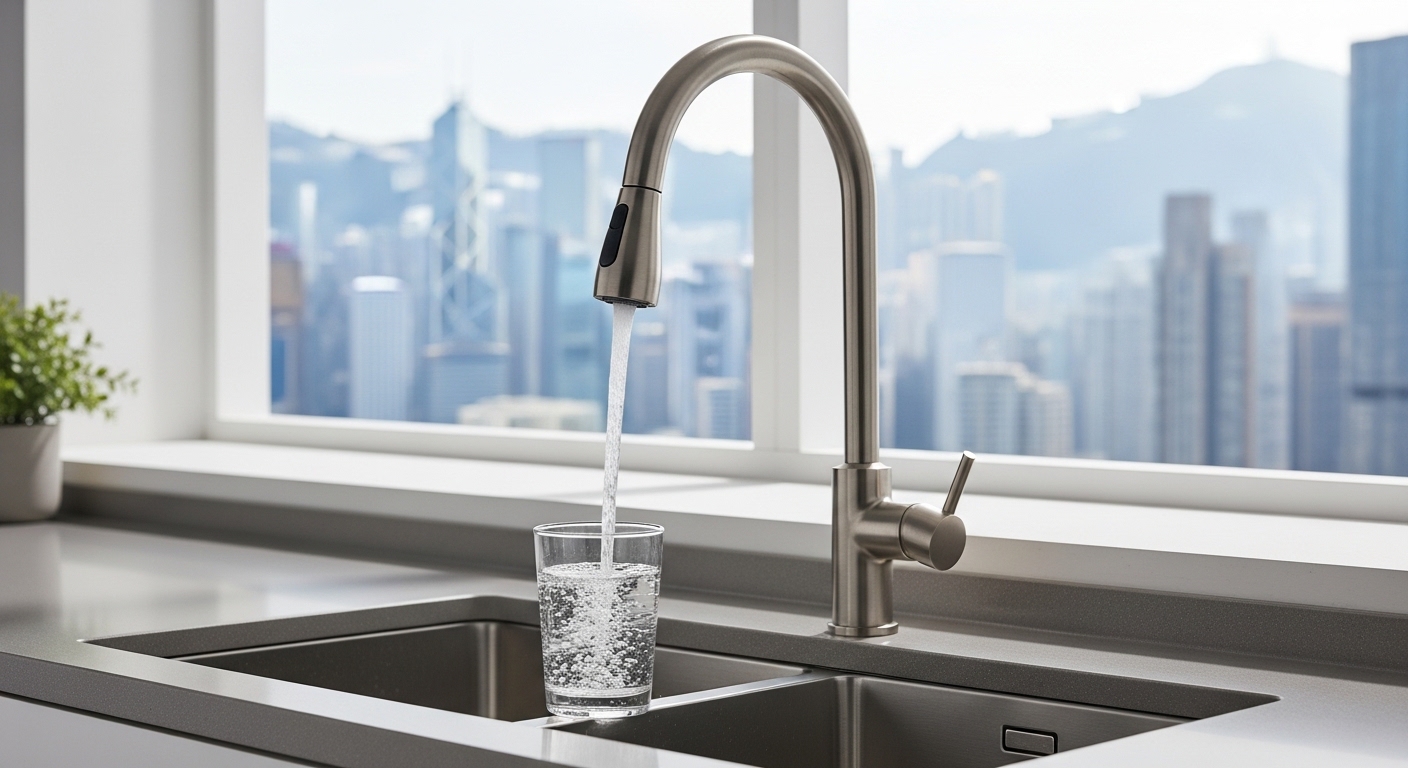
If you’ve been searching for the right tap water filter Hong Kong setup for your apartment, village house, or serviced flat, you’re already ahead of most residents. Hong Kong’s Water Supplies Department delivers water that leaves the treatment plant well within drinking standards, but what flows out of your kitchen tap can be very different — especially in older walk-ups in Sai Ying Pun, North Point, or Yau Ma Tei where galvanized steel risers and rooftop tanks add a final layer of contamination. This guide breaks down the filter technologies that actually work in Hong Kong’s plumbing reality, the certifications worth paying for, and how to match a filter to your specific faucet and flat.
Why a Tap Water Filter Hong Kong Households Actually Need It
Hong Kong sources roughly 70-80% of its raw water from Dongjiang in Guangdong and the rest from local catchments. After treatment at plants like Tai Po and Sha Tin, the water is chlorinated, fluoridated, and pumped through hundreds of kilometers of pipework. The chemistry leaving the plant is clean. The problem is the journey afterward.
In a typical Hong Kong residential building, treated water travels through underground mains, into a basement sump tank, up through a riser, into a rooftop storage tank, and then down through internal building plumbing before reaching your faucet. Each of these stages is a potential source of recontamination — biofilm in tanks, sediment from old pipes, copper or lead solder leaching, and chlorine byproducts that form during long retention times.
A point-of-use tap water filter solves the last-mile problem without requiring you to renovate a single pipe. That’s why filtration has become standard equipment in modern Hong Kong kitchens, alongside instant boiling taps and pull-out spray faucets.
The Contaminants Most Worth Filtering in Hong Kong
- Chlorine and chloramines — added at treatment for disinfection; causes the swimming-pool taste and dries out skin.
- Sediment and rust particles — from aging galvanized risers, often the cause of brown water after a building water cut.
- Lead traces — historically an issue after the 2015 Kai Ching Estate incident; still a concern in some older fittings.
- Trihalomethanes (THMs) — disinfection byproducts that form when chlorine meets organic matter.
- Microplastics — increasingly documented in urban water supplies worldwide.
- Volatile organic compounds (VOCs) — trace industrial residues, especially relevant for Dongjiang-sourced water.
Types of Tap Water Filters Available in Hong Kong
There’s no single “best” filter — the right choice depends on your faucet style, water pressure, cabinet space, and how much you’re willing to spend per liter of filtered water. Below is the breakdown that matters when you’re choosing a tap water filter Hong Kong apartments can realistically accommodate.
1. On-Faucet Filters
These screw onto the end of your existing spout in place of the aerator. They’re the cheapest entry point — typically HK$250 to HK$800 — and require zero plumbing work, which is why they’re popular with renters. The trade-off is flow rate: most on-faucet units bottleneck your tap to around 1.5 L/min, and they only fit faucets with standard male or female aerator threads (M22 or M24 in most cases).
2. Countertop Gravity Filters
Standalone units that sit beside your sink and dispense filtered water through their own spigot. They occupy counter space — at a premium in any Hong Kong kitchen — but they offer multi-stage filtration without touching your plumbing. Good for households where the existing faucet has an unusual finish you don’t want to disturb.
3. Under-Sink Filters
Mounted inside the cabinet below the sink, connected to the cold-water supply line. Filtered water is delivered through a dedicated secondary faucet or, increasingly, through a three-way mixer faucet that combines hot, cold, and filtered water in a single fixture. This is the most popular installation in newer Hong Kong builds.
4. Reverse Osmosis (RO) Systems
A subcategory of under-sink filters that includes a semi-permeable membrane stripping out almost everything — including dissolved minerals. RO produces the purest water but wastes 2-4 liters of reject water per liter of filtered output, which matters if your building meters water aggressively.
5. Whole-Home Filters
Installed at the water main entry point, treating every tap, shower, and toilet in the flat. Rare in Hong Kong residential builds due to space and access constraints, but increasingly common in village houses in the New Territories.
Tap Water Filter Hong Kong Comparison Table
Use the table below to narrow down which category of filter fits your living situation. Prices reflect typical Hong Kong retail ranges as of early 2026 and exclude installation labor.
| Filter Type | Typical Price (HK$) | Filtration Stages | Flow Rate | Best For | Annual Cost (Cartridges) |
|---|---|---|---|---|---|
| On-Faucet | 250 – 800 | 1 – 2 | ~1.5 L/min | Renters, studios, short leases | HK$400 – 900 |
| Countertop Gravity | 900 – 2,500 | 3 – 4 | Gravity-fed (slow) | Heritage buildings, no-install scenarios | HK$600 – 1,200 |
| Under-Sink (Standard) | 1,500 – 4,500 | 3 – 5 | ~3 – 5 L/min | Most family flats, modern kitchens | HK$800 – 1,800 |
| Reverse Osmosis | 3,500 – 9,000 | 4 – 7 | ~0.5 – 1 L/min (tanked) | Concerned households, infant formula prep | HK$1,200 – 2,400 |
| Whole-Home | 8,000 – 25,000 | 2 – 3 (per cartridge) | ~15 – 30 L/min | Village houses, large flats | HK$1,500 – 3,500 |
The Filtration Technologies That Actually Matter
Marketing copy in Hong Kong’s filter retail space throws around terms like “nano,” “molecular,” and “ionized” with abandon. Ignore the jargon and focus on these four proven technologies, ideally combined in sequence.
Sediment Pre-Filtration
A pleated polypropylene cartridge, usually rated at 5 microns, that catches rust flakes, sand, and other particulates before they reach the finer stages. This stage is non-negotiable in older Hong Kong buildings — without it, your finer cartridges clog within weeks. It also protects the aerator inside your kitchen faucet, which is one of the small mercies that extends fixture life.
Activated Carbon Block
The workhorse stage. Compressed coconut-shell carbon adsorbs chlorine, chloramines, THMs, VOCs, and most organic contaminants while improving taste and odor. A quality carbon block rated to 0.5 microns will also catch cysts like Giardia and Cryptosporidium. Look for a stated NSF/ANSI Standard 42 or 53 certification.
Heavy Metal Reduction (KDF / Specialized Resin)
Stages designed specifically to capture lead, copper, mercury, and other heavy metal traces. KDF-55 media is the most common; some premium units use proprietary lead-selective resins. This is the stage that matters most after Hong Kong’s historical lead-in-water incidents.
Reverse Osmosis Membrane
If used, the membrane is the final barrier — a TFC (thin-film composite) membrane with a pore size of around 0.0001 microns. It will strip out fluoride, nitrates, and dissolved solids, but it also removes beneficial minerals, which is why higher-end RO systems include a remineralization cartridge afterward.
How to Choose the Right Filter for Your Hong Kong Faucet
Compatibility is where most homeowners go wrong. A beautiful three-way mixer tap is useless if your countertop doesn’t have a third hole, and a premium RO system won’t fit under a sink already crowded with a garbage disposal and pull-out spray hose retractor.
Step 1: Audit Your Existing Faucet
Identify whether your kitchen faucet is single-hole, three-hole, or has a separate side spray. Check the aerator thread size — most Hong Kong installations use M22 male or M24 female threading. If you’re planning to keep a high-end faucet finish like brushed gold or matte black, make sure the dedicated filter spout matches; mismatched finishes age very differently. Our guide on how to protect faucet finishes from scratches covers this in detail and is worth a read before you start unscrewing anything.
Step 2: Measure Your Under-Sink Space
Standard under-sink filters need at least 35 cm of clear vertical space and 20 cm of width. RO systems with a storage tank need significantly more — often 45 cm of vertical clearance for the cartridge housing plus space for a 10 to 15 liter tank.
Step 3: Match the Filter to Your Spout Style
If you’ve already invested in a wide-bodied faucet — the kind with an oversized spout common in design-led Hong Kong kitchens — you’ll want a filter that doesn’t require swapping the aerator. Our wide faucet water filter buyer’s guide walks through the specific adapter compatibility issues for oversized spouts, and the guidance there applies directly to filtered-water aerators too.
Step 4: Confirm Building Water Pressure
Hong Kong building water pressure varies enormously by floor level and building age. RO systems need at least 40 psi (~2.8 bar) to operate efficiently. If you live above the 30th floor in a tower with insufficient booster pumping, an electric pump-assisted RO is the safer choice.
Certifications and Standards Worth Paying For
Anyone can print “filters 99.9%” on a box. The certifications that mean something are issued by independent labs that test claims under controlled conditions.
- NSF/ANSI Standard 42 — covers aesthetic effects like chlorine, taste, and odor reduction.
- NSF/ANSI Standard 53 — covers health-related contaminants including lead, cysts, VOCs, and asbestos.
- NSF/ANSI Standard 58 — specific to reverse osmosis system performance.
- NSF/ANSI Standard 401 — emerging contaminants including pharmaceuticals and pesticides.
- WRAS Approval — UK Water Regulations Advisory Scheme, common on European-made filters sold in Hong Kong.
- Hong Kong WSD Listing — products listed under the Water Supplies Department’s voluntary scheme have passed local material compatibility checks.
A reputable manufacturer will publish the actual test report PDFs, not just logo claims. If a retailer can’t produce them on request, treat the marketing claims as unverified.
Installation: DIY vs. Professional
On-faucet and countertop filters are firmly in DIY territory — fifteen minutes with an adjustable wrench and you’re done. Under-sink and RO installations are where the question gets interesting.
If your kitchen already has a dedicated cold-water angle valve under the sink (most flats built after 2000 do), an under-sink filter is technically within reach for a confident homeowner. You’ll need to install a saddle valve or T-piece, drill a 12 mm hole through the counter for the dedicated filter faucet (impossible on stone countertops without a diamond bit), and bleed the system before use.
For RO systems, drain saddle installation for the reject water line is the step most likely to go wrong. Unless you’ve plumbed before, hire a licensed plumber — typical installation in Hong Kong runs HK$800 to HK$2,000 depending on complexity.
Maintenance: The Hidden Cost Most Brands Don’t Talk About
A water filter you never replace becomes worse than no filter at all. Spent carbon stops adsorbing chlorine and starts releasing accumulated contaminants back into your water. Sediment cartridges packed full of rust restrict flow and create a substrate for bacterial growth.
Realistic Hong Kong replacement schedules:
- Sediment pre-filter: every 3-6 months in older buildings, 6-9 months in newer ones.
- Carbon block: every 6-12 months or 4,000-9,000 liters, whichever comes first.
- KDF / heavy metal stage: every 12 months.
- RO membrane: every 2-3 years, depending on input water hardness.
- Remineralization cartridge: every 12 months.
Calendar reminders work better than guessing. Some premium systems include flow-meter monitors that signal cartridge end-of-life automatically.
Common Mistakes Hong Kong Buyers Make
Buying on Filtration Stage Count Alone
A seven-stage filter isn’t necessarily better than a three-stage one. What matters is the quality of the media at each stage and the contact time water has with it. A premium three-stage system with NSF-53 certification beats a cheap seven-stage unit that’s essentially the same carbon repeated.
Ignoring Reject Water Ratios on RO
Older RO systems waste 4 liters of reject water for every 1 liter of filtered output. Modern membrane technology has brought this down to 1.5:1 or even 1:1 in tankless RO units. Over a year, the difference is hundreds of liters and a measurable bump on your water bill.
Forgetting About Hot Water
Standard under-sink filters and RO systems are rated for cold water only. Never connect them to the hot supply — you’ll destroy the cartridge housings and void the warranty. If you want filtered hot water, look for instant-boiling filtered taps designed for the purpose.
Neglecting the Aerator
Even with a filter installed, sediment in old plumbing will collect inside your faucet’s aerator over months. A clogged aerator drops flow, sprays unevenly, and stresses the cartridge inside your main faucet. Unscrew and clean it in a vinegar bath every 3 months.
Why Avovida for Tap Water Filter Hong Kong Setups
Avovida is a faucet and bathroom fixtures specialist designing fixtures that integrate cleanly with point-of-use filtration. Our three-way mixer taps are pre-engineered to accept standard 1/4″ filtered water lines, the spouts are tested to 500,000 actuation cycles, and every fitting carries a 10-year warranty against finish defects. Where most general fixture brands treat filters as an afterthought, our product designers spec for them from the first sketch — including aerator threading, internal flow paths, and the routing space inside the spout body.
All Avovida fixtures sold in Hong Kong meet WRAS material standards and our filter-compatible models include a Hong Kong WSD listing reference on the product page. We also publish the actual NSF test PDFs for our cartridges on the support portal — not summary infographics.
FAQ
Is Hong Kong tap water actually safe to drink without a filter?
The Water Supplies Department’s treated water meets WHO drinking water guidelines at the point it leaves the treatment plant. The variability comes from what happens between the plant and your tap — building risers, rooftop tanks, and internal plumbing. Most public health experts recommend at least a basic carbon filter for cooking and drinking water, especially in pre-2000 buildings.
How much does a good tap water filter for Hong Kong cost over five years?
A mid-range under-sink three-stage system runs about HK$2,500 upfront plus HK$1,200 a year in cartridges, so roughly HK$8,500 over five years. That works out to under HK$5 per day for unlimited filtered water — significantly cheaper than bottled water for a family of four.
Do I need reverse osmosis or is carbon filtration enough?
For most Hong Kong households, a multi-stage carbon system with a dedicated lead-reduction stage handles the relevant contaminants. RO is the right choice if you’re concerned about fluoride, dissolved solids, or you’re preparing infant formula and want maximum purity. The trade-off is reject water waste and the removal of beneficial minerals.
Can I install a filter on my building’s pre-installed kitchen faucet?
In almost all cases, yes. Under-sink filters connect to the cold-water angle valve regardless of which faucet you have above. On-faucet filters need a compatible aerator thread, which is standardized on most fixtures sold in Hong Kong. Where it gets tricky is wide-spout or sensor-activated faucets — check our wide faucet water filter guide linked above for specifics.
How often should I really change the cartridges?
Manufacturer schedules assume average use — typically 4 liters per person per day for drinking and cooking. In a busy family kitchen running filtered water for everything including pot-filling, you’ll hit cartridge end-of-life sooner. Going by liters processed rather than calendar months is more accurate. A flow meter accessory costs about HK$300 and pays for itself within a year.
Will a water filter affect my faucet’s water pressure?
Slightly, yes. Expect a 10-20% reduction in flow at the filtered spout compared to unfiltered cold water. This is normal and is the cost of the filtration contact time. If your pressure drops dramatically over time, your sediment cartridge is overdue for replacement.
Are there filters that protect against the bacterial issues sometimes reported in older rooftop tanks?
Yes — look for filters rated to 0.5 microns or finer with NSF/ANSI 53 certification for cyst reduction. Ultrafiltration (UF) membranes go further, down to 0.01 microns, blocking bacteria entirely. UV stages add another layer if you’re particularly concerned, common in village house installations where the tank is exposed to roof temperatures year-round.
Author note: This guide was written by the Avovida product editorial team, with technical review from our in-house faucet engineering team based on installation data from 12,000+ Hong Kong residential projects. All filtration performance figures are drawn from manufacturer-provided NSF certification reports or independent lab testing commissioned by Avovida. Pricing figures reflect HK retail conditions as of early 2026 and may vary.