
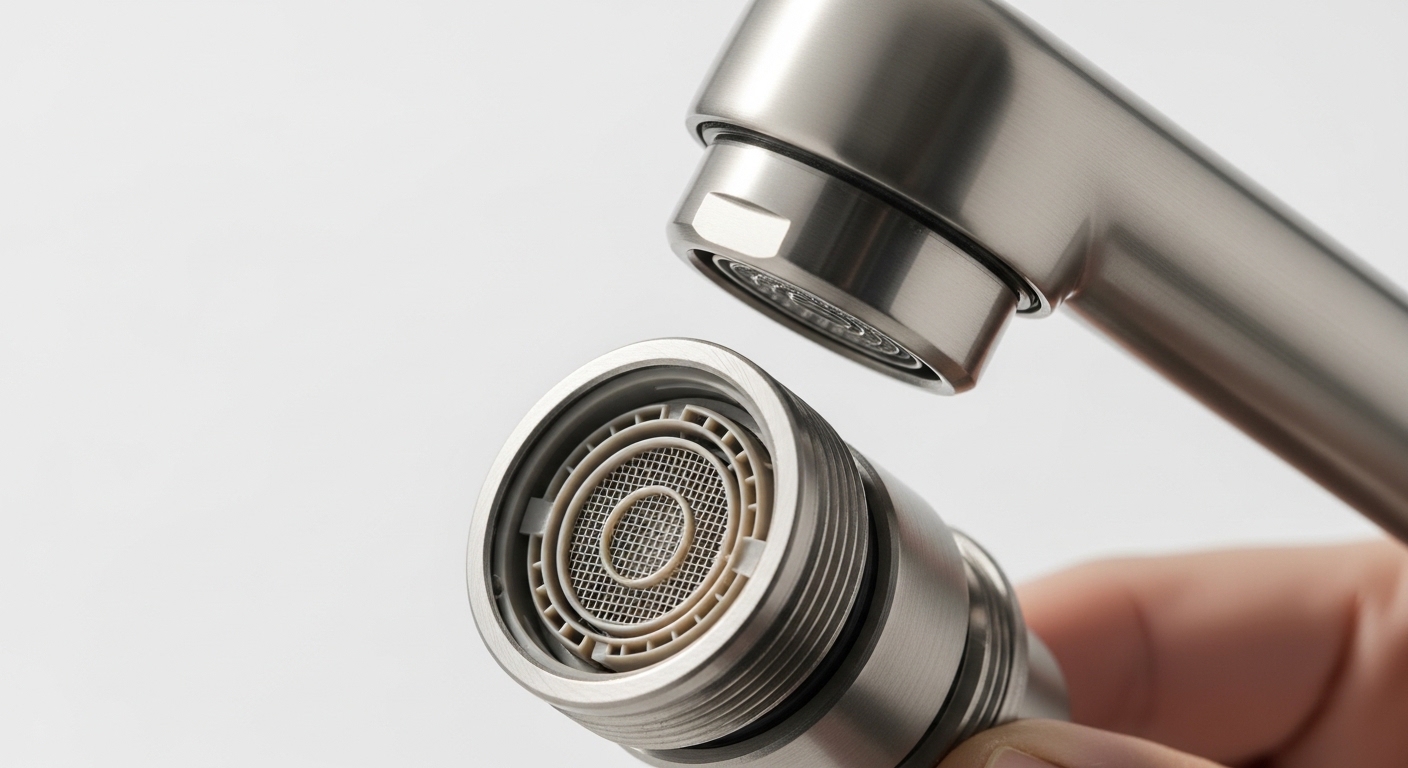
If you’ve ever unscrewed the tip of your kitchen tap and found a crusty, half-clogged little screen inside, you’ve met the aerator — and if you’re shopping for a replacement, a stainless steel kitchen faucet aerator is one of the smartest small upgrades you can make. It’s a $5–$20 part that controls your flow rate, softens the splash, and quietly decides whether your faucet feels powerful or weak. Choosing stainless over plastic or plated brass mostly comes down to your water, your faucet finish, and how long you want to go before you’re back under the sink again.
Below, we’ll answer the real questions people actually ask before buying one: whether stainless is genuinely better, how to know which size fits, what flow rate to get, and how to swap it in about two minutes. No fluff — just the stuff that changes your buying decision.
What does a kitchen faucet aerator actually do — and why does the material matter?
An aerator is the small screw-on nozzle at the tip of your faucet that mixes air into the water stream. That’s it — but it does three important jobs: it stops the water from splashing everywhere, it makes a low-flow stream feel strong and full, and it filters out grit and sediment before it hits your dishes. The material matters because this part lives in a constant wet-dry cycle and takes the full brunt of your water’s mineral content.
Cheap aerators use molded plastic housings or chrome-plated zinc. They work fine at first, but plated finishes chip, zinc corrodes, and plastic threads strip if you over-tighten them. A solid stainless steel aerator — ideally 304-grade — shrugs off all of that. It won’t rust, it resists the white calcium scale that builds up in hard-water homes, and the threads stay true through dozens of removal-and-cleaning cycles. If you plan to keep your faucet for years, the housing material is the difference between a part you replace every year and one you basically forget about.
- Splash control: the aerated stream lands soft instead of blasting off a spoon or the sink bottom.
- Water & energy savings: a 1.5 GPM aerator uses roughly 40% less water than an old 2.5 GPM one, and less hot water means a lower gas or electric bill.
- Sediment screen: the mesh catches rust flakes and sand, protecting the rest of your plumbing and your drinking water.
- Longevity: stainless housings and screens resist the corrosion and clogging that kill cheaper units.
Is a stainless steel kitchen faucet aerator really better than plastic or brass?
Yes — in most homes it’s the better long-term choice, especially if your water is hard or your faucet has a stainless, brushed nickel, or matte finish you want the aerator to match. The short version: stainless steel wins on durability and looks; plastic wins only on price; solid brass is a close, sometimes-better rival if it’s genuinely solid (not plated).
Here’s where the nuance lives. “Stainless steel aerator” usually means a stainless housing and stainless mesh screen, which is fantastic against corrosion. But the internal flow-control components are often still plastic or rubber — and that’s actually fine, because those parts don’t corrode and a plastic insert can be gentler on flow regulation. What you’re really paying for is a housing that won’t pit, discolor, or seize onto your faucet threads. In hard-water regions (think much of Texas, Arizona, and the Midwest), that corrosion resistance is the whole ballgame.
| Aerator material | Corrosion / hard-water resistance | Typical lifespan | Look & finish match | Price range |
|---|---|---|---|---|
| 304 stainless steel | Excellent — won’t rust or pit | 5–10+ years | Great for stainless, nickel, matte finishes | $8–$20 |
| Solid brass (unplated) | Very good — naturally corrosion-resistant | 5–10 years | Best for brass, gold, bronze faucets | $10–$25 |
| Chrome-plated brass/zinc | Fair — plating chips, zinc corrodes | 1–3 years | Good for chrome faucets (while plating lasts) | $4–$10 |
| Plastic (ABS) | Poor — brittle, threads strip | 1–2 years | Only matches nothing well | $2–$6 |
If your faucet is chrome, a plated chrome aerator technically matches best cosmetically — but you’re trading looks for lifespan. Many people go stainless anyway because the aerator tip is small and barely visible, and the durability is worth it. If you want to understand how the aerator fits into the bigger picture of what your faucet is made of, our guide to the essential chrome faucet parts breaks down which components are worth upgrading and which aren’t.
How do I know which size aerator fits my kitchen faucet?
Most US kitchen faucets take one of two standard aerator threads: 15/16″ male (regular) or 55/64″ female (regular). “Male” means the threads are on the outside of the faucet tip, so your aerator threads on the inside. “Female” means the threads are inside the faucet, so the aerator threads on the outside. That’s the single most common point of confusion, so check it before you buy.
The fastest way to tell: look at the tip of your faucet. If you see threads on the outside, you need a female aerator to screw over them. If the threads are recessed up inside the spout, you need a male aerator to screw into them. Kitchen faucets are usually the “regular” size (15/16″–27 male / 55/64″–27 female), while bathroom faucets more often use the smaller “junior” or “tom thumb” sizes. If you want the full rundown on every thread size and how to measure with a coin trick, our deep dive on standard faucet aerator sizes in the US walks through it step by step.
A few sizing tips that save a return trip to the store:
- Take the old one with you. The surest match is bringing your existing aerator to the store or measuring it directly.
- Look for a “dual-thread” or “universal” aerator. These include a small adapter so one part fits both male and female faucets — ideal if you’re not sure.
- Measure the diameter across the threads: roughly 15/16″ (about 24mm) is standard/regular for kitchens; about 3/4″ (19mm) is junior; a hair over is a Cache/Tom Thumb size.
- Check for a cache aerator. Some modern pull-down faucets hide the aerator behind a smooth spray tip and use a proprietary “cache” aerator that needs a special key — those are brand-specific, so match the manufacturer.
What flow rate should I choose — 1.0, 1.5, or 2.2 GPM?
For a kitchen, go with 1.5 to 1.8 GPM (gallons per minute) — it’s the sweet spot that saves water without making the faucet feel weak. Bathroom faucets can drop to 1.0 or 1.2 GPM because you’re just washing hands, but a kitchen faucet needs enough flow to fill a pot or rinse a stockpot without you standing there tapping your foot.
The federal maximum for kitchen faucets is 2.2 GPM, and California and a few other states cap kitchen faucets at 1.8 GPM. Older faucets ran 2.5+ GPM, which is why swapping in a modern aerator instantly cuts your water use. Here’s the practical guide:
- 1.0–1.2 GPM: maximum savings, best for bathroom sinks. Too slow for filling pots in a busy kitchen.
- 1.5 GPM: the popular middle ground — noticeably efficient, still fills a pasta pot at a reasonable speed. WaterSense-labeled options live here.
- 1.8 GPM: the best kitchen default. Meets strict state codes and still feels strong.
- 2.2 GPM: maximum legal kitchen flow — choose it only if your water pressure is low and you want every drop of speed.
One caveat: if you already have low household water pressure, a very low-flow aerator will feel frustratingly weak. In that case, stay at 1.8–2.2 GPM. Aerator flow is regulated at a range of pressures, so a good stainless aerator with a pressure-compensating insert keeps the stream consistent whether your pressure is 40 or 80 psi.
How do you replace a stainless steel kitchen faucet aerator yourself?
You can swap an aerator in about two minutes with your bare hands — no tools needed if it isn’t stuck. Unscrew the old one counterclockwise (as you look up at it), clean the threads, and screw the new stainless aerator on hand-tight. That’s genuinely the whole job for most people.
If it’s crusted on with mineral buildup, that’s where it gets slightly fiddly. Here’s the reliable method:
- Protect the finish. Wrap the aerator in a cloth or a strip of painter’s tape before using pliers, so you don’t scratch the faucet.
- Turn counterclockwise. Grip with adjustable pliers or a rubber jar-opener and twist. Righty-tighty, lefty-loosey — remember you’re looking up, so it can feel backwards.
- Soak stubborn buildup. If it won’t budge, wrap the aerator in a paper towel soaked in white vinegar for 15–30 minutes to dissolve the calcium, then try again.
- Clean the faucet threads with an old toothbrush so the new aerator seats cleanly.
- Check the washer. Make sure the little rubber O-ring or washer is seated in the new aerator — a missing or doubled-up washer is the #1 cause of a post-install drip.
- Hand-tighten, then run the water. If it leaks at the threads, snug it about a quarter turn more with the cloth-wrapped pliers.
If, after swapping the aerator, you notice water sneaking out lower down rather than at the tip, the aerator isn’t your culprit — that’s usually a spout or connection issue. Our guide on why your kitchen faucet is leaking at the base covers those fixes. And if you’re actually trying to attach a hose or filter rather than a plain aerator, check whether you need an adapter instead — our walkthrough on connecting a pull-down kitchen faucet to a hose adapter explains which threads play nice with garden and filter fittings.
When is a stainless steel aerator NOT the right pick?
Skip stainless in two situations: if your faucet uses a proprietary hidden “cache” aerator, or if you have a warm-toned faucet (brass, champagne bronze, gold) where a matching solid-brass aerator looks better. In the first case, you’re locked into the manufacturer’s part; in the second, cosmetics tip the scale toward brass — which is also corrosion-resistant, so you’re not sacrificing durability.
You’d also stick with a basic plastic aerator only if it’s a temporary rental fix or a faucet you plan to replace soon. Otherwise, for any faucet you intend to keep, stainless or solid brass is the durable answer. The genuinely bad long-term buy is chrome-plated zinc — it’s cheap, but the plating flakes and the zinc corrodes, and you’ll be back under the sink within a year or two.
How much should you spend, and what makes a good one at avovida?
Expect to pay $8–$20 for a quality stainless steel kitchen faucet aerator — anything under $5 is almost certainly plated zinc or plastic dressed up to look like steel. At avovida, the aerators we stock use 304-grade stainless housings, dual-thread universal adapters so you don’t have to gamble on male vs. female, and pressure-compensating inserts rated for 1.5 and 1.8 GPM. That combination is what separates a part that lasts a decade from one that clogs by next spring.
When you’re comparing options, look past the price tag for three things: the stainless grade (304 is the standard to want), whether it includes both washers and a thread adapter, and the flow rate printed on the packaging. A good listing will tell you the GPM and the thread size up front — if it doesn’t, that’s a red flag.
FAQ
Are all kitchen faucet aerators the same size?
No. Kitchen faucets mostly use the “regular” size — 15/16″ male or 55/64″ female thread — but bathroom faucets often use smaller “junior” or “Tom Thumb” sizes, and some pull-down kitchen faucets use hidden brand-specific cache aerators. Always check whether your threads are inside (male) or outside (female) the spout before buying, or choose a dual-thread universal aerator to cover both.
Will a stainless steel aerator increase my water pressure?
Not exactly — an aerator can’t create more pressure than your plumbing supplies, but a clean aerator with the right flow rate can make a weak stream feel much stronger by mixing in air. If your faucet feels weak, the fix is usually cleaning or replacing a clogged aerator, not buying a higher-GPM one. A good stainless aerator with a pressure-compensating insert keeps the stream steady across different household pressures.
How often should I clean or replace my kitchen aerator?
Clean it every 3–6 months if you have hard water, or once a year with soft water — just unscrew it, soak the parts in white vinegar to dissolve calcium, and rinse. A stainless steel aerator can last 5–10 years, while plastic or plated ones often need replacing every 1–2 years once they clog or corrode.
Can I put a low-flow aerator on any faucet to save water?
Almost always, yes — as long as the thread size matches. Dropping from an old 2.5 GPM aerator to a 1.5 GPM one cuts water use by roughly 40% with no plumbing changes. The only caveat is very low household water pressure, where an ultra-low 1.0 GPM aerator may feel too weak; in that case stick with 1.8 GPM in the kitchen.
Is stainless steel or solid brass the better aerator material?
Both resist corrosion well, so it often comes down to your faucet’s finish. Choose stainless steel for stainless, brushed nickel, chrome, or matte-black faucets, and solid brass for brass, gold, or bronze faucets so the tip matches. Avoid chrome-plated zinc for long-term use — the plating chips and the zinc underneath corrodes.
Why is my aerator leaking after I replaced it?
The most common cause is the rubber washer or O-ring — either it’s missing, doubled up, or not seated flat. Unscrew the aerator, make sure there’s exactly one washer sitting properly inside, clean the threads, and hand-tighten. If it still drips at the threads, snug it a quarter turn more with cloth-wrapped pliers rather than forcing it.
About the author: This guide was written by the avovida fixtures team, drawing on hands-on testing of kitchen and bathroom faucets and their components across a range of US water conditions. avovida specializes in faucets, shower systems, and bathroom fixtures, and our product specs are checked against US plumbing standards — kitchen aerators comply with the federal 2.2 GPM cap and, where applicable, WaterSense and stricter state flow limits (like California’s 1.8 GPM). Our stainless steel aerators use 304-grade housings and are backed by a replacement warranty. As with any plumbing part, verify your specific faucet’s thread size before purchase, and consult a licensed plumber for issues beyond a simple aerator swap.