
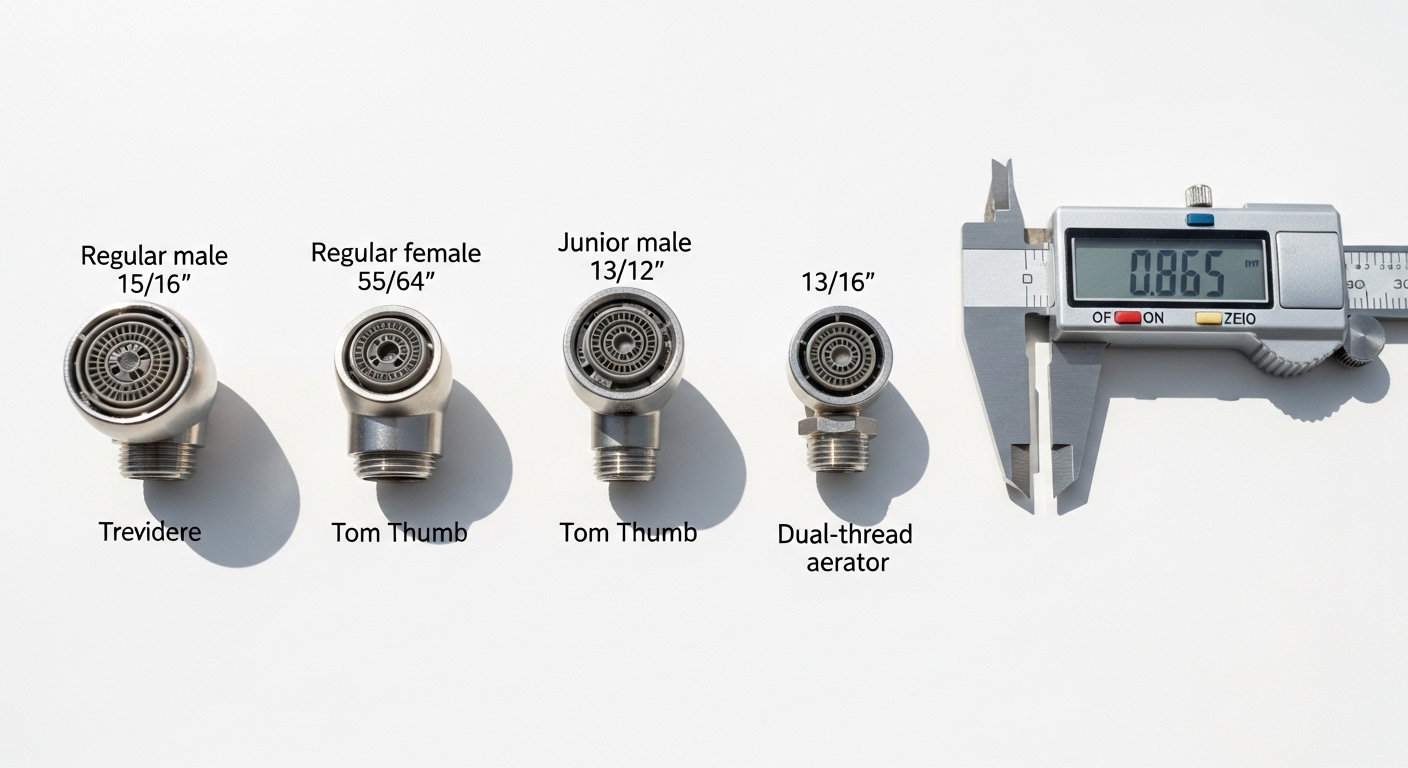
If you’ve ever stood at the hardware store holding a leaky, crusty aerator and wondering which replacement to grab, you’re not alone — faucet aerator sizes us is one of the most-searched faucet questions precisely because the numbers (15/16″, 55/64″, 13/16″, M18, M22, M24) look like a foreign language. The good news: there are really only a handful of standard sizes in American homes, and once you know how to measure, choosing the right one takes about two minutes. This guide walks you through every US aerator size, how to tell male from female threads, what flow rate to pick, and how to avoid buying the wrong part twice.
What are the standard faucet aerator sizes in the US?
There are three common US aerator size families: Regular, Junior (also called Small or Mini), and Tom Thumb. Regular is by far the most common on kitchen and bathroom faucets, Junior shows up on newer bathroom faucets and some European-influenced designs, and Tom Thumb is reserved for very small or specialty spouts. Each family comes in a male version (threads on the outside) and a female version (threads on the inside).
Here’s the part that trips people up: aerator sizing describes the thread diameter and gender, not the flow. Two aerators that both say “1.5 GPM” can have completely different threads. So you’re really answering two separate questions — what size/thread do I need to physically screw it on, and what flow rate do I want out of it. Nail the thread first; you can pick flow afterward.
| Aerator Name | Male Thread (outside) | Female Thread (inside) | Metric Equivalent | Typical Use |
|---|---|---|---|---|
| Regular (standard) | 15/16″-27 | 55/64″-27 | M24 (male) / M22 (female) | Most US kitchen & bath faucets |
| Junior / Small | 13/16″-27 | 3/4″-27 | M18.5 (male) / M20 (female) | Newer bath faucets, compact spouts |
| Tom Thumb | 15/16″-27 (short body) | 11.5/16″ style | M16 variants | Tiny bar, RV, specialty faucets |
| Dual-thread | 15/16″ outer | 55/64″ inner | M24 / M22 | Universal — fits both Regular genders |
Notice the “-27” after each fraction — that’s the thread pitch (27 threads per inch), and it’s the same across almost all US aerators. So you don’t usually have to worry about pitch; you’re matching diameter and gender. That’s what makes a dual-thread aerator so handy: it packs a male 15/16″ thread on the outside and a female 55/64″ thread on the inside of the same housing, so it covers the two most common Regular fittings in one part.
How do I measure my faucet aerator so I buy the right size?
Measure the thread diameter with calipers or a ruler, and note whether the threads are on the outside (male) or inside (female) of the spout. A Regular male thread measures about 15/16 inch (24.5 mm) across the outside of the threads; a Junior male measures about 13/16 inch (21.5 mm). If you can’t see any threads on the outside of your faucet tip and instead see them recessed up inside the spout opening, you have a female faucet — which means you need a male aerator to thread into it.
If you don’t own calipers, here’s the coin trick that plumbers actually use:
- Place a US nickel against the aerator face. A nickel is about 13/16″ wide. If the aerator is roughly the same size as the nickel, you likely have a Junior aerator.
- Place a US quarter against the aerator face. A quarter is about 15/16″ wide. If the aerator matches the quarter, you almost certainly have a Regular aerator.
- Feel for the threads: run a fingernail around the tip. Threads you can feel on the outside = male aerator needed is female-housing… wait — outside threads on the faucet means you need a female aerator; recessed inside threads mean you need a male aerator.
That gender rule is the single most common mistake. Remember it this way: the aerator and the faucet are opposites. Male faucet spout (threads out) → female aerator. Female faucet spout (threads hidden inside) → male aerator. Get the diameter and the gender right and the part will thread on smoothly by hand with no cross-threading.
While you’ve got the aerator off, it’s a smart moment to inspect the rest of your spout for wear — mineral scale, a worn washer, or a corroded housing. If you’re already replacing worn components, our rundown of the essential chrome faucet parts you need to know before you repair or replace one will help you spot what else deserves attention while the faucet is apart.
What flow rate (GPM) should my aerator be, and does it matter?
For most homes, pick a bathroom aerator between 0.5 and 1.5 GPM and a kitchen aerator between 1.5 and 2.2 GPM. GPM (gallons per minute) is stamped or laser-etched on the side of the aerator, and by US federal law new faucets max out at 2.2 GPM at 60 psi. Many states go lower — California and Colorado cap bathroom faucets at 1.2 GPM and kitchen faucets around 1.8 GPM.
Flow rate is independent of thread size, so you can choose it freely once you know your thread. Here’s how to think about it by room and use case:
| Location / Use | Recommended GPM | Why |
|---|---|---|
| Bathroom lavatory | 0.5 – 1.2 GPM | You only wash hands and brush teeth — low flow saves water without any real downside |
| Kitchen faucet | 1.5 – 2.2 GPM | You need to fill pots and rinse dishes fast; too low is frustrating |
| Utility / laundry sink | 2.2 GPM | Filling buckets and mop water benefits from max legal flow |
| Low water pressure home | 1.5 – 2.2 GPM (non-aerated or spray) | A restrictive aerator on already-weak pressure feels like a trickle |
One nuance worth knowing: aerators also come in different spray patterns — aerated (soft, bubbly, splash-free), laminar (a clear, solid non-splashing stream popular in healthcare settings), and spray (a wide shower-like pattern for rinsing). If your water pressure is low, a laminar or spray insert often feels stronger than an aerated one at the same GPM because it doesn’t mix in as much air.
Should I go lower than 1.0 GPM to save water?
Only in the bathroom, and only if your water pressure is decent. A 0.5 GPM bathroom aerator is genuinely fine for handwashing and can cut faucet water use by 30–50% versus an old 2.2 GPM unit. But putting a 0.5 GPM aerator on a kitchen faucet is a mistake — filling a pasta pot will feel like it takes forever, and you’ll end up running the tap longer, which defeats the purpose.
What’s the difference between male and female aerators again?
A male aerator has its threads on the outside of the housing and screws into a female faucet spout; a female aerator has its threads on the inside and screws onto the outside of a male faucet spout. The faucet and aerator always have opposite genders — that’s the whole rule. Get this backward and the part simply won’t attach, no matter how correct the diameter is.
This gender question matters even more when you want to attach accessories. If you’re planning to connect a water filter, a portable dishwasher, or a garden hose to your tap, you need to know your aerator’s thread and gender first, because the adapter has to match it. Our guide to picking the right faucet adapter to connect a hose or filter to your tap breaks down which adapter maps to which aerator thread. And if your specific goal is hooking a sprayer-style tap to a hose, see whether you can connect a pull-down kitchen faucet to a hose adapter before you buy hardware — not every pull-down design cooperates.
Are faucet aerator threads universal, or brand-specific?
Aerator threads are largely universal across US brands because they follow the same standard sizes — a Regular 15/16″ male aerator from one brand will thread onto a Regular female faucet from almost any other. The catch is a handful of premium and imported brands that use hidden, tamper-resistant, or “cache” aerators with a proprietary key.
Brands like some Kohler, Delta, and Grohe models use recessed cache aerators that sit flush inside the spout and require a small plastic removal key (usually included in the box, and infamously easy to lose). These are still standard threads underneath — you just need the key, or a needle-nose pliers and patience, to remove them. European brands sometimes use M22 or M24 metric threads, which map very closely to US 55/64″ and 15/16″ respectively, so a US aerator will often still fit or a cheap adapter ring bridges the gap.
- Standard US brands (Moen, Pfister, American Standard): almost always Regular 15/16″/55/64″ — easy universal replacement.
- Cache/hidden aerator brands (some Kohler, Delta, Grohe, Hansgrohe): standard threads but need the removal key.
- Imported/metric brands: M22/M24 — usually cross-compatible or need a $2 adapter.
- Bar, RV, and specialty faucets: may use Junior or Tom Thumb — measure, don’t assume.
Why does my new aerator leak or drip after installing it?
A post-install leak almost always means a missing or misseated rubber washer, cross-threaded threads, or mineral debris trapped on the seat — not the wrong size. Unscrew it, check that the small rubber or fiber washer is seated flat inside, rinse out any grit, and hand-tighten firmly (never over-crank with pliers, which distorts the washer). If the base of the faucet itself is weeping rather than the aerator, that’s a different problem — our walkthrough on why a kitchen faucet leaks at the base and how to fix it covers that scenario in detail.
How do I remove a stuck or corroded aerator without breaking it?
Wrap the aerator in a cloth to protect the finish, grip it with adjustable pliers, and turn counterclockwise (as you look up at it from below). If it’s frozen solid with mineral scale, soak a rag in white vinegar, wrap it around the aerator for an hour, then try again — the vinegar dissolves the calcium lock. Here’s the step-by-step that saves finishes and knuckles:
- Try by hand first — turn counterclockwise. Many come off finger-tight.
- Protect the finish — wrap a cloth or use rubber-jaw pliers so you don’t scratch the chrome or brushed coating.
- Break the mineral lock — soak with a vinegar-dampened rag for 30–60 minutes if it won’t budge.
- Apply steady pressure, not jerks — a smooth, firm counterclockwise turn beats sudden yanks that can crack the housing.
- Use the key for cache aerators — insert the plastic removal tool, align the tabs, and turn.
- Clean the spout threads — old plumber’s tape and grit will make the new one leak; wipe them clean before installing.
Remember the direction can feel reversed because you’re usually working upside down under the spout. Righty-tighty still applies from the aerator’s own perspective — when you’re looking up at it, that means turning it toward your left to loosen.
Which aerator size should I actually buy if I’m not sure?
Buy a dual-thread Regular aerator — it fits the two most common US threads (15/16″ male and 55/64″ female) in a single housing, so it solves roughly 80% of American faucets without you needing to measure perfectly. Pair it with a mid-range flow rate (1.5 GPM for bath, 1.8–2.2 GPM for kitchen) and you’ll have a functional, code-compliant replacement that works on the vast majority of standard faucets.
If the dual-thread doesn’t fit, you almost certainly have a Junior (13/16″/3/4″) faucet, so grab a Junior dual-thread next. Keep the receipt, and consider buying a small multi-size aerator kit — for under $12 these kits include Regular male, Regular female, and Junior inserts plus washers and a key, which means you’re covered no matter what you find when the old one finally comes off.
FAQ
What is the most common faucet aerator size in the US?
The most common is the Regular size: 15/16″-27 male thread or 55/64″-27 female thread (metric M24 male / M22 female). The large majority of standard American kitchen and bathroom faucets use this size, which is why dual-thread Regular aerators are marketed as “universal.”
How do I know if I need a male or female aerator?
Look at your faucet spout. If the threads are on the outside of the spout tip, you need a female aerator (threads inside). If the threads are hidden up inside the spout opening, you need a male aerator (threads outside). The aerator is always the opposite gender of the faucet.
Are all faucet aerators the same thread size?
No, but there are only a few standard sizes — Regular (15/16″/55/64″), Junior (13/16″/3/4″), and Tom Thumb for tiny fixtures. The thread pitch (27 TPI) is nearly always the same, so you’re really just matching diameter and gender. Most US faucets are Regular.
Can I use a metric M24 aerator on a US faucet?
Usually yes. M24 is almost identical to the US 15/16″ male thread, and M22 matches 55/64″ female very closely, so European aerators often thread onto US faucets and vice versa. If it binds, a cheap adapter ring bridges the tiny difference.
What GPM should a bathroom faucet aerator be?
Between 0.5 and 1.2 GPM is ideal for a bathroom lavatory, since you only wash hands and brush teeth. Federal law caps faucets at 2.2 GPM, but states like California require 1.2 GPM or less on bathroom faucets. Lower flow here saves water with no real loss of function.
Why did my aerator stop working or lose pressure suddenly?
Nine times out of ten it’s clogged with mineral scale, sediment, or rust flakes — especially in hard-water areas. Unscrew the aerator, disassemble the screen and insert, soak them in white vinegar for an hour to dissolve the calcium, rinse, and reassemble. If flow is still weak, the flow restrictor disc may be blocked or the part is simply worn out and cheap to replace.
Expert note, testing, and why you can trust this guide
This guide was written by the Avovida fixtures team, who source, bench-test, and install faucets and aerators across US and imported thread standards every week. We verify aerator dimensions with digital calipers against the ASME A112.18.1 / CSA B125.1 plumbing-fixture standards that govern US faucet fittings, and we cross-check flow rates against EPA WaterSense (1.5 GPM) and federal (2.2 GPM) limits. Avovida specializes exclusively in faucets, showers, and bathroom fixtures — not general home goods — so our sizing and compatibility advice comes from hands-on product testing, not spec-sheet guesswork. Replacement aerators are inexpensive, but always confirm your specific faucet’s warranty before modifying it: swapping an aerator is normally warranty-safe, but altering a proprietary cache assembly on some premium brands can affect coverage, so check the manufacturer’s documentation first.